
'I've Ridden for Over 30 Years. Sia's Case Shows Why More Women Must Ride'
'Women in Gurugram won’t give up the freedom of riding to accommodate fragile egos,' writes a biker.
advertisement
My father was a maverick in ways that, even today, will be considered incredibly modern and forward-thinking.
He married a 16-year-old, promising her father that he would fully support her in her studies for as long as she wished. Not only did he keep his word; she ended up with a PhD, and he also tried to teach her to ride a Lambretta scooter. Sadly, she was too short for it.
He started all his kids young, standing in front.
Delhi, being Delhi, eve-teasing was something one endured, turned a blind eye to, and deafened up to, water off a duck's back. Then, in 1991, as I stood waiting for my bus, the incident was just too much.
I came home and swore I would never travel by public transport again. Between the two of us, my husband and I, we had a bike, a Kawasaki Bajaj. I learnt to ride it in an evening, and that was the end of my public transport journey. It became an extension of my body. The sheer freedom was exhilarating and joyous.
A few uncomfortable seconds later I went, "Look, look, paanch aadmi ek Maruti mein hain, aage wale bhi mard hain, peechhe wale bhi mard hain" (five men are in one Maruti, the ones in front are men too, the ones behind are men too). That stopped them cold.
To be fair, they were just surprised and excited about it, not challenged in their egos. Weird as it was, it was simply an expression of interest. Most other such encounters were in a similar vein—excitement and respect, across Delhi and the NCR.
'That Was the Good. Now for the Bad and the Ugly'
And then there were the two young men on a bike, swooping around, zipping up and down, challenging me to a race, pushing me to swerve, challenging my skills. I tried speeding. I tried slowing to a crawl, sticking behind cars.
Eventually, at Dhaula Kuan (it was still a roundabout then), I pretended to head straight, and they crossed straight while I slid away on a left turn. That was a scary encounter.
In the last few years, I have read of several young riders who have lost their lives while riding, so many young men and women. Sometimes it hits like a truck, and it's difficult to breathe. According to the Ministry of Road Transport and Highways and national crime data, two-wheeler riders make up roughly 45 percent of all annual road crash fatalities in the country.
Recent statistics show that approximately 84,599 two-wheeler riders died on Indian streets, averaging nearly nine fatalities every hour. Young men aged 15 to 39 face the highest risk, with road accidents serving as a leading cause of mortality in this age group. The reasons are manifold:
This is the group with the highest number of two-wheeler riders, both because it's the ride of the youth and because of the economics of entry-level jobs
The riders themselves are at an age when they think of themselves as indestructible and take undue risks
It's an age when following rules seems like one is a fuddy-duddy
Owners of larger, more expensive vehicles imagine they have a bigger right of way
'The Gurugram Road Rage'
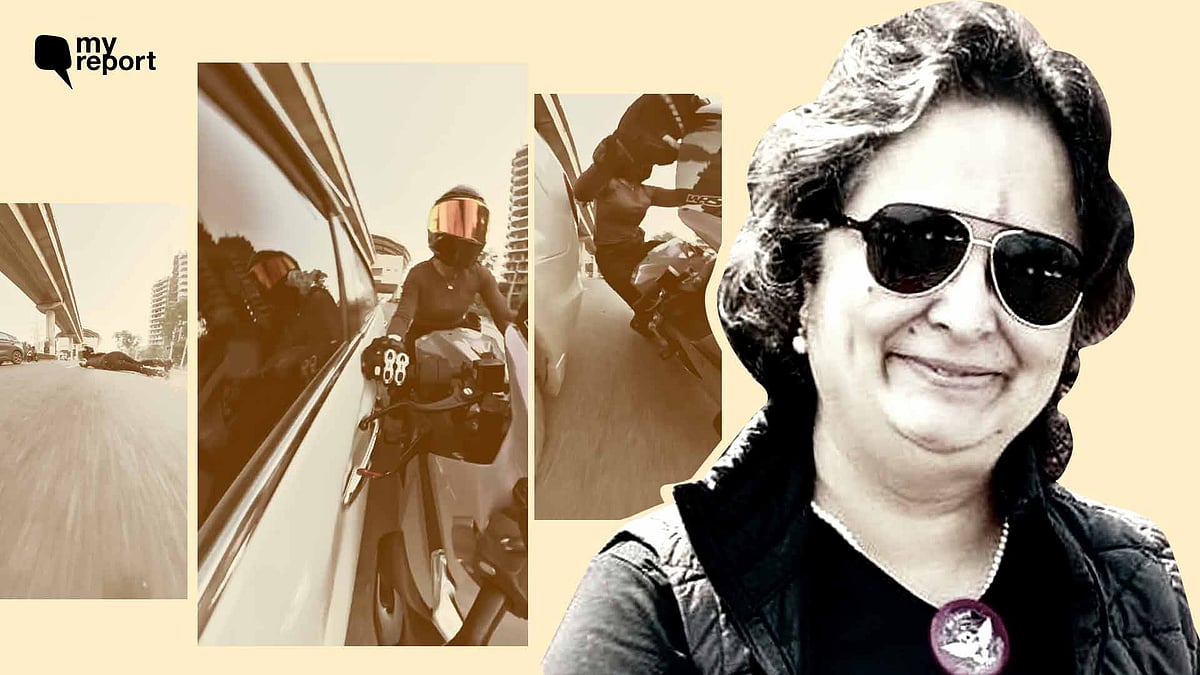
And then there is the incident of the car chasing and hitting the rider, simply because she did not stop and talk to the entitled men in the car who felt it was their right that she should kowtow to their demands.
The original video is very, very clear in recording the entire sequence of events. She was chased and deliberately hit, perhaps because she did not stop to talk to a bunch of men in a car.
The perpetrators may have found it funny, but it is not funny at all, and they need to pay for their actions. The severest penalties should be inflicted.
They might laugh at this, but would they be laughing if it were their sister or daughter? What would their own thoughts be if it were a woman driver in the car and a young man on the bike? Would it still be funny? Would it still be acceptable?
There are questions being raised about the safety of women riders, and voices pushing women back into purdah, ostensibly for their 'safety.' The need of the hour is for more women to be out and about, to make the city safer, not the inverse. The safety of women lies in more women in public spaces, not fewer. It's easier to target a lone woman than a group.
To all women: be more. Be bigger, better, and the gorgeous goddesses you are. Learn to stare back, to question every effort made to make you smaller.
Being respectful of our elders and betters does not mean taking any nonsense. It does not mean making choices that are detrimental to oneself. Disagreement does not mean disrespect. Anyone who needs you to shrink yourself should be ejected from your life, or at the very least kept at arm's length.
'Reclaim the Road'
The enduring presence of women motorcyclists on Gurugram's asphalt is a testament to unyielding resolve. Demanding their rightful place on public thoroughfares is neither an indulgence nor a provocation; it is a fundamental civil right.
Meaningful change requires structural and cultural accountability:
Zero-Tolerance Enforcement: Deliberate vehicle ramming, vehicular tailing, and road harassment must be treated as severe criminal offences under relevant legal statutes rather than generic traffic infractions.
Infrastructure Auditing: Municipal bodies must eliminate blackspots, maintain working illumination in underpasses, and install comprehensive CCTV coverage on peripheral bypass routes.
Institutional Sensitivity: Police personnel need specialised training to handle road harassment complaints with urgency, treating dashcam footage from motorcyclists as primary, actionable evidence.
Cultural Normalisation: Society must shed the regressive notion that an engine and two wheels belong exclusively to men.
Every time a woman puts on her helmet, twists the throttle, and claims a lane on Golf Course Road, she is not just commuting, she is reshaping the culture of the road itself.
(All 'My Report' branded stories are submitted by citizen journalists to The Quint and the views expressed above are the citizen journalist's own. The Quint neither endorses nor is responsible for the same.)
- Access to all paywalled content on site
- Ad-free experience across The Quint
- Early previews of our Special Projects
Published: undefined