
A Widow, Pregnant Women, a Graduate: The Cost of Kuki-Naga Clashes in Manipur
'These women are not at war. They are not in government. Why were they killed?' asked one activist.
advertisement
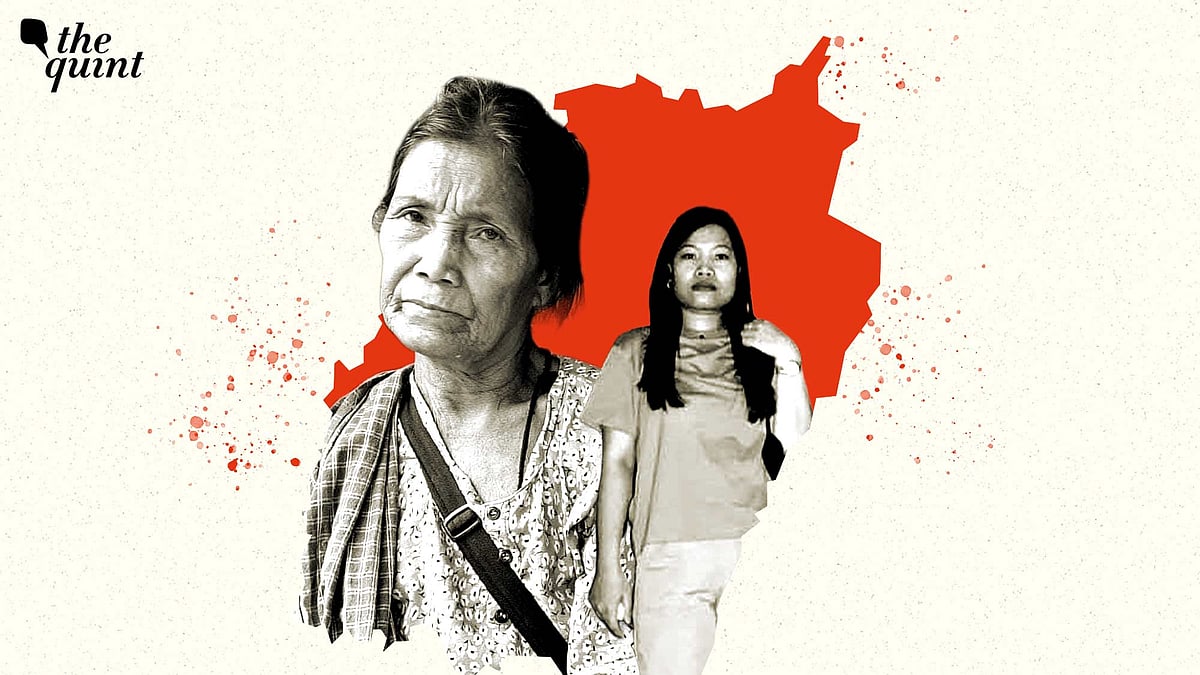
Around 3 pm on 15 September, Tuesday, the sun was shining bright upon the heads of Pi Chonga Sitlhou and 28-year-old Kimboi Singson. The two women were busy working on a paddy field near their homes in Manipur's Tamenglong district when they were allegedly shot dead.
The paddy farm belonged to Sitlhou, a 76-year-old widow. Kimboi, a nursing graduate from Guwahati who was visiting her parents, was helping the elderly woman to collect firewood.
Jangminthang Singson, a distant kin of Kimboi, said that for her parents, the 28-year-old was the only hope. “They are deeply anguished. She wanted to work at a hospital eventually and pursue a career in nursing. She was set to return next month," Jangminthang, who is part of Kuki Inpi, the apex Kuki civil society organisation (CSO), told The Quint.
Upon hearing the gunshots, residents of the nearby Leisangphai village reached the site and found the bodies of the two women sprawled near the shrubs, with bundles of firewood lying astray.
A local source said, requesting anonymity, claimed, "This was done by the combined force of NSCN-IM, ZUF-K, and NSCN-K (Khaplang) faction. From New Kaiphundai village, they came towards Babukhal, and from Babukhal they entered the jungle close to where the incident happened."
'26 Kuki-Zo Killed Since March'
Even as the victims’ bodies were taken for postmortem on Tuesday night, the Kuki-Zo Council (KZC) issued a notification to all CSOs, directing that no Kuki-Zo person killed by Naga armed groups in Manipur shall be buried until further notice.
“Enough is enough,” KZC's Ginza Vualzog said. “This is not an isolated incident. It comes amid a series of attacks and killings involving Kuki civilians in Jiribam, Tamenglong, and Noney districts,” he told The Quint.
According to Janghaolun Haokip, media and information in-charge for Kuki Inpi, 26 Kuki-Zo persons have been killed by Naga or proxy groups since March this year. The toll includes at least seven women and two children.
The current string of casualties on the Kuki side began on 11 March, Janghaolun alleged to The Quint, with the abduction and killing of two men from Ukhrul and Kamjong hill areas when they were carrying out repair work. More recently, on 13 September, four more Kuki-Zo persons, including a pregnant woman, were allegedly killed in two separate attacks in Manipur's Tamenglong and Noney districts. A six-year-old child sustained injuries, and lost both his parents in the attacks.
No armed groups have officially taken responsibility for these attacks so far.
A list of Kuki-Zo casualties attributed to Naga and proxy militant groups since March 2026, shared by Kuki-Zo CSOs. No armed groups have officially taken responsibility for these attacks so far.
(Credit: Kuki-Zo CSOs)
While Naga-Kuki enmity is not new, this is the first time since the 1980s-90s when clashes between the two groups have taken such a violent turn.
“We have from the very beginning said that NSCN-IM and its proxy groups have been attacking Kuki villages and brutally killing our people, young, old, men, women, even the unborn. We have written several memorandums to the state and the Centre. But no concrete measures can be seen,” Janghaolun said.
10 Nagas Killed Since May
The Yumnam Khemchand government, which assumed office in February, consists of the Meitei Chief Minister and two tribal Deputy CMs—Naga leader Losii Dikho and Kuki leader Nemcha Kipgen—a move which was seen as "appeasement politics" by both Naga and Kuki sides.
Last week, Dikho, who represents the Naga People's Front (NPF) led by Chief Minister Neiphiu Rio in Nagaland, and is said to be close to him, appealed to the Manipur and the Central government for justice for the Naga persons killed in the ongoing clashes. The Quint reached out to Dikho for a comment on phone. A response is as yet awaited.
The Naga groups blamed the casualties to Kuki armed groups such as the Kuki Nationalist Organisation (KNO) as well as demanded the resignation of the deputy CMs.
Lorho Ng, chief of a key Naga body, United Naga Council (UNC), alleged that the chain of violence started with the "Kuki people" attacking a Tangkhul Naga man just three days after the new government was formed in February, leading to counter-attacks and mob violence.
"Since last [Tuesday] night till 8 am today, Chawangkining Naga village in Kangpokpi was under attack of militants. Two homes have been burnt. They are being called 'retaliatory' attacks but it's only adding to the spiral of violence. At this moment, the Nagas have decided not to react," Ng said.
"The numbers may vary but armed groups on both sides are currently active and acting out of ulterior motives that go beyond just loyalty to the communities they purportedly defend," a source well-versed with the security situation in the region added.
Incidentally, Thuingaleng Muivah, who's the co-founder of NSCN-IM, returned to his home village in Somdal in Manipur's Ukhrul district last October after nearly six decades.
Why a Spike in Violence Now?
According to Thongkholal Haokip, who teaches at the Centre for the Study of Law and Governance, Jawaharlal Nehru University, the Naga-Kuki conflict has become a flashpoint again over the Kuki-Zo people asserting their political and territorial demands for autonomy.
In an editorial for Force magazine, Thongkholal notes that as per Kuki CSOs and human rights groups, between 1956 and 1987, 67 Kuki villages were uprooted in Tamenglong, Ukhrul, and Senapati districts, and 36 people were killed.
In 1993, hundreds of Kukis were displaced from their homes, and about 115 Kukis killed during the Joupi massacre.
Security and northeast expert and author Kishalay Bhattacharya believes that the issue today has echoes of the past. "I wouldn’t say Muivah is calling the shots but given his lead role in the 1993 massacre by NSCN-IM, his presence will obviously trigger some concern."
Others such as former Bharatiya Janata Party (BJP) spokesperson Chongtham Bijoy Singh feel that allowing the ethnic clashes to simmer can also be a strategy of the Indian government to "control" the hill region, parts of which still remain largely controlled by local groups and rebels due to the small and scattered nature of tribal villages.
Paolienlal Haokip, the BJP MLA from Saikul, too, feels that the conflict is being synchronised by "forces that are not local". "If this was a Kuki-Naga conflict, things would already have reached the level of a civil war. This violence appears more controlled."
"While there is anxiety on ground and obvious mistrust, both Naga and Kuki communities do not want a full-scale civil war. We haven't yet reached that point but will soon do if the Government of India continues to ignore this issue," Paolienlal told The Quint.
The Kuki leader added that the incidents on both sides reflect a "systematic attempt to shift the fight from the (Meitei-dominated) valley to the hills."
A former member of the apex Naga CSO, Naga Ho Ho, said the developments could reflect an attempt to realign the "fractured NSCN-IM into a unified entity, and thereby reviving the Naga demand for political solution."
Meanwhile, Ng from UNC added that the continuum of violence also represented the failure of the security forces in reigning in the "rogue elements".
Women Caught in the Line of Fire
For many in Manipur, though, ethnic violence seems to have become cyclical. Starting in 2023 when the Meitei-Kuki conflict erupted, causing the death of over 300 people since and displacement of thousands, the renewed spree of Naga-Kuki violence is yet another reminder of past wrongs, piled on top of even older wrongs. And more often then not, it is the women who pay the price.
Delhi-based activist Kim Haokip said the killing of the two "unarmed, defenceless women" in Tamenglong showed the brutality of the attackers.
The killings have also been condemned by some Naga civil groups and leaders, including senior Naga leader and NPF MLA Awangbou Newmai.
Ng, too, noted that condemnations were pouring in from various quarters. "Women should not be targeted in such violence," he said. However, he added that "condemnation is just that, condemnation."
In 2025, a 2023 Kuki gangrape survivor succumbed to her injuries and prolonged trauma from the incident. No convictions, and in some cases, arrests, have been made in the nearly dozen cases of sexual violence reported amid the clashes.
Meanwhile, Tamenglong Police SP Luikham Lanmiyo told The Quint that the area was under strict scrutiny since the killings.
Sources in the police, however, feel that the incidents go beyond the scope of local law enforcement. "The Naga-Kuki ethnic conflict has been seething for some time, and it's not a local issue. It's a statewide one. We cannot confirm which particular group is doing what, but yes, armed groups from both sides have been involved. The matter is under investigation," an officer said.
He further added that while the forces have been active in patrolling and surveillance, the forested terrain of the hills and remote topography of many villages means there are parts that even they cannot reach. "The police are operating under supervision of the Central government," the personnel concluded.
(The Quint made multiple attempts to reach out to NSCN-IM's current chief VS Atem, largely seen as the successor to Muivah, for his comments on the allegations against NSCN-IM. A response is as yet awaited.)
- Access to all paywalled content on site
- Ad-free experience across The Quint
- Early previews of our Special Projects
Published: undefined