'Michael' Review: The Way You Make Me Feel…Is Disappointed
'Michael' has sparked a discourse online about its failure to address allegations of child abuse against Jackson.
advertisement
Isn’t it incredible that there exists a biopic about one of the most celebrated and revered Black artists that doesn’t once meaningfully engage with the issue of racism? Isn’t it amusing that a film addressing the strained relationship between a father and son fails, rather catastrophically, to make you feel even the slightest hint of emotion for either of them?
When Trauma Becomes Montage
It is the year 1966. The Jackson 5 is being assembled in a house in Gary, Indiana. Colman Domingo plays Michael’s father Joseph Jackson, who comes across as the male equivalent of a pageant mom. He has spent his life working in a steel mill and doesn’t want his kids to endure the same fate.
This oppressive fatherhood occupies centre stage in the film. Jaafar Jackson, Michael’s nephew, plays the King of Pop with an earnestness that cannot undo the film’s foundational hollowness.
The first 50 minutes are essentially montages that move at the speed of light, dumping information in a matter-of-fact manner, not letting any emotion linger beyond a few seconds. The outcome is the pop star's journey being flattened into tick marks. Vitiligo, nose surgery, and toxic family dynamics are stated plainly rather than dramatised for effect.
A World of One-Note People
Heck, even Jackson’s fascination with all sorts of exotic animals—a chimpanzee, a snake, a llama, and a giraffe—is reduced to a quirk. It is an eccentric personality trait at best, and an evasive caricature at worst. Jackson’s compassion for animals and his commitment to wildlife conservation are flattened into irrelevance.
Colman Domingo as Michael Jackson's father Joseph.
(Photo Courtesy: YouTube)
Each of these characters is so criminally devoid of any unique identifying traits that you could replace one with the other and no one would notice. They are credited as cast members but make the same contribution as extras who play Jackson’s fans in the film. This is actually an indictment of writer John Logan’s inability to flesh out any of these characters’ identities beyond the “well-meaning white men who want a black artist to succeed” trope.
Nia Long as Michael's mother Katherine Scruse-Jackson is not very different from other one-note characters in the film. None of the mother-son bonding scenes between Nia and Michael come across as remotely endearing. Katherine seems less Michael’s ally—the mother who stands firmly with her son, defying his father’s tyranny—and more as a passive bystander in his journey.
That the members of Jackson 5 are not assigned any unique identifying traits—except that, at one point, we are (thankfully) told their names—is a bummer. It reminded me, quite hilariously, of how the girl group Destiny’s Child was often called ‘Beyonce and her backup dancers’, except Michael’s backup dancers exist as mere faceless extensions of him.
Nia Long as Michael Jackson's mother Katherine.
(Photo Courtesy: YouTube)
Milestones Without Meaning
The biopic has sparked a discourse online about its failure to address serious allegations of child abuse against Jackson.
Case in point: his Thriller music video being played on MTV.
This critic was born in 1996, a solid thirteen years after Michael Jackson’s Thriller premiered. Even in the 2000s, I distinctly remember hearing about the uphill victory that was MTV finally caving in and playing Jackson’s music—which was unheard of for Black artists of that era. How did this unfold in the biopic, you ask?
The CBS Records executive Walter Yetnikoff puts his foot down and—you guessed it right—throws a tantrum. “I need you to run Billie Jean for me”, he says angrily while speaking to an MTV executive. The power dynamics of what eventually made MTV give in aren’t fleshed out adequately. The win doesn’t seem monumental because we never know what it took to get there. And it wouldn’t be wrong to extrapolate this to how Fuqua portrays every major milestone in Jackson’s life: with a haste that mistakes mention for meaning.
Philanthropy as Performance
Jackson’s many visits to children’s hospitals are dramatised for effect. They are as moving as Tyra Banks’ cosplay as a ghetto-dweller on America’s Next Top Model and Ananya Panday travelling on Mumbai locals—it’s giving rich people on a poverty excursion; the kind who donate a small percentage of their massive wealth and act like they are morally superior to anyone who has ever existed.
An actual scene shows Michael donating money to burn victims—noble on the surface, until you realise it’s compensation he received for his own burn injury, a personal tragedy the film reduces to a convenient catalyst.
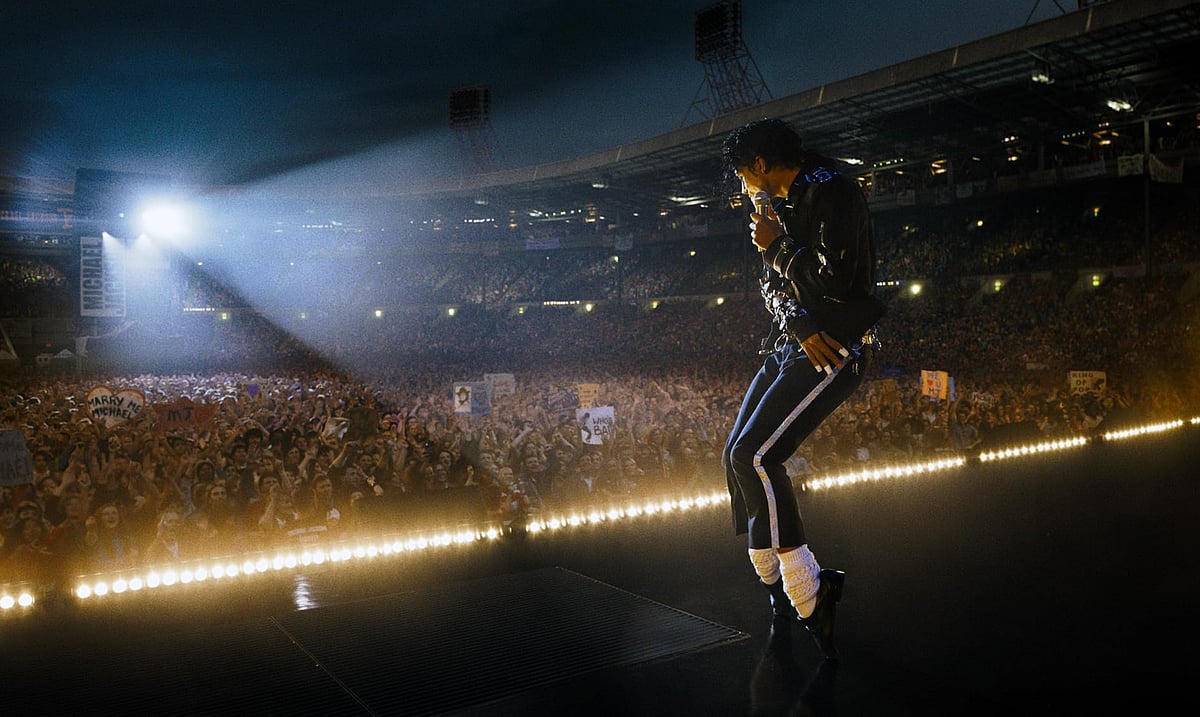
Michael is played by his nephew Jaafar Jackson.
(Photo Courtesy: YouTube)
Where the Film Almost Finds Its Soul
The film’s potential arrives like a faint echo—heard briefly, then gone. One of the most striking scenes illustrates this: when Michael is in the pool, gazing into the sky with rapt attention, almost in a trance-like state with the Jackson 5 boys by the pool. “I am letting the creator give me songs,” Michael says. The moment made me pause and wonder: why didn’t Fuqua explore the idea of the universe speaking to Jackson in songs? Why was this reduced to a fleeting mention?
What remains, then, is a film that circles a legend without ever seeing him. In trying to cover everything, it understands nothing. It is a highlight reel with highlights missing. You keep asking it to Beat It into something meaningful—but it just won’t.
(Deepansh Duggal is a film critic based out of New Delhi. His work has appeared in Hindustan Times, OPEN, Outlook, Frontline Magazine and The Economic Times. He has a particular interest in anti-capitalist narratives and films that lie at the intersection of power and ideology. This is an opinion article and the views expressed above are the author’s own. The Quint neither endorses nor is responsible for them.)