Snowfall at Last in North India: What’s Happening to Himalayan Winters?
What’s unfolding in the Himalayas reflects deeper climate shifts that scientists have been tracking for years.
advertisement
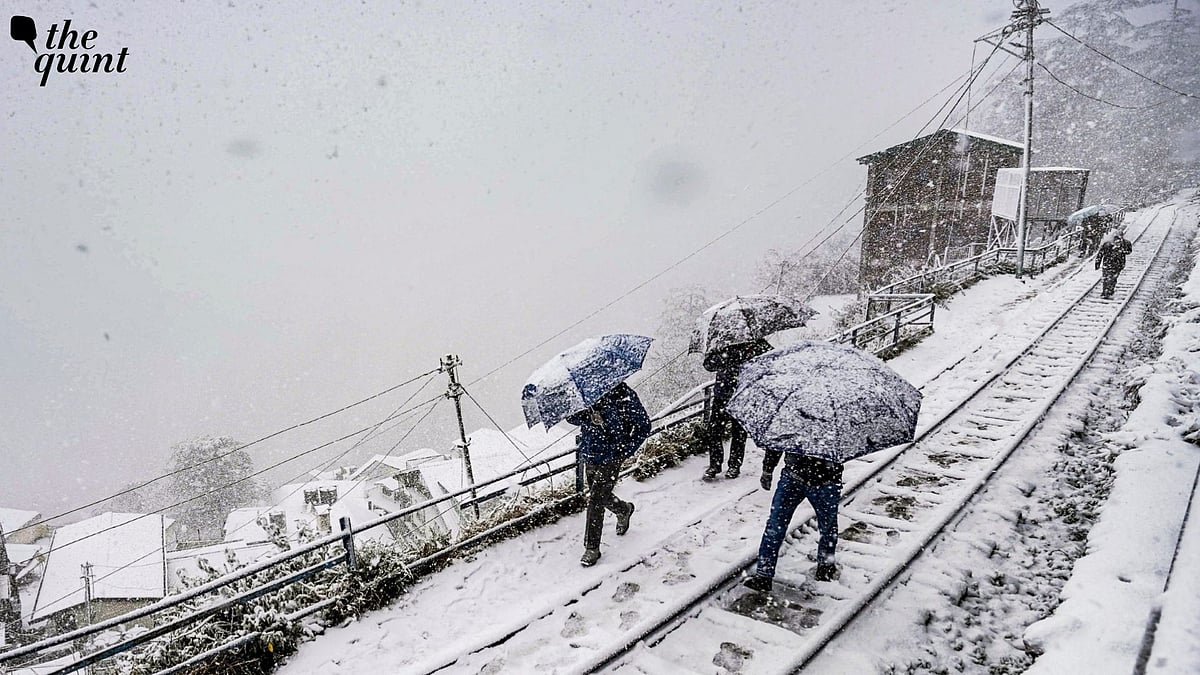
Western disturbances have finally brought snowfall to the parched peaks of Uttarakhand, Himachal Pradesh, and Jammu & Kashmir, bringing a brief return of white slopes to parts of the higher Himalayas.
The India Meteorological Department (IMD) has forecast widespread rain and snowfall in the western Himalayas through the end of the month.
In places like Badrinath, Kedarnath, and across much of the Garhwal region, landscapes where winter snow is not just expected but taken for granted, January almost passed with little to no snowfall. Locals and long-time observers say this is the first time in decades, possibly close to 40 years, that these high-altitude areas have remained largely bare during the heart of the snow season.
At first glance, this might seem like just another unusual year. Weather, after all, is fickle. But when snow days shrink so drastically in places that have depended on it year after year, generation after generation, it stops being a curiosity. It becomes a signal.
Snow arriving this late is typically thinner, short-lived, and far more vulnerable to rapid melting as temperatures begin to rise toward spring.
Where Himalayan Winter Snow Comes From
Unlike much of India, the western Himalaya does not rely on the summer monsoon for its winter precipitation. Instead, it depends on weather systems known as Western Disturbances—moisture-bearing storms that originate over the Mediterranean region and travel eastward, guided by large-scale atmospheric circulation.
When conditions align, these systems bring snow to the mountains of Jammu & Kashmir, Himachal Pradesh, and Uttarakhand between December and February. This winter, those systems have largely failed Uttarakhand.
Western Disturbances have been fewer, weaker, or displaced northward. Several passed through the region carrying little moisture; others missed it altogether. The result has been long dry spells during what should be the core snowfall months.
Crucially, late snowfall cannot compensate for the absence of sustained snowfall in December and early January, when winter snowpack normally builds and persists.
However, weakened storm systems alone do not fully explain why the mountains remain bare.
When Cold Is No Longer Cold Enough
Equally important is the quieter but more consequential shift of rising winter temperatures.
As the climate warms, the freezing level, the altitude at which air temperatures drop below zero degrees Celsius, is steadily moving higher up the mountains. Elevations that once reliably stayed cold enough for snow now hover dangerously close to the freezing threshold.
Snow accumulates, storing water that is then released slowly over months. Rain, by contrast, runs off almost immediately.
It can intensify erosion, destabilise slopes, and when it falls on glaciers, accelerate melting rather than replenishing ice.
A winter that looks “wet” in rainfall statistics can still function as a snow drought on the ground, leaving little lasting water stored in the landscape.
This shift, from snow-dominated to effectively snow-free winters, is one of the clearest fingerprints of climate warming in mountain regions worldwide. It often goes unnoticed because total precipitation may not change dramatically. But the form of precipitation changes everything.
From Weather to Climate
A single low-snow winter, by itself, would not be cause for alarm. Mountain climates are naturally variable. But the current situation fits into a longer-term pattern that is becoming increasingly difficult to dismiss.
Over recent decades, temperatures across the Himalayan region have risen faster than the global average. Observations and satellite records show a steady decline in snow persistence (the length of time snow remains on the ground), particularly at mid- to high elevations.
Recent global research led by Manuel Blau, which I was also part of, shows that the changes seen in Uttarakhand and across High Mountain Asia are not a local anomaly. The study finds a nearly 7 percent global decline in persistent mountain snow cover over the past 44 years.
High Mountain Asia is among the most sensitive regions: With just a warming of about 1.5°C, persistent snow has declined by 9.5 percent.
The study finds that reduced snowfall outweighs increased snowmelt, favouring a net loss of long-lasting seasonal snow. In other words, it is not just faster melting, but the failure of snow to accumulate in the first place that is driving the retreat of persistent snow cover. The snowless winter now unfolding in Uttarakhand is a textbook example of this process in action.
Why Snow Matters More Than You'd Think
In the Himalaya, snow is far more than a seasonal backdrop. It is a form of natural infrastructure.
Snowpack acts as a slow-release reservoir, storing winter precipitation and releasing it gradually through spring and summer.
When snow is absent or short-lived, that buffering function weakens. Rivers may swell briefly during winter rain events, but flow declines earlier and more sharply later in the year, precisely when water demand is highest. The consequences are felt far beyond the mountains.
Ecologically, snow plays a stabilising role. It insulates fragile alpine soils, preserves moisture, and regulates the timing of plant growth.
There are immediate knock-on effects as well. Dry winters leave forest floors parched, increasing the risk of early and intense forest fires. In recent years, Uttarakhand has already seen fires in winter and early spring, an alarming departure from historical fire seasons.
People and the Cultural Costs
For mountain communities, a snowless winter is not an abstract scientific concern; it is a lived reality.
Winter tourism and pilgrimage economies depend on predictable seasonal conditions. Farmers rely on snowmelt to recharge springs and sustain crops. Pastoral systems are adapted to snow-covered winters that regulate grazing pressure and water availability.
Culturally, snow is deeply woven into how people understand the mountains and their seasons and their risks. When snow vanishes, it unsettles not only livelihoods but long-held assumptions about how the mountains behave and what can be expected of them.
A Glimpse of the Future?
The most unsettling aspect of this winter is not that it happened, but that it aligns so closely with what climate science has long projected.
If warming continues along its current trajectory, snowlines will keep rising. Winters will increasingly feature rain instead of snow at elevations that once served as reliable snow reservoirs. Glaciers will struggle to recover mass during winter, accelerating their long-term retreat.
In this future, snow does not disappear entirely but it becomes episodic, unreliable, and insufficient to sustain the systems built around it. Uttarakhand’s bare peaks this January may well be an early glimpse of that reality.
The Himalaya is often described as the “water tower of Asia.” But like any tower, its stability depends on its foundations. Snow cover is one of those foundations, and it is quietly eroding.
Responding to this challenge requires more than short-term weather explanations. It demands sustained monitoring of snow cover, better integration of mountain climate science into water and disaster planning, and recognition that climate change in the Himalaya is not a distant future threat; it is already reshaping winters in real time. A winter without snow in the high Himalaya is not just unusual. It is a clear message.
The question is whether we are prepared to listen and to act before such winters become the norm rather than the exception.
(Dr Pratik Kad is a Climate Scientist, currently working as a PostDoc at NORCE Research in Bergen, Norway. He is an affiliated member of the Bjerknes Centre for Climate Research. This is an opinion piece and views expressed are the author's own. The Quint does not endorse nor is responsible for them.)