
Bangladesh Youth Delegate Puts Human Face on Adaptation Finance at COP30
Bangladesh’s delegation at COP30 includes five youth leaders who want to bring about a "meaningful change".
advertisement
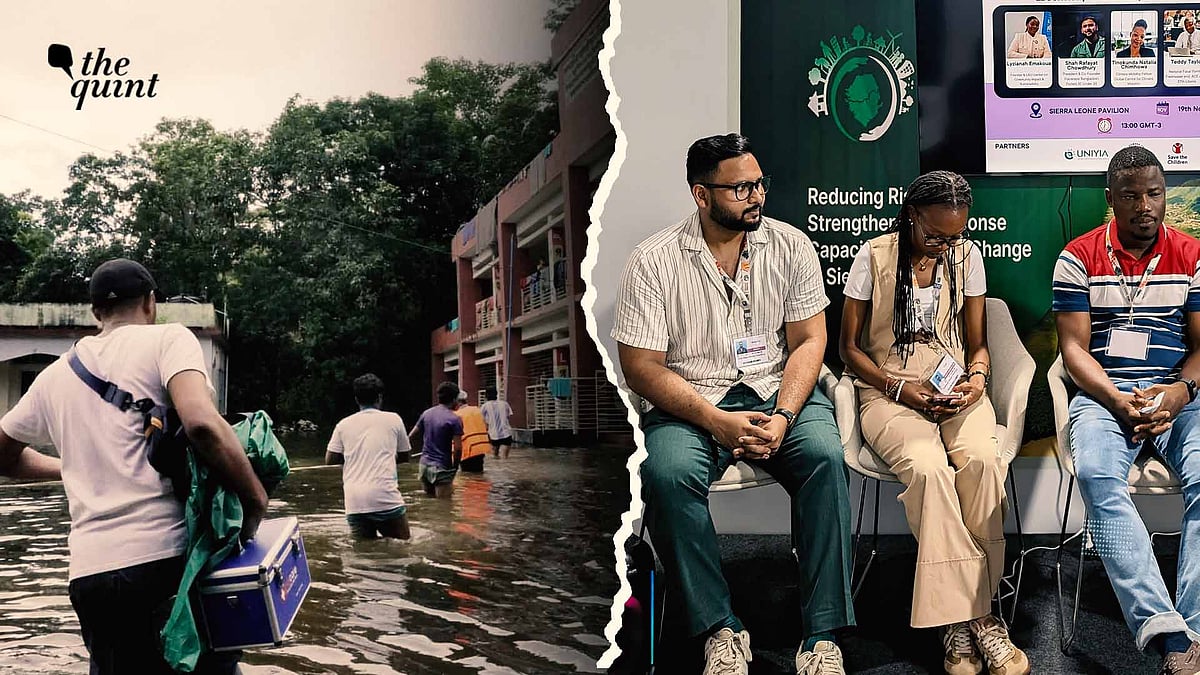
In 2024, southeast Bangladesh saw one of the country's worst floods in living memory. "I was in Noakhali during a rescue and relief mission, and I broke my arm. It took us nine hours to get me to the nearest hospital. I saw the health system, the roads, and the transportation system fail in front of me,” recalls 29-year-old Shah Rafayat Chowdhury.
“That is why I am here today—I am fighting not only for the experience I went through, but for the experiences of hundreds and thousands of people who are going through this in Bangladesh,” he says about the long hours he's putting in at COP30.
Chowdhury runs Footsteps Bangladesh, an NGO building self-reliant communities facing the brunt of climate change. Far from his home in Dhaka, he's currently representing his country in Belém, Brazil, as one of the youth delegates within Bangladesh's 15-member delegation.
In 2024, Feni, a city in southeastern Bangladesh saw one of the country's worst floods in living memory.
(Photo: Sourced by The Quint)
At its core, climate adaptation is about equipping nations with the resilience needed to withstand the impacts of climate change.
The 2024 floods, for instance, affected nearly 5 million people, according to local reports.
"Without adaptation, climate change becomes a poverty multiplier, dismantling livelihoods, displacing workers and deepening hunger. As impacts intensify, failure to act is not technical negligence; it is a political choice about who lives and who dies," COP30 President André Aranha Corrêa do Lago had noted in his eighth letter from the presidency.
Second-Generation Negotiator
Chowdhury’s father, Quamrul, was a lead negotiator for the Least Developed Countries (LDCs) and G-77 developing countries on climate and sustainable development for 30 years. He was also a member of the first UN Climate Adaptation Committee formed back in 2012.
“Adaptation was very important to my father. I'm fighting to protect his legacy,” he tells The Quint.
His father was also the reason he had found his way to Noakhali during the 2024 floods.
Shah Rafayat Chowdhury during relief work in Bangladesh.
(Photo: Sourced by The Quint)
Soon after, others from his NGO arrived to rescue the stranded. “I was trying to get signal on my phone to communicate with others when I slipped and fell and dislocated my shoulder completely,” he says as he holds up his hand in the air trying to imitate his action from that fateful day.
His colleagues held up his shoulder, walked him through the flooded streets to a nearby market, and somehow managed to put him in the back of a pickup truck. It took him nine hours to get to a hospital.
“I didn't think I’d survive that day," he says. "The entire national grid had shut down, and the only source of light the whole time was the torch on my phone.”
Adaptation Talks
Inside the COP30 venue, the past few days of negotiations have been intense, with updated drafts of the climate deal emerging daily. One of the 12 crucial items is the Global Goal on Adaptation (GGA), adopted in 2015 under the Paris Agreement.
"As and when the GGA is agreed it will, in time, mean we have a global scorecard for resilience and a clearer sense of who is prepared, what the needs are and where the gaps persist," wrote Natalie Unterstell, a climate change policy and negotiations expert from Brazil, and Daniel Porcel, a climate policy specialist at Talanoa Institute, last month.
“The main fight between the developed and the developing nations is not on the 'how' of adaptation, but 'when'," Chowdhury, who is a graduate in environmental economics and policy from Pennsylvania State University, tells The Quint.
Shah Rafayat Chowdhury, along with his colleague, at COP30.
(Photo: Sourced by The Quint)
As far as the GGA goes, success at COP30 will mean locking in the indicators, agreeing on adaptation finance as well as a workplan to put it in action.
Just weeks before COP30, the UN Environment Programme's Adaptation Gap Report 2025 warned that by 2035, adaptation finance needs of developing countries will be at least 12 times greater than current international public flows.
The report updated the cost of adaptation finance needed in developing countries, putting it at a minimum of $310 billion per year in 2035. Meanwhile, international public adaptation finance flows to developing countries were $26 billion in 2023, down from $28 billion the previous year.
"At this critical juncture of the COP30 negotiations, the question is not simply how we measure adaptation progress but whether we are prepared to finance it at the scale at which it is needed. For India—and indeed for all large developing economies—adaptation is the bedrock of climate resilience, livelihoods, and sustainable economic development. Developed countries and multilateral institutions must commit to public, grant‑based, predictable adaptation financing that matches the urgency on the ground,” says Aarti Khosla, founder and director of Climate Trends.
She adds,
On Tuesday, negotiations on the GGA purportedly ran past 6 pm. A few developed countries, including the European Union, Switzerland, the UK, and Japan, wanted the paragraph on tripling adaptation fianance in Tuesday’s draft to be deleted as the LDCs argued otherwise, The Quint has learnt.
Meanwhile, disagreements over the indicators themselves have persisted among countries.
“Even though the list of adaptation indicators has been worked on, there is no inclusion, for example, for people of disabilities. Or, we're talking a lot about AI and technological advancement, otherwise, but where is the indicator for technological adaptation? Right now, so many people work online. Imagine if the internet connectivity shuts down during a cyclone or floods, how are they going to earn their income? How are they going to do their online jobs?” Chowdhury asks.
Another sticking point is that developed countries want the indicators to be voluntary. However, experts argue this contradicts the very idea of a global goal—it requires a mandatory, universal framework.
“In his eighth letter, the COP presidency has stated—though in somewhat ambiguous language—that this year's COP will be the COP of adaptation. He's invited all participants to consider adaptation through a new lens,” said Professor Mizan R Khan, Bangladesh's principal negotiator.
“My hope is that we see strong implementation, a comprehensive list of indicators established, as well as a GGA that is truly global in its nature, not voluntary, but compulsory,” he says.
As one of the most flood-prone countries in the world, water, sanitation, and hygiene (WASH), and agriculture are the most crucial indicators to Bangladesh.
Bangladesh's Young Faces
Besides Chowdhury, Bangladesh’s delegation has four other youth delegates.
“Bangladesh has, this time around, the highest number of youths participating in the party delegation. Last year, that number was limited to two,” said Amanullah Porag, founder and executive director at Youth4NDCs, who's one of the delegates.
Amanullah Porag, founder and executive directors at Youth4NDCs, is one of the youth delegates at COP30 representing Bangladesh.
(Photo: Sourced by The Quint)
“Even with an interim government, we are getting more opportunities to raise our voice,” Porag adds, confirming that he took part in the student-led protests in Bangladesh that brought down the Sheikh Hasina government in August 2024. So did Chowdhury.
At least 1,400 people had reportedly been killed as tensions escalated.
“This is the reason we are continuing our work as hard as possible because so many young people gave their lives. We don't want those lives to fade. We want to bring meaningful change, and now we have that opportunity with a more open government who's welcoming towards young people," Porag says.
However, he adds, having an interim government means there's lack of manpower and capacity.
- Access to all paywalled content on site
- Ad-free experience across The Quint
- Early previews of our Special Projects
Published: undefined