‘Death by Definition’: Why Climate Activists Are Protesting SC’s Aravalli Ruling
Experts warn SC’s new Aravalli definition could open 90 percent of the ranges to mining and commercial activity.
advertisement
“Hum pollution ke niche, sarkaar Aravalli ke peechhe, WTE lega meri jaan, haaye Bhandwari (landfill) se pareshaan… Bola sirf ‘sau metre ke upar’ Supreme Court ki Aravalli definition, yeh definition legi sabki jaan, haaye sarkaar se pareshaan...”
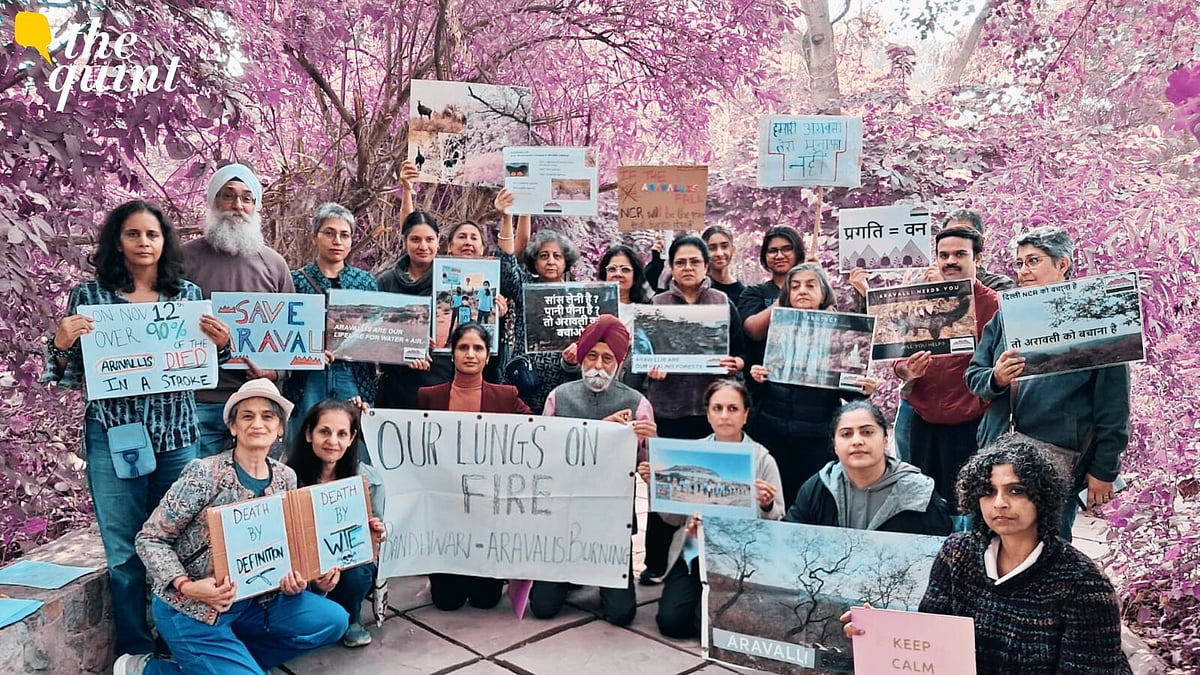
Set to the tune of the famous Hindi song Kajaraa Mohabbat Wala, these lines were sung by activists, concerned residents, parents and children who gathered at the Chakkarpur–Wazirabad Eco-Restoration Corridor in Gurugram for a “Sunday Baithak”, put together by Aravalli Bachao, to raise their objection against two recent policy moves that they say will lead to the “death by definition” of the Aravallis.
The satirical song may be a facetious way to draw attention to a serious issue, but the situation is anything but funny, say activists who have spent years fighting to protect the Aravallis, and now find themselves facing yet another battle.
On 20 November, the Supreme Court accepted a Union Environment Ministry panel’s redefinition of the Aravalli hills, along with its proposal to exempt waste-to-energy (WTE) plants and landfills from mandatory environmental clearance. Both decisions have been sharply criticised by activists and experts, who say they will make it easier to open up protected Aravalli land for mining and other commercial activity.
"This is the culmination of issues that have been building up for years. While politicians often prioritise business interests, people's interests lie in protecting the environment. These two have always clashed. Now, the conflict has reached a point where the public is losing, and business interests are taking the upper hand," Col (retd) SS Oberoi, Managing Trustee of Aravalli Bachao, tells The Quint.
A Sunday Baithak, organised by Aravalli Bachao, a citizen-led movement, aimed to raise awareness about the Supreme Court’s new ruling on the Aravallis and its potential impacts.
(Photo: Anoushka Rajesh/The Quint)
'Death By Definition'
As Col Oberoi noted, the Aravalli issue has been simmering for years, caught in a three-way tug of war between local communities, commercial interests of industries, and the government.
The latest point of contention emerged on 20 November, when the Supreme Court accepted a new definition of the Aravalli hills. Under this definition, only landforms rising more than 100 metres above the local terrain (plains), along with their slopes and the 500-metre area around them, will be classified as hills of the Aravalli range.
“What is not mentioned is that by this definition, more than 90 percent of the Aravalli hills, which were previously protected under broader Forest Survey of India (FSI) norms, will not be counted as 'Aravalli' anymore and be potentially open to mining and construction,” says Nidhi Batra, a development practitioner, who was present at the Baithak, on Sunday, 30 November.
Speaking to The Quint, Chetan Agarwal, an independent environment and forest analyst, says the 100-metre definition was accepted by the MoEFCC even though it had “not been proposed by any technical agency”; instead, it was an arbitrary benchmark used by the Rajasthan Mining Department since around 2002.
Under this standard, only hills rising more than 100 metres above the local plain were barred from mining, effectively making every other area “fair game” for mining licences.
In 2010, the Supreme Court tightened restrictions on mining activiy in the Aravalli hills in Rajasthan and put a ban on mining in 157 mining sites. The apex court also directed the FSI to carry out satellite imaging of the Aravalli ranges.
In 2010, the FSI then proposed defining a hill as any landform with a slope greater than 3 degrees. This was considered a “very low threshold,” and the MoEFCC ultimately chose and presented the 100-metre criterion to the Supreme Court, after the latter directed it to finalise a policy on the definition.
"This makes no sense," says Agarwal, adding, “If you have 10 hills and only one of them rises above 100 metres, the 100-metre rule would include just that single hill. The 3-degree slope definition, however, is a much lower threshold, which would classify almost all 10 as hills. So how can the 100-metre criterion be considered more inclusive? Yet, this is exactly what the environment ministry’s counsel told the court, and that claim was recorded in the judgment.”
"This is an absurd claim also because they haven’t provided anything on record to show how much additional area, in square kilometres or hectares, would be protected now that wasn’t protected earlier (under the new definition)," adds Ritwick Dutta, a senior environmental lawyer.
In fact, an internal assessment by the FSI found that only 8.7 percent of the Aravalli hills meet the 100-metre height criterion (just 1,048 out of 12,081 hills), according to an investigative report by The Indian Express.
"By this new definition, Gurugram and Faridabad only has two or three points which are more than 100 meters relative height, which means there would be no Aravallis left in Gurugram and Faridabad," adds Agarwal.
No formal response has been released yet by MoEFCC on the issue.
The Quint has sent a detailed questionnaire to both the Environment Ministry and the Director General of Forests and Special Secretary at MoEFCC for their response on the matter. This story will be updated once they reply.
(Photo: Anoushka Rajesh/The Quint)
Why the Rush, and Where Is the Public Consensus?
"Why was there such a tearing hurry for an official definition?" asks Ritwick Dutta.
Although the court has banned new mining leases until a sustainable mining plan is in place, experts warn that the redefinition could still have catastrophic consequences.
“The real-estate lobby can now easily argue that since the Supreme Court has accepted this definition (even if it was originally meant for mining), it can apply here as well. They’ll say, ‘We have an official definition from the court, so we’re going to use it,’” says Agarwal.
A similar concern surfaced in September when the Haryana government issued a notification defining a forest as land spanning at least five hectares in isolation, or two hectares if adjoining notified forests, with a canopy density of 0.4 or more, which would exclude vast swathes of the Aravalli ridge in Haryana — areas that are already under intense pressure from mining and rapid development.
Experts say these successive redefinitions are slowly shrinking the area of Aravallis protected under environmental safeguards, making it easier for commercial and industrial interests to encroach on critical ecosystems.
"Do we even need a legal definition for ecological entities when scientific definitions already exist? The law doesn’t require forests, rivers, mountains, or other natural features to be defined in such precise terms," Dutta, tells The Quint.
"Creating these legal definitions, therefore, opens a can of worms. Today we are debating what legally constitutes the Aravallis; tomorrow, the same question could be raised about the Himalayas," he adds.
14-year-olds Avisha Bajpai (left) and Samyra Shah (right) hold up the handmade posters they created for the Baithak to talk about the issue.
(Photo: Anoushka Rajesh/The Quint)
Why Protecting the Aravallis Is Vital for Delhi’s Health
Spanning over 670 kms across three states, the Aravalli ranges are often called the 'green lungs of India'. Experts have time and again drawn attention to why the protection of Aravallis is so cruicial.
Apart from serving as vital wildlife corridors between protected areas such as Sariska Tiger Reserve and Ranthambhore National Park, and supporting rich biodiversity, the Aravalli Range also acts as a natural barrier, helping prevent sandstorms from the Thar Desert in Rajasthan from reaching Delhi and the NCR region.
In recent years, loss of forest cover in the Aravallis has been linked to a rise in sand and dust storms in Delhi–NCR. A study by the Wildlife Institute of India (WII) that analysed land use in the Aravallis between 1975 and 2019 found that deforestation and mining activity have eroded the range’s forest cover, creating “gaps” that compromise its ability to block sand migration from the Thar Desert toward the eastern plains, increasing vulnerability to dust storms.
Experts warn that the continued loss of lower hills could further expose the Indo-Gangetic plains, including Delhi-NCR, to dust and sand, posing serious threats to public health and local livelihoods.
The forests of the Aravallis also play a crucial role in curbing air pollution by trapping dust, smoke, and other airborne pollutants. Trees and shrubs capture PM2.5 and PM10 particles on their leaves, reducing the amount of particulates that reach nearby cities. Dense vegetation also generates oxygen and helps improve overall air quality.
Dr Sharda Yadav, another protestor at the site on Sunday, says, "As a doctor I am seeing more and more patients who are suffering the consequences of living in high levels of pollution. In such a situation, how can we destroy the Aravallis, which is a living system that has supported health and wellness of this region for centuries?"
"What is the real cost of this development happening? If it comes at the expense of people’s health and children’s well-being, is that a trade-off we’re prepared to make?" adds Sangeeta Nayyar, climate activist and zero-waste advocate.