
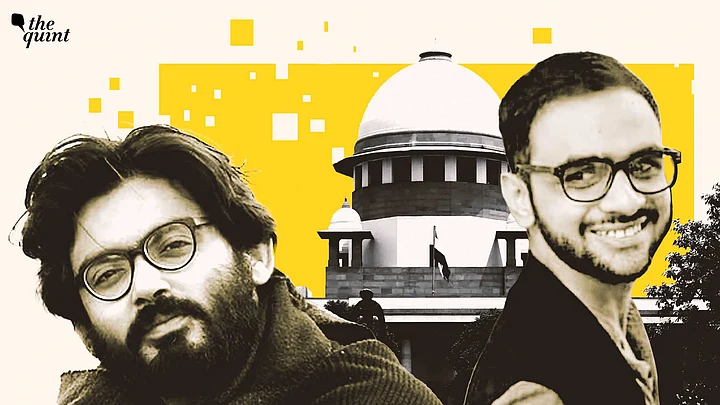
On 5 January 2026, the Supreme Court delivered its judgement in the bail applications of the Delhi Riots larger conspiracy case i.e, Gulfisha Fatima vs State (Govt of NCT of Delhi) and others. While granting bail to Gulfisha Fatima, Shifa ur Rehman, Meeran Haider, Shadab Ahmad and Salim Khan, the Court dismissed the bail pleas of Umar Khalid and Sharjeel Imam.
This judgement, cloaked in the language of judicial restraint and statutory rigour, represents a profound departure from the Court’s own foundational principles governing liberty, speech, and the limited scope of judicial inquiry at the bail stage. By accepting the prosecution’s expansive narrative of a "phased conspiracy" at face value and deeming the statutory embargo of Section 43D(5) of the Unlawful Activities (Prevention) Act (UAPA) as an almost insurmountable barrier, the Court has effectively elevated the state’s accusation over the constitutional presumption of innocence.
This reasoning, which conflates political mobilisation and protest rhetoric with the "foundational" architecture of terrorism, does more than deny two individuals their liberty; it undermines settled jurisprudential safeguards.
The decision stands in stark and uncomfortable tension with the Court’s own recent, more liberty-conscious pronouncements in cases like Javed Gulam Nabi Shaikh va State of Maharashtra, creating a dangerous dissonance where the interpretation of liberty under the UAPA hinges not on consistent principle, but on the perceived gravity of the political context.
In Javed Gulam (supra), the Court emphasised that Article 21 (Right to Life and Liberty) applies even in serious UAPA cases and the State can't delay trials indefinitely, regardless of the offence's gravity. This ruling held that prolonged pre-trial incarceration violates fundamental rights, forcing courts to balance stringent UAPA provisions with liberty, especially when the trial stalls.
What the Judgement Says
The bail applications were filed by seven individuals accused in the 2020 Delhi Riots conspiracy case, booked under severe charges including UAPA. The central legal issue was balancing the constitutional right to personal liberty (Article 21) against the stringent restrictions on bail under Section 43D(5) of the UAPA, especially in the context of prolonged pre-trial incarceration.
The Court clarified that while prolonged incarceration is a serious constitutional concern, it does not automatically override the statutory embargo of the UAPA. Delay must be examined contextually, considering the gravity of the offence, the accused's role, and the cause of the delay.
In this judgement, the Supreme Court anchored its analysis firmly within the stringent legal framework of UAPA. It reiterated the high threshold for bail set by the Zahoor Ahmad Shah Watali precedent, confining its inquiry to whether the prosecution's accusations appeared prima facie true based on the material presented, without weighing evidence or testing defences.
Crucially, the Court interpreted the definition of a "terrorist act" under Section 15 of UAPA in a broad manner, holding that it is not confined to conventional violence but extends to acts intended to threaten national unity or security through the deliberate disruption of essential services and civic life. Within this strict statutory context, the Court rightly emphasised the necessity of an individualised assessment for each accused, rejecting a blanket conspiracy approach and drawing a critical distinction between "conspiratorial centrality" and mere "conspiratorial association."
It is important to point that the Court has dangerously expanded the definition of a "terrorist act" under the UAPA, eroding the legal bulwarks that protect legitimate dissent from state overreach. By accepting the prosecution's argument that the planning of a non-violent chakka jam—a traditional form of protest—falls under the "any other means" clause of Section 15 of the Act due to its alleged "design, intent, and effect," the Court has moved the goalposts from proving violent action to speculating about subversive thought.
As has been rightly argued, this judgement effectively criminalises the strategic organisation of protest itself, granting the State a blank cheque to deploy the draconian, trial-delaying machinery of anti-terror law against its political critics.
While creating a hollow "hierarchy" to grant bail to five co-accused deemed mere facilitators, the core logic of the judgement weaponises the UAPA to transform adversarial mobilisation into a conspiracy against national integrity, paving the way for a future where dissent is not just disciplined but pre-emptively silenced under the shadow of terrorism charges.
The "Mastermind" vs "Foot Soldier" Dichotomy
Central to the judgement is the creation of a judicial hierarchy among the accused, which justified diametrically opposite outcomes. For Khalid and Imam, the Court accepted the prosecution's prima facie narrative that they occupied a "central and directive role" as ideological drivers and principal architects.
Their alleged acts, from conceptualising the protest strategy to delivering speeches—were deemed part of a "continuous chain" setting the conspiracy in motion. Their physical absence from riot sites was rendered legally irrelevant by this theory of phased conspiracy liability.
In stark contrast, the five co-accused granted bail were judicially categorised as "local-level executors" confined to "operational" and "derivative" tasks like site management or local funding. The Court found their alleged conduct, while part of the same alleged conspiracy, to be of a "facilitative nature" that did not demonstrate "autonomous strategic command."
This constructed dichotomy allowed the Court to apply the stringent UAPA bail bar fully to the alleged "masterminds," while for the "foot soldiers," the balance tipped in favour of liberty due to prolonged incarceration and proportionality.
Selective Application of Constitutional Safeguards
The judgement reveals a troubling selectivity in applying constitutional principles. The Court acknowledged the grave concern of prolonged incarceration—over five years without trial—yet held that for Khalid and Imam, the gravity of the prima facie case overrode this Article 21 violation, with the remedy being expedited trial, not release.
The plea of parity was also dismissed, as their roles were deemed "qualitatively different" from bailed co-accused. However, for the five others, these same principles—proportionality, the necessity of continued detention, and parity—were invoked to justify their release.
This selective application underscores that under the UAPA, constitutional safeguards such as the right to a speedy trial are not absolute rights but negotiable commodities, their weight contingent on the court's preliminary assessment of the accused's perceived centrality to the state's narrative.
The ruling thus establishes a perilous precedent: the more effectively the state paints an accused as an ideological ringleader, the less protection they receive from the very constitutional provisions designed to check State power.
Separate Outcome for Each Accused
One Year Bar
Perhaps the most restrictive part of the judgement is the imposition of a mandatory one-year waiting period for Khalid and Imam. This condition not only runs contrary to Article 21 of the Constitution but also creates a hurdle in the event of a change in circumstances, particularly since there is no statutory bar on applying for bail when circumstances materially change.
Although they may file an application before the trial court immediately upon the occurrence of any material "change in circumstances"—such as the discharge of key co-accused, the discrediting of a protected witness in a related case, or demonstrable evidence that the trial will extend far beyond the one-year horizon—they would be required to argue that such developments warrant an exception to the Supreme Court’s general timeline.
These avenues, though procedurally challenging, remain vital safeguards against a condition that risks normalising indefinite pre-trial detention through procedural fiat rather than substantive judicial assessment.
By creating an artificial one-year "blackout period"—even while acknowledging the concerning five-year pre-trial detention—the Court effectively sanctions further punitive custody divorced from any demonstrated investigative or procedural necessity.
This time-based barrier operates as an extra-statutory procedural roadblock, transforming bail consideration from a judicial assessment of necessity into a mechanised calendar exercise. The condition becomes especially oppressive given the Court's own recognition of its duty to prevent incarceration from becoming "punitive by reason of unreasonable and unjustified delay."
The Road Ahead
Khalid and Imam now have the option of approaching the Supreme Court directly under Article 32, arguing that the restrictive conditions imposed violate their right to personal liberty under Article 21.
Alternatively, they can also seek a review of the judgement, contending that the blanket one-year bar operates as a mechanical and disproportionate restriction.
The tragedy of this verdict, however, is not merely the continued incarceration of Umar Khalid and Sharjeel Imam. It is the corrosion of a consistent jurisprudential defence against the arbitrary use of draconian laws.
By distancing itself from the spirit of Javed Gulam—which insisted on a tangible, critical look at whether allegations actually constitute a "terrorist act"—the Court has weakened a crucial bulwark. In its laudable effort to grant bail to the five co-accused, the Court correctly applied principles of individualised justice and proportionality.
It is sad to note that in judgements such as Jalaluddin Khan v Union of India, the same Supreme Court held that “bail is the rule and jail is an exception” is settled law. The Court stated that this principle applies even in cases where there are stringent statutory conditions for the grant of bail, the only modification being that bail may be granted once the conditions prescribed under the statute are satisfied.
It further held that “the rule also means that once a case is made out for the grant of bail, the Court cannot decline to grant bail. If courts start denying bail in deserving cases, it would amount to a violation of the rights guaranteed under Article 21 of the Constitution.”
Yet, by denying the same principles to Khalid and Imam based on a more ominous-sounding but equally unproven characterisation of their roles, it has inadvertently sanctioned a two-tiered system of liberty. The message is chilling: under the UAPA, the nature of the accusation can now overwhelm the constitutional right to a meaningful bail hearing, leaving the fate of the accused contingent not on law alone, but on the political narrative they are alleged to have authored.
In doing so, the Court has not just delayed justice; it has compromised its role as the Constitution’s primary guardian against the limitless power of the state.
(Areeb Uddin Ahmed is an advocate practising at the Allahabad High Court. He writes on various legal developments. This is an opinion piece and the views expressed above are the author’s own. The Quint neither endorses nor is responsible for them.)
