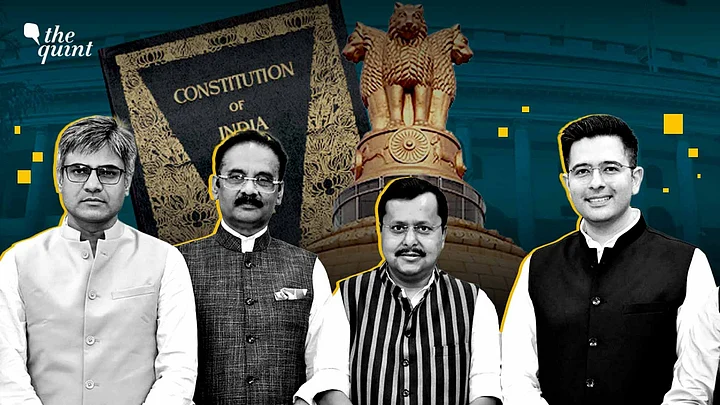
Last week, seven out of ten Rajya Sabha MPs from the Aam Aadmi Party (AAP), led by Raghav Chadha, announced their merger with the Bharatiya Janata Party (BJP).
The merger has been accepted by the Rajya Sabha Chairman, but questions regarding its constitutionality and whether it attracts disqualification under the Tenth Schedule of the Constitution remain.
Tenth Schedule, Disqualification Rules & Two-Thirds Merger Clause
The Tenth Schedule of the Constitution deals with the disqualification of political actors or suspect mergers on the grounds of defection. It was introduced in 1985 to address a specific concern: the destabilisation of elected governments through opportunistic shifts in party affiliation.
In colloquial terms, it sought to curb the phenomenon of ‘Aaya Ram, Gaya Ram’, where legislators frequently switched political parties, thereby undermining stability in the House and the broader political process.
The Schedule sought to secure a measure of stability by attaching legal consequences to such shifts and treating them as grounds for disqualification.
It identifies three broad categories of disqualification.
Voluntarily giving up membership of a political party.
Joining another political party after election.
Voting or abstaining from voting in the House contrary to the direction of the party.
The underlying premise is clear—legislators elected on a party ticket ought not to depart from it in a manner that undermines the electoral mandate.
However, the operation of the law over time reveals structural tensions that call into question whether it continues to serve that objective.
An important exception to the Schedule is found in the case of a ‘merger’ (Paragraph 4 of the Tenth Schedule).
A member is not disqualified if their original political party merges with another party and they either accept the merger or opt to function as a separate group.
Sub-paragraph 2 provides the constitutional threshold for recognising such a merger. It reads, “For the purposes of sub-paragraph (1) of this paragraph, the merger of the original political party of a member of a House shall be deemed to have taken place if, and only if, not less than two-thirds of the members of the legislature party concerned have agreed to such merger.”
This language is significant. It provides that a merger shall be “deemed” to have taken place “if, and only if, the two-thirds threshold is satisfied (‘deemed merger’).
The consequence is that a legislative supermajority is treated as sufficient to constitute, for the Schedule, a merger of the political party itself.
In doing so, the provision, at least prima facie, collapses, the distinction between the political party as an organisational entity and the legislature party as a numerical group within a House.
This is the very provision relied upon by the Rajya Sabha MPs belonging to AAP.
Merger Clause in Practice: Legal Validity, Precedents, Open Questions
So, on a strict reading of the Tenth Schedule, the position appears prima facie constitutional.
This interpretation also finds support in the judgment of the Bombay High Court in Girish Chodankar v Speaker, State Legislative Assembly of Goa (2022), where the Court dealt with a similar situation involving MLAs (belonging to the Congress) who had merged with another party (BJP) and claimed protection from disqualification under the deemed merger provision.
The Court accepted the argument on two grounds—first, the purpose of Paragraph 4(1), which carves out an exception to disqualification; and second, the language of Paragraph 4(2), particularly the phrase “if, and only if”, which was interpreted to operate as a distinct and self-contained condition for recognising such a merger.
This judgment has been challenged before the Supreme Court; however, its operation has not been stayed, and it continues to be valid law.
Notably, a similar course of action was adopted in the Rajya Sabha in 2019, when members of the Telugu Desam Party (TDP) merged with the BJP, and the move was accepted as valid by the Chairman.
However, an alternative interpretation has been advanced by some scholars. They argue that the requirements of Paragraph 4 are not disjunctive but conjunctive.
On this view, for the exception to disqualification to apply, the original political party must first merge as an organisational entity, followed by the merger of the legislature party. If accepted, this would render the merger of AAP as unconstitutional.
This argument draws on a few judgments.
First, the judgment of the Supreme Court in Subhash Desai v Principal Secretary, Governor of Maharashtra (2023), which held that the “political party” and the “legislature party” under the Tenth Schedule are distinct, and that a valid merger necessarily requires a merger of the former.
This observation must be read in context.
It is, at best, an obiter (non-binding, yet persuasive), made in a case that did not directly concern the application of the deemed merger exception, but instead addressed issues relating to disqualification, the authority to issue a whip, and the relationship between the political party and the legislature party.
Second, reliance is placed on Ram Bilas Sharma vs Speaker, Haryana Vidhan Sabha (1997), where the Punjab and Haryana High Court held that a legislature party is not an independent entity but merely a wing of the original political party.
However, that case dealt with the now-deleted Paragraph 3 of the Tenth Schedule, which concerned splits and not mergers. Importantly, the structure and language of Paragraph 4(2) depart materially from the erstwhile split provision.
A closer analogy is found in the judgment of the Bombay High Court in Shah Faruq Shabbir vs Govindrao Ramu Vasave (2016), where the Court, in the context of municipal councils, interpreted a similar provision under the Maharashtra Local Authority Members’ Disqualification Act, 1986.
The Court held that both “split” and “merger” must occur at the level of the original political party, and cannot be constituted solely by the actions of members within the legislature or municipal party.
On this view, the two-thirds requirement operates not as a mechanism to create a merger, but as a condition for recognising or validating an already existing organisational transformation.
This reasoning stands in tension with the textual interpretation discussed earlier and may be relied upon to argue that such defections are unconstitutional.
However, these observations arose in a distinct statutory and factual context and did not concern the functioning of Parliament or State Legislative Assembly.
Ultimately, it remains an unsettled question that would require authoritative determination by the Supreme Court.
The Special Case of Rajya Sabha and the Larger Constitutional Question
Even if the “deemed merger” provision is accepted on a strict reading of the Tenth Schedule, its application in the context of the Rajya Sabha raises a distinct constitutional concern.
Unlike members of the Lok Sabha, who are directly elected and may claim a degree of personal electoral legitimacy, members of the Rajya Sabha derive their mandate indirectly through State Legislative Assemblies. Their position is therefore closely tied to the party strength within those Assemblies.
Members of the Rajya Sabha are elected by MLAs of a State Legislative Assembly, who themselves act on a party mandate. In this sense, Rajya Sabha representation is an extension of the political will expressed in the Assembly.
Yet, we now encounter a situation where members elected by MLAs of the AAP in Punjab have aligned with the BJP, even as AAP continues to exist organisationally and retains its legislative strength in the very Assembly that elected them.
The result is a disjunction. The party ceases to exist in the Rajya Sabha while continuing to exist in the State Assembly.
This raises a basic question of democratic coherence—how can representatives elected on one party’s mandate subsequently realign with another political party in a manner that effectively negates that mandate, without attracting disqualification?
Here, the interpretive tension discussed earlier becomes more pronounced.
A textual reading of Paragraph 4(2) would suggest that the satisfaction of the two-thirds threshold is decisive, and that no disqualification would follow.
However, a purposive reading—keeping in view the object of the Tenth Schedule, namely the preservation of party discipline and the integrity of electoral mandates—would resist the conclusion that legislators may, through numerical strength alone, reconstitute the political party to which they belong.
Broader Concerns With the Anti-Defection Law
This episode also presents an opportunity to re-examine the anti-defection framework more broadly.
In its present form, the law draws a sharp distinction between individual and collective action. Individual legislators who defect or depart from the party line are liable to disqualification, whereas a sufficiently large group acting in concert may avail itself of the merger exception.
The result is an inherent asymmetry—individual dissent is penalised, while collective action is accommodated, provided it meets the numerical threshold.
While this reflects the problem the Tenth Schedule originally sought to address, namely individual defections, it sits uneasily with the broader objectives of preserving party discipline and the integrity of electoral mandates.
Equally significant is the question of timely adjudication in matters of disqualification.
The authority to determine whether a defection attracts disqualification rests with the Speaker or Chairman, whose decisions are subject to judicial review. In practice, however, concerns have been raised regarding partisan decision-making and the possibility of both hurried decisions and deliberate delay in adjudication to secure political advantage.
In either case, parties may approach the courts; however, that process itself is time-consuming, and often by the time a decision is made, the issue becomes academic due to political developments.
As recognised by the Supreme Court itself, timely adjudication in matters of disqualification is essential, given that such decisions may have a direct bearing on the composition of governments and other political outcomes. Delayed adjudication, even if it arrives at the correct conclusion, risks turning the process into one where “the operation is successful, but the patient is dead.”
(The author leads Charkha, the Constitutional Law Centre at the Vidhi Centre for Legal Policy. He specialises in constitutional law and administrative law, with a particular focus on constitutional interpretation and judicial review. This is an opinion piece and the views expressed above are the author’s own. The Quint neither endorses nor is responsible for the same.)