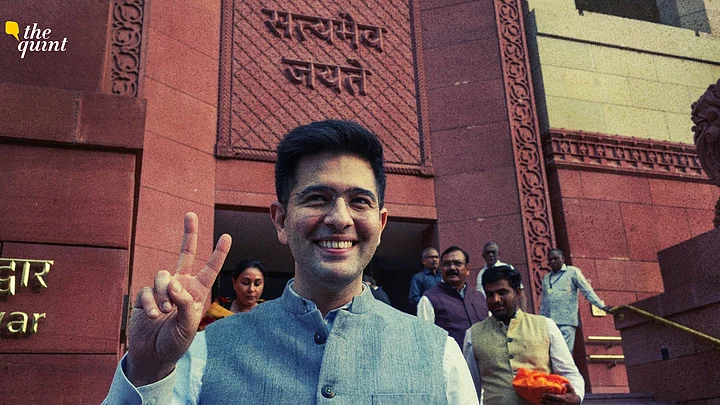
On 27 April 2026, Rajya Sabha chairperson CP Radhakrishnan officially accepted the merger of seven Aam Aadmi Party (AAP) Members of Parliament, including Raghav Chadha, with the Bharatiya Janata Party (BJP). This decision increased the BJP’s strength in the Upper House to 113 and reduced AAP’s representation to three MPs. The seven MPs had announced their departure from AAP and intention to join the BJP three days prior to the chairperson’s acceptance.
According to Scroll, the seven MPs who merged with the BJP are Raghav Chadha, Ashok Mittal, Harbhajan Singh, Sandeep Pathak, Vikramjit Singh Sahney, Swati Maliwal, and Rajinder Gupta. The Rajya Sabha’s updated party position now lists these members under the BJP, reflecting the change in the official records.
As reported by Hindustan Times, the BJP’s total in the 245-member Rajya Sabha now stands at 113, while the National Democratic Alliance (NDA) has at least 148 members. The AAP’s tally has dropped to three MPs, with Sanjay Singh, Balbir Singh Seechewal, and ND Gupta remaining in the party.
As highlighted by Deccan Herald, the merger was announced by the defecting MPs at a press conference on 24 April 2026. The move came ahead of the Punjab Assembly elections scheduled for the following year and was described as a significant setback for AAP. The NDA is now just ten seats short of a majority in the Upper House.
As noted in an article by The Indian Express, the anti-defection law under the Tenth Schedule of the Constitution allows a merger if at least two-thirds of a party’s members agree. In this case, the seven MPs constituted the required majority, enabling the merger without immediate risk of disqualification. The Rajya Sabha’s official records were updated to reflect the new party positions.
“The latest Rajya Sabha party position, published on Monday morning, shows a sharp shift in numbers, with the Aam Aadmi Party’s strength reduced to three MPs and the Bharatiya Janata Party’s tally rising to 113, indicating Upper House Chairman C P Radhakrishnan’s acceptance of the merger of seven AAP members with the BJP,” the article stated.
Legal challenges have emerged, as AAP leader Sanjay Singh submitted a petition to the Rajya Sabha chairperson seeking the disqualification of the seven MPs. The petition argues that the merger does not meet the legal requirements under the Tenth Schedule, and calls for the termination of the MPs’ membership. The final decision on the disqualification plea rests with the chairperson.
Raghav Chadha, in a public statement, cited a “toxic work environment” within AAP as a key reason for his departure. Chadha explained that decision-making in AAP had shifted to “corrupt and compromised” individuals, and that he and the other MPs felt unable to work or speak freely. He assured the public that he would continue to raise citizens’ issues as a BJP member.
Further developments included the Rajya Sabha website updating its records to show the seven MPs as BJP members. The AAP’s petition for disqualification remains pending, and protests have been reported in Punjab against the defecting MPs. The situation has led to ongoing legal and political debates regarding the interpretation of the anti-defection law.
“I gave 15 years of my prime youth to this party. I worked very hard for this party with my blood, sweat and tears. But today, this party is not the old party. This party has a toxic work environment. You are stopped from working,” Chadha said in his statement.
Party officials have indicated that the BJP expects to gain additional seats in upcoming Rajya Sabha elections, potentially moving closer to a two-thirds majority. The Congress remains the second largest party in the Upper House, while the AAP’s reduced numbers have affected its parliamentary influence.
Recent statements from BJP leaders have welcomed the new members, emphasizing their parliamentary conduct and commitment to the NDA’s legislative agenda. The merger has intensified political competition ahead of key state and national elections.
Note: This article is produced using AI-assisted tools and is based on publicly available information. It has been reviewed by The Quint's editorial team before publishing.