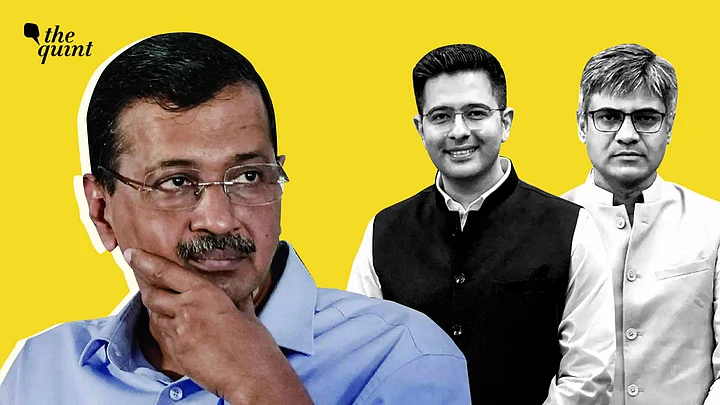
In the high-stakes arena of Indian politics, where loyalty often defines survival, the Aam Aadmi Party (AAP) under Arvind Kejriwal has suffered a massive internal rupture. On 24 April, 2026, seven of its 10 Rajya Sabha MPs, led by Raghav Chadha, announced their decision to merge their faction with the Bharatiya Janata Party (BJP), invoking the anti-defection law’s two-thirds provision.
This group included key figures such as Sandeep Pathak, Ashok Mittal, Swati Maliwal, Harbhajan Singh, Rajinder Gupta, and Vikram Sahney. The move has not only slashed AAP’s parliamentary footprint but also exposed deep fault lines within a party that rose on the promise of transparency, anti-corruption, and people-centric governance.
The trigger was visible weeks earlier when Kejriwal’s inner circle, including Manish Sisodia, Sanjay Singh, Atishi, and Saurabh Bhardwaj, directed the stripping of Raghav Chadha from his post as deputy leader in the Rajya Sabha, replacing him with Ashok Mittal. This decision signalled to power circles that the rift was irreparable. AAP leadership had long sensed Chadha’s growing disillusionment and potential shift, particularly ahead of the 2027 Punjab Assembly elections.
What began as whispers of defection escalated into a full storm. Six of the departing MPs hail from Punjab, one from Delhi, reflecting regional tensions.
More Than Numbers: A Structural Crisis
This exodus is not merely about numbers but vulnerability. AAP, a 15-year-old party that disrupted national politics with its 2012 origins in the Anna Hazare movement, now confronts questions about internal cohesion.
While it is premature to declare an obituary for the party, especially one that governs Punjab, these departures highlight ignored deeper fault lines: sidelining of influential voices, over-centralisation around Kejriwal and Delhi-centric leaders, and mounting pressures from legal battles and organisational drift.
The departure of strategists and financiers who shaped AAP’s successes in 2020 Delhi and 2022 Punjab polls marks a critical inflection point. It raises doubts about the party’s ability to maintain its distinctive “Aam Aadmi” identity amid allegations of deviation from core principles.
The timing amplifies the blow. With Punjab elections looming in 2027 and limited parliamentary sessions ahead (monsoon, winter, and budget), AAP’s reduced voice in the Rajya Sabha weakens its national platform. This event underscores how personal ambitions, perceived sidelining, and external pressures can unravel even resilient structures in Indian politics.
As Kejriwal and his core team grapple with this loss, the party must confront whether its model of governance and expansion can withstand such high-profile exits without compromising its foundational ethos.
Will This Exodus Cripple AAP’s Parliamentary Presence?
The impact on Parliament is immediate and tangible. AAP’s Rajya Sabha strength has plummeted from 10 to just three MPs: Sanjay Singh (Delhi), Narain Das Gupta (Delhi), and Balbir Singh Seechewal (Punjab).
Sanjay Singh remains the most prominent voice, but the others are less vocal due to age and other factors. In the Lok Sabha, AAP holds only three seats from Punjab—Gurmeet Singh Meet Hayer, Malvinder Singh Kang, and Dr. Raj Kumar Chabbewal—who have historically operated from the sidelines.
For a party reliant on parliamentary debates to amplify its governance narrative in Punjab, this depletion is significant. Though sessions before 2027 are limited, the loss of articulate voices like Chadha and Pathak diminishes AAP’s ability to counter BJP narratives or push its welfare schemes nationally. The psychological effect on remaining members and allies could further erode morale.
Why Pathak’s Exit Cuts the Deepest
Sandeep Pathak’s departure strikes at the very heart of Arvind Kejriwal’s leadership in a way that Raghav Chadha’s exit, though damaging, does not. An IIT Delhi alumnus and former associate professor, Pathak first caught Kejriwal’s attention during alumni gatherings. Kejriwal was deeply impressed by his sharp analytical mind and mastery over numbers, data, and strategy. With roots firmly in Chandigarh, Pathak already carried a quiet connect with the AAP’s original cause of clean politics and public service.
From the 2019 Lok Sabha elections onward, Pathak worked tirelessly behind the scenes, feeding Kejriwal critical data analysis and election insights. Before the 2020 Delhi Assembly polls, he took the bold step of quitting his academic career to join the party full time. His organisational brilliance became evident during that campaign, where he played a key role in scripting AAP’s massive victory. He was also instrumental, along with Raghav Chadha, in bringing Prashant Kishor’s I-PAC team on board.
Pathak’s influence only grew after 2020. He emerged as the master strategist for the landmark 2022 Punjab victory, and steered crucial campaigns in Gujarat and Goa. Within Delhi, he was the driving force behind the party’s organisational expansion. Recognising his unmatched value, Kejriwal created a special post for him — General Secretary (Organisation) — a rare honour. This was followed by his nomination to the Rajya Sabha from Punjab.
Even after the 2025 Delhi defeat, Pathak remained highly influential, though he felt unfairly blamed for the loss. His role had allegedly been curtailed since the liquor policy controversy and arrest of top leadership including Kejrriwal, Manish Sisodia and Sanjay Singh, with the party leaning more on figures like Vijay Nair for internal communication, media management, data and surveys. Yet he continued to command respect.
For Kejriwal, losing Pathak is not just the exit of a capable leader, it is the loss of a trusted intellectual partner who understood both numbers and the soul of the movement. At a time when AAP needs sharp strategy the most, this departure leaves a void that will be extremely difficult to fill.
AAP’s Fragile Core: Punjab at Risk
Organisationally, the Aam Aadmi Party has always revolved heavily around Arvind Kejriwal. Among the Rajya Sabha MPs who departed, only a handful like Sandeep Pathak, Raghav Chadha, and Swati Maliwal brought genuine political experience and grassroots connect.
The rest, including Ashok Mittal, Harbhajan Singh, Rajinder Gupta, and Vikram Sahney, came largely from business and celebrity backgrounds. Their exit leaves a vacuum that exposes how fragile the party’s structure has become.
The real crisis lies in Punjab. Most of AAP’s MLAs in the state share deep ties with Sandeep Pathak, who, along with Raghav Chadha, personally selected and nurtured them. These legislators’ loyalty does not rest with Chief Minister Bhagwant Mann.
Mann’s organisational abilities have faced questions for years. Back in 2017, when AAP was the main opposition and Mann held key organisational responsibilities, the party witnessed major internal exits and turmoil. Many insiders still blame his handling for those setbacks.
Delhi vs Punjab Faultlines
After the 2025 Delhi Assembly defeat, the situation worsened. Kejriwal, Manish Sisodia, and the core Delhi leadership shifted focus to Punjab, camping there for extended periods. Local Punjab leaders, including Mann himself, feel increasingly sidelined. They believe the Delhi team has hijacked the state unit, running it from the top with little regard for regional voices. Kejriwal has appointed several of his trusted Delhi associates to key boards and government bodies in Punjab, further centralising control and breeding resentment on the ground.
This exodus is not just a loss of faces in Parliament. It is a psychological blow that the BJP known for playing the long game, will surely exploit.
With Pathak and Chadha gone, the personal networks that held the Punjab unit together are severed. Loyalty among MLAs is now in doubt, organisational depth is shallow, and the disconnect between Delhi’s command centre and Punjab’s ground realities has never been starker. As the 2027 elections approach, AAP’s Punjab fortress stands dangerously exposed.
What Drove the Split
Multiple grievances converged. Chadha’s removal as deputy leader after perceived distancing and non-participation in walks-outs alongside Pathak crystallized the split.
Swati Maliwal had been aggrieved, campaigning subtly against AAP in 2025. Pathak’s outreach for resolution reportedly went unheeded. Business-background MPs like Ashok Mittal (LPU founder, recently raided by ED), Rajinder Gupta, and Vikram Sahney faced agency pressures. Harbhajan Singh added star appeal to the group.
Chadha united them, citing deviation from AAP’s principles. Yet, the idea of a two-third party merger was Pathak’s brainchild, a tactical device designed to prevent defection law while preserving Rajya Sabha berths that would otherwise have been lost.
At this stage, the BJP was scarcely in a position to accommodate them with fresh Upper House nominations.The two-thirds merger protected them legally, reflecting calculated timing amid Kejriwal’s legal battles.
Financially, the setback is severe. The Delhi liquor policy case has imposed massive legal costs for high-profile advocates, with accounts under scrutiny and seizures reported. Financiers among the departed— notably Mittal and other industrialists provided crucial support. Their exit, alongside Chadha and Pathak’s networks, intensifies funding crunches.
Before 2027, this compromises candidate selection, campaign scale, and national operations. Resource diversion to legal fights leaves less for ground mobilisation, potentially forcing compromises that dilute AAP’s welfare-focused image. The cumulative effect signals a party in transition, where internal blows test its resilience against a resurgent BJP.
(Sayantan Ghosh is the author of two books, Battleground Bengal and The Aam Aadmi Party, and teaches at St. Xavier’s College (Autonomous), Kolkata. Views expressed are the author's own. The Quint does not endorse or is responsible for them.)