
ADVERTISEMENTREMOVE AD

Why Modi's Austerity Message Isn't Landing With His Core Supporters

BJP's core constituency has been restive for months, starting with UGC reforms, writes Manish Anand.

Published
story-hero-img
i
Aa
Aa
Small
Aa
Medium
Aa
Large

The "Modi wave" was seeded in the womb of social media. As social media became a focal weapon in India’s politics, the seed sprouted into a giant electoral brand. New digital spaces were weaponised by "Team Modi" to pounce on the Opposition, ridiculing then Prime Minister Manmohan Singh and Congress leader Rahul Gandhi with the narrative that India lost a decade of opportunities under the UPA government.

Yet, the proverbial wheel of time turns, and now that very social media is replete with signs of a million mutinies within the Bharatiya Janata Party (BJP)’s core constituency, particularly the narrative amplifiers.

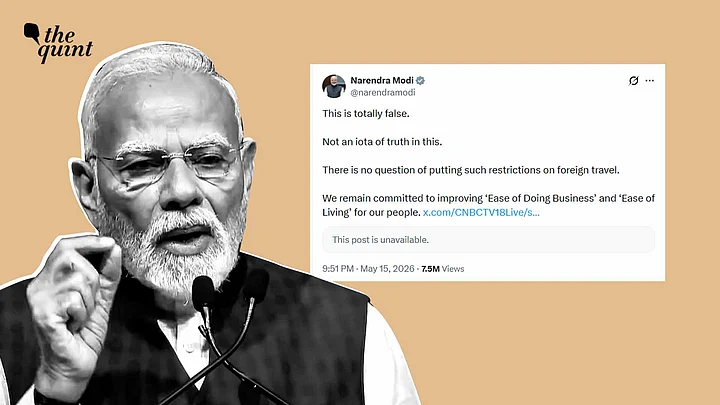
These signals have been read within the Narendra Modi-led dispensation with caution. And the first visible evidence of apparent distress tumbled out when the Prime Minister himself fact-checked (a rare event in itself) a speculative report of the government mulling a certain measure as a part of the austerity drive.

ADVERTISEMENTREMOVE AD

Austerity’s Discordant Notes

The West Asia crisis has become household news, even among people in rural India, as war videos whet the popular appetite for violence of the screen-addicted audiences in the country.

The ruling BJP has been trying to feed the narrative to believers of the saffron ecosystem that the Prime Minister insulated the people from the upheavals unravelling in Iran and West Asia. But the narrative ruptured solely on account of the timing.

The electioneering blitzkrieg where the BJP top guns unleashed carpet-bombing—as the term goes in popular election reportage—the states which went to polls recently, was followed by all. But the fact that India visibly slipped into a severe energy crisis just after the conclusion of the state elections seems to have struck a discordant note with even the more ardent followers of the BJP and the Prime Minister.

Modi’s call for austerity has been read within his core support base with nervousness, allayed by the fear of a forced work-from-home drill, akin to the COVID-19 lockdown, which had led to job losses and wage cuts during the pandemic.

Besides, the core constituency is now familiar with the patterns identified with the "Modi Model" of governance—rushing forward with decisions made without wider consultations and amending them after laborious channelling of the feedback when the followers have already suffered the pain.

Decisions like demonetisation, hasty rollout of the Goods and Services Tax (GST), imposing lockdowns at controversial times during the pandemic, and others are still remembered painfully even by those who usually assert to be life-long supporters of Modi and the BJP. The core support base of the BJP fears that they may be subjected to another spell of pain for no real gains and justifications.

Jolted, Jilted, and the Knock of Disillusionment

The fact is, the BJP's core constituency has been restive for months, starting with the contentious University Grants Commission (UGC) resolution. Many of the "Brand Modi" amplifiers on social media were crestfallen after Union Education Minister Dharmendra Pradhan pushed for it. Saffron supporters from the upper caste segments read between the lines to conclude that the BJP is taking its OBC politics to campuses. That was a big red flag.

Urban elites among the core support base also faced a spell of heartbreaks when Environment Minister Bhupender Yadav defended a contentious decision with regard to the Aravalli hills, which led to a major outpouring of anger on social media and non-legacy news platforms. The Modi government was finally restrained by the Supreme Court, staying the ministry's decision on the fragile hill range.

For the past few years, the NEET exam controversy has been making the urban middle class, which constitutes the core of the BJP’s support base, nervous. Paper leaks and an examination system marred with scandals douse the flames of aspiration that Modi had sought to fire when he arrived at the national stage in 2014.

Modi rode the electoral successes on the back of "development".

He came out with slogans such as “New India”, “Aspirational India”, “Doubling Farmers’ Income”, “Smart City”, “Startup India”, and “Stand Up India”. Till 2019, masses were indeed believing that India would change with such slogans.

In the aftermath of the COVID-19 pandemic, the dreams refused to transform into reality. The BJP’s core support base was seeking upward economic mobility. They hoped that Modi would rapidly scale up and expand the Indian economy. But they found that Modi had abandoned the aspirational template of his politics. He had transformed into a pro-poor mascot.

Gareeb kalyan” (welfare of the poor) became the key mantra of the Modi government as well as states ruled by the BJP. Free rations for over 80 crore people, and a host of welfare giveaways, flowed from Modi’s governance kitty. The core support base is reading the writing on the wall—the Modi government is a Leftist regime in its economic outlook. And their reaction is becoming more and more visible now on social media.

ADVERTISEMENTREMOVE AD

Reinventing With Every Election

The closest that the BJP came to losing Gujarat unfolded in 2017. The Patidar agitation was at its peak. Gujarat went into the Assembly elections for the first time in several years without Modi as a state actor. Unemployment among the Patidars and others, as well as income inequality, dominated the discourse. Modi also knew that the BJP faced the most daunting task. He camped and campaigned laboriously in the state.

Word on the street at the time was: "We would give the party a warning but spare the BJP from humiliation of a defeat". The mandate carried that sense eventually, as the BJP narrowly scraped through.

Since then, the BJP has been reinventing itself with each poll, and in the course of the time, the outfit is seeking to rewrite the grammar of elections. The codes involve pulling strong political rivals into its own camp and micro-managing elections while expanding its support base with a strong dose of welfarism.

The political cocktail of welfarism and Hindutva bring rich electoral windfalls for the BJP. Yet, the fear remains in the saffron camp, where some quietly feel that 2024 Lok Sabha elections had an imprint of the people’s unhappy verdict on Modi’s crisis management during the pandemic.

In the first election since the pandemic, the BJP had lost its majority in the Lok Sabha. If the next big crisis comes visiting, will the 2029 script stay intact?

(The author is a senior Delhi-based journalist, with over two decades spent in tracing the BJP and Indian politics. This is an opinion piece and the views expressed are the author's onw. The Quint does not endorse or is responsible for them.)

Speaking truth to power requires allies like you.
Become a Member
Monthly
6-Monthly
Annual
Check Member Benefits
×
×