
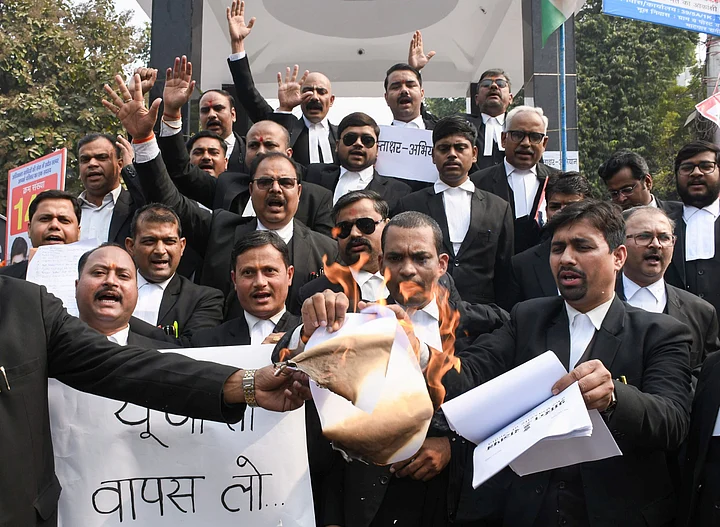
Less than a month ahead of the Supreme Court’s next hearing on the new regulations notified by the University Grants Commission (UGC), the debate on equity at central universities has emerged as a major flashpoint.
This equity debate took a violent turn last week outside the Arts Faculty in North Campus, prompting Delhi University to ban “public meetings, processions, demonstrations and protests of any kind” for a period of one month starting 17 February. Meanwhile, protests at Delhi's Jawaharlal Nehru University (JNU) intensified over the weekend after its Vice Chancellor Santishree Dhulipudi Pandit in an interview reportedly called UGC rules "totally unnecessary", "irrational", and "wokeism". Clashes broke out late last night between Left-led All India Students' Association (AISA) and RSS-affiliated Akhil Bharatiya Vidyarthi Parishad (ABVP), who accused each other of violence and stone-pelting.
The University Grants Commission (Promotion of Equity in Higher Education Institutions) Regulations, 2026 mandates establishing Equal Opportunity Centres, Equity Committees and Equity Squads to keep caste-based discrimination in check; time-bound grievance redressal; as well as punitive actions against central universities for non-compliance.
Soon after they were notified on 13 January, these regulations were met with severe backlash from upper caste groups (including several BJP office bearers), which unified to demand a rollback of these rules claiming they would lead to “reverse discrimination,” “malicious or fake complaints against general category students,” and “division among students on campuses.”
Despite the Union Education Minister Dharmendra Pradhan assuring critics that “there will be no discrimination and no one can misuse the law,” the regulations were challenged in the Supreme Court by a batch of petitions filed on 27-28 January. Claiming that the rules were “exclusionary” and “discriminatory against people belonging to general classes,” the petitioners sought an urgent hearing, which the top court granted.
On 29 January, a Bench comprising Chief Justice of India Surya Kant and Justice Joymalya Bagchi stayed the 2026 regulations—observing that they were prima facie vague and capable of misuse—and ordered that the 2012 regulations will operate in the interim. The Supreme Court issued a notice to the Union government and the UGC to file a response in the next hearing scheduled for 19 March.
In this story, The Quint examines the new UGC rules to ascertain: