
ADVERTISEMENTREMOVE AD

India Promised NEET Reform After 2024. What Happened?

The WhatsApp breach originated not within the NTA's own controlled systems, but at a printing press.

Published
story-hero-img
i
Aa
Aa
Small
Aa
Medium
Aa
Large

It started with a WhatsApp message and then the forwards.

On the evening of 2 May, the night before India's most consequential medical entrance examination, a Kerala-based MBBS student forwarded 300 "guess paper" questions to his father in Sikar, Rajasthan, with a casual instruction: distribute these to the girls at your hostel. The hostel operator did so the following morning. The exam came and went.

It was only when a local coaching teacher methodically checked how many questions from that "guess paper" had actually appeared in NEET-UG 2026 that the scale of what had happened began to sink in.

All 90 biology questions. Thirty chemistry questions. A staggering 120 questions in total matched the actual examination paper.

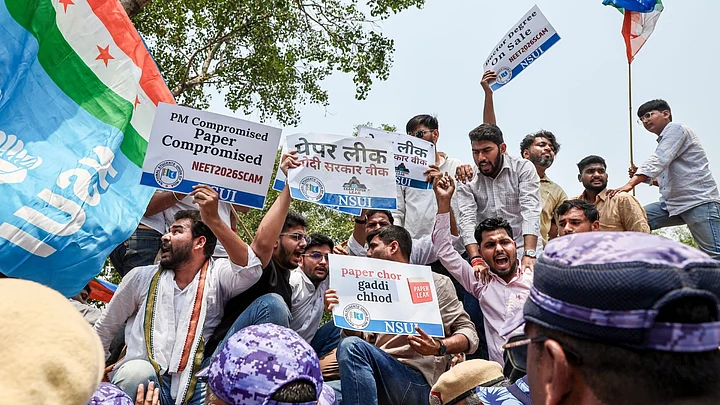
On 12 May, Tuesday, the National Testing Agency (NTA) made it official. In a statement issued with the approval of the Government of India, the NTA announced the cancellation of NEET-UG 2026, conducted on 3 May, citing inputs examined jointly with central agencies and investigative findings shared by law enforcement. The government has referred the matter to the Central Bureau of Investigation (CBI) for a comprehensive inquiry, directed to trace the leak from its suspected origin, a printing press in Jaipur.

Around 15 individuals have been detained. The alleged "guess papers" were reportedly being sold for as much as Rs 30 lakh. Evidence gathered suggests the material had reached a counsellor's mobile phone by 29 April, four days before the examination was held.

ADVERTISEMENTREMOVE AD

A Familiar Scandal

For the 22 lakh-plus students who appeared on 3 May, this is not an administrative inconvenience. It is a betrayal. What makes this moment particularly excruciating is the eerie familiarity of it all.

Please cast your mind back to 2024. NEET-UG was rocked by a paper leak scandal that triggered nationwide protests, Supreme Court intervention, and a CBI investigation. The then Director General of NTA was removed. The government constituted a high-level committee headed by former ISRO Chairman Dr K Radhakrishnan, and included former AIIMS Director Randeep Guleria, to recommend reforms to the examination process, data security protocols, and the agency's structure. Parliament was convulsed. The Education Minister took moral responsibility. Solemn assurances were given.

It is here that the Radhakrishnan committee's fate becomes a damning exhibit in its own right. Constituted in June 2024 and submitting its report in October that year (made public only six months later in April 2025), the seven-member panel produced 101 recommendations.

Its core proposals were unambiguous and sensible:

  • Transition NEET to online or hybrid computer-based testing

  • Eliminate centralised pre-printing of question papers through a "DIGI-Exam" system, where papers are generated securely at centres on exam day

  • Seal exam centres in the presence of district administration and police

  • Place a dedicated NTA presiding officer at every centre

  • Develop Kendriya Vidyalayas and Navodaya Vidyalayas as permanent computer-based testing infrastructure

  • Reduce dependence on private delivery agencies

  • Restructure the NTA's governing body with independent sub-committees overseeing audit, ethics, and transparency

What was actually implemented before NEET 2026? The NTA deployed GPS-tracked vehicles for paper transport and AI-assisted CCTV surveillance, steps that fall squarely within the existing pen-paper framework the committee had urged moving away from.

A facial recognition pilot using Aadhaar-based authentication was conducted at select centres.

The question paper, however, continued to be printed at a commercial press. The DIGI-Exam system was not in place. Structural governance reforms were pending. The transition to computer-based testing (CBT) had not happened. The committee had pointed to the exit; the government had decorated the door.

A High-Tech Security System Defeated by WhatsApp

The irony is particularly sharp. The NTA had, in its 10 May press release, listed its formidable security apparatus for NEET-UG 2026: GPS-tracked vehicles, unique watermark identifiers, AI-assisted CCTV surveillance, and biometric verification. All of it was real. None of it stopped a WhatsApp message sent on the evening of 2 May from unravelling the entire examination.

The breach, investigators now believe, originated not within the NTA's own controlled systems but at a printing press, upstream of all those technological safeguards.

Three things must change, and change now.

  1. Firstly, NEET has to be migrated to CBT. JEE Mains has been conducted in CBT mode for years. There is no principled reason why NEET, with randomised question sets and multiple sessions, should remain a pen-and-paper exam. The entire premise of a single physical question paper, printed weeks in advance and transported across the country, is an invitation to organised crime. The question is whether political will can overcome the resistance of those who benefit from the current opacity.

  2. Secondly, pre-printed centralised question papers should be eliminated. Even where paper-based formats persist, question papers must not exist as printable documents days before an exam. India needs encrypted, modular question banks where papers are generated at examination centres on the day of the exam through secure, auditable terminals, never at a commercial printing facility. The Jaipur printing press angle in this year's scandal is damning precisely because it reveals how far upstream the vulnerability sits, well beyond any security protocol the NTA can impose at exam centres. No amount of GPS tracking or biometric scanning at the venue can compensate for a compromised supply chain that begins weeks earlier at a private press.

  3. Thirdly, an independent statutory examination regulator has to be set up. The NTA operates under the Ministry of Education, subject to political cycles, bureaucratic pressure, and leadership churn that has now seen multiple Directors General removed or reshuffled mid-crisis. India needs a National Examination Commission with statutory autonomy, fixed-term leadership insulated from political interference, independent audit authority, and mandatory public accountability reporting. The Radhakrishnan committee reportedly made structural recommendations along these lines in 2024. It is past time that those moved from report pages to law.

Approximately 22 lakh students sat in examination halls on 3 May in good faith. Many had spent two, three, sometimes four years preparing. Their families made financial and emotional sacrifices that cannot be quantified. They did nothing wrong. They deserve not another CBI inquiry, not another high-level committee, not another solemn ministerial statement, but an examination system that simply works.

India has the technocratic talent, the policy tools, and the institutional knowledge to build that system. Let's do it right now. 

(Subimal Bhattacharjee is a Visiting Fellow at Ostrom Workshop, Indiana University Bloomington, USA, and a cybersecurity specialist. This is an opinion piece. The views expressed above are the author’s own. The Quint neither endorses nor is responsible for them.)

Speaking truth to power requires allies like you.
Become a Member
Monthly
6-Monthly
Annual
Check Member Benefits
×
×