
ADVERTISEMENTREMOVE AD

Why a Pause on Women’s Quota Bill Won’t Dent Mamata’s Core Support

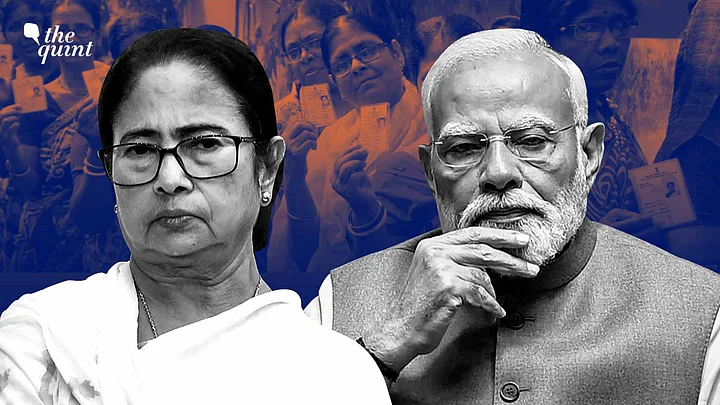
That Mamata chose to join forces with the Opposition is a testament to her political astuteness, writes Shuma Raha.

Published
story-hero-img
i
Aa
Aa
Small
Aa
Medium
Aa
Large

Last week the Narendra Modi-led NDA government’s attempt to ram through the delimitation of Lok Sabha seats based on the 2011 census by tying it to the implementation of the Women’s Reservation Bill was defeated in Parliament.

No doubt, the government believed that the strategy was a win-win for them. If the Constitution (131st Amendment) Bill went through, it would help the government realise its objectives, overriding the Opposition’s contention that a delimitation based on data from 15 years ago, and not on the Census that is being carried out now, would unfairly redraw the electoral map of India and would be detrimental to the southern, eastern, and northeastern states.

In case the Bill failed, however, the Opposition could be portrayed as having stymied the “operationalisation” of the Women’s Reservation Bill and, hence, betrayed the cause of women. And this could be a convenient political narrative days before the Assembly elections in West Bengal and Tamil Nadu.
ADVERTISEMENTREMOVE AD

Why Bengal Bears More Than Tamil Nadu

The shrewd politician that she is, Bengal Chief Minister and Trinamool Congress (TMC) chief Mamata Banerjee would have anticipated this gambit on the part of the Bharatiya Janata Party (BJP), a party with which she is locked in a do-or-die battle in the upcoming Assembly elections which gets underway on 23 April.

On paper, the narrative that the Opposition’s action is akin to “female foeticide”, as the Prime Minister put it so dramatically in his address to the nation on Saturday, 18 April, is of greater consequence in Bengal than in Tamil Nadu.

In the latter, the BJP is but a marginal player in the elections. But West Bengal is a different story.

The Special Intensive Revision (SIR) of electoral rolls in Bengal has deleted 63 lakh voter names (deceased or outdated) and another 27 lakh after the adjudication process. The Supreme Court mandated tribunals may add back only a handful of names to the voter rolls in the short time that remains.

Besides, multiple research have pointed out that in many areas Muslims, considered to be a big chunk of Mamata’s vote bank, are disproportionately high on the deletions list. Hence, the BJP smells a real chance this time, not least because the gap between the votes polled by the TMC and the right-wing party was about 65 lakh in the 2021 Assembly elections.

Consolidating Bengal's Women Voters

In this scenario, Mamata knows that she must do all she can to protect and consolidate her woman voter base which has stood by her in every election. Women accounted for 52 percent of the votes polled by the TMC in 2016. In the 2021 elections 50 percent of women voted for her party and only 37 percent for the BJP.

And yet, the TMC supremo joined hands with the Opposition to defeat the Constitution Amendment Bill, thereby risking the accusation that she has blocked the reservation of seats for women in Parliament and should therefore be seen as anti-women.

Did she do it because she felt that she must stand with the Opposition in its effort to thwart the BJP’s attempt to carry out a hasty delimitation exercise piggybacking on the emotive Women’s Reservation Bill which was passed in 2023?

Or did she do it chiefly because she knew that the anti-women charge against her will simply not stick?

The reason is probably a combination of both.

Women voters have emerged as an enormously influential bloc in Indian elections. Mamata understood the trend early on and has nurtured this base for years with a plethora of welfare schemes for women such as Lakshmir Bhandar, Kanyashree, and so on. In February this year, the monthly payout to eligible women under Lakshmir Bhandar was increased to Rs 1,500 a month for the general category and Rs 1,700 for the SC/STs.

The BJP has been going all out to chip away at this base.

Although it has refrained from launching personal attacks against her this time—the snarky, distinctly off-colour Didi, O Didi” cry by the Prime Minister did not go down well in 2021—it is trying its best to project her administration as an enabler of atrocities against women.

The accusations of land grab, molestation, and rape by TMC functionaries in Sandeshkhali in North 24 Parganas in early 2024, and the rape and murder of a junior doctor in RG Kar Medical College in Kolkata in August the same year have been held up as proof of her government’s gross ineptitude at best and complicity at worst when it comes to tackling crimes against women.

The BJP has even given a ticket to the victim’s mother, no doubt in an effort to rekindle the widespread feeling of disaffection against the TMC government that led to huge street protests in the wake of that horrific crime.

ADVERTISEMENTREMOVE AD

BJP's Charge Lacks Credibility

However, public memory is short. Mamata knows this. She also knows that the BJP’s poll promise of Rs 3,000 cash transfer to women may not carry the same weight as the payouts from her own welfare schemes. Their proven track record may seem much more authentic to women than the blandishments of a newcomer.

Again, no matter how hard the BJP pushes the narrative that Mamata is opposed to the reservation of 33 per cent seats for women in Parliament, the charge will lack credibility given that 11 out of the 28 MPs from her party in the Lok Sabha are women (37 percent), as are 6 out of 13 MPs in the Rajya Sabha (46 percent).

In the past, the TMC has often chosen not to vote with the Congress and other members of the Opposition in the Lok Sabha.

For example, in February this year, the party abstained from signing the resolution to remove the Speaker Om Birla from his post.

That Mamata chose to join forces with the Opposition this time to nix the Constitution Amendment Bill is a testament to her political astuteness. Perhaps she surmised that it would have no impact on her positive image amongst the women voters of West Bengal. On the contrary, it would show Bengal’s electorate that it is easy to vanquish the BJP—on the floor of the House, and at the hustings.

(Shuma Raha is a journalist and author. This is an opinion piece and the views expressed are the author's own. The Quint does not endorse or is responsible for them.)

Speaking truth to power requires allies like you.
Become a Member
Monthly
6-Monthly
Annual
Check Member Benefits
×
×