
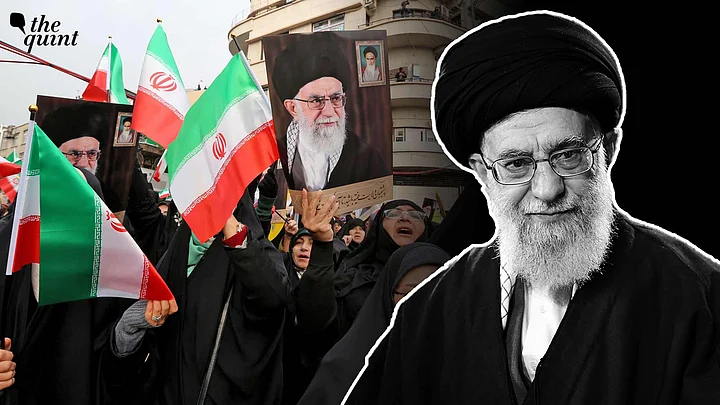
I used to joke with my Shia friends in Kargil in years past that, if Ayatollah Khamenei told them to jump off a cliff, they would do it. The response would often be a grin, a shrug, and: "Of course."
Khamenei, who was killed in a war strike by the US and Israel on Sunday, was arguably the second most highly respected Shia religious leader in the world (quite apart from his political position in Iran). His killing will have repercussions.
There have already been spontaneous peaceful protests in various parts of India, including Kashmir and, of course, Lucknow. It would be a mistake to underestimate the depth of sentiment on this topic among devout Shia everywhere.
A Shia pir from Kashmir said, "We have always been peaceful, and our processions are peaceful. (It’s just that) the world should know what a great personality has been killed. He was a spiritual leader of the highest level."
The fact that Iran had agreed in back-channel talks to reduce its stockpile of nuclear materials to zero—as Oman’s foreign minister has revealed—will give the attack the colour of an even more immoral and untenable move in the eyes of Iran’s backers. For, the stated aim of the US and Israel is to prevent Iran from acquiring a nuclear weapon.
It is pertinent to note that there is a widely known legend among Shias that a great war between forces of good and evil is to be fought between armies based out of the Levant and Iran—the latter led by a figure such as Khamenei—which would pave the way for (prophecies regarding) the end-times to unfold.
Political Hot Potato
The attack has even entered the realm of politics. The Viduthalai Chiruthaigal Katchi (VCK), a relatively small but dynamic political group of Tamil Nadu, tried to blockade the US consulate in Chennai soon after the news of Khamenei’s death spread. It did so in alliance with a Chennai-based Shia organisation.
The Ambedkarite party draws enough support from Dalit voters to be a vital ally for larger political parties in Tamil Nadu. The fact that its cadres mobilised almost immediately indicates the strength of sentiment among Shia citizens in that city.
The Shia population is estimated to be no more than half of one per cent of the total population of Tamil Nadu. More significant is the fact that many Shia in Chennai are from the Bohra trader community, which is among the least radical, and therefore least likely Muslim communities in the country to take to agitation.
The fact that there was nevertheless an agitation is an indicator of how deeply the killing of the Ayatollah, and the attack on Iran, has affected some citizens.
A key fact to keep in mind is that memorialising martyrdom is the key to Shia praxis. Shia around the world beat their chest ritually during the month of Moharram in memory of the brutal killing of Imam Hussein, the grandson of the Prophet Mohammed. We are halfway through Ramzan now, which means that Moharram is about four months away.
Already, over the past few years, Shias around the world, including Kashmir, have memorialised General Qasim Suleimani as a martyr, killed by Israel. Posters with his portrait have been common in Shia-dominated localities in Kashmir, particularly around Moharram.
Unlike Iraq or Libya
War strategists among the attackers may have figured that the result of killing Khamenei would be similar to the decapitation of the top political leader in Iraq and Libya over the past 23 years: chaos in that country, many deaths, prolonged warfare, and hugely inflated profits for manufacturers of arms, equipment, and supplies.
In both Iraq and Libya, consequent violence was limited to the country which had been attacked. Citizens of the country suffered terribly as the economy collapsed, and millions died, but the rest of the world was largely unaffected. The trajectory of this war is already different.
Iran has demolished parts of Dubai and targeted US bases in the region, and a UK military base in Cyprus. Airports and hotels as far afield as India have been affected.
Although President Donald Trump has promised that the war will end in four weeks, that statement could turn out like George W Bush’s "Mission Accomplished" speech soon after the invasion of Iraq. That war lasted years; this war zone could expand dangerously.
Russia could take the opportunity to indirectly hit back against the North Atlantic Treaty Organisation (NATO), which it has been fighting in Ukraine—directly, as Russian strategists see it. Depending on what kind of missiles and warheads Russia might send to Iran, the war could reach Europe and even England.
China has already been supplying Iran crucial intelligence and other support in recent months. It may step up its support, especially if Iran keeps oil and gas supplies going.
Political and Economic Impact
India has traditionally maintained good relations with the gamut of broadly Muslim countries, and has had especially good relations with Iran. For its part, that country backed India on matters such as the Kashmir issue at crucial junctures, for eg., at the 57-nation Organisation of Islamic Cooperation (OIC).
However, since Prime Minister Narendra Modi visited Israel, and was celebrated there by the ruling right-wing government, just a couple of days before the attack, Iran is likely to see India as ranged against it at this crucial juncture.
Shia Indians are among the most patriotic communities in the country, but there is very real distress among them at this point. Their concerns ought to be addressed with a healing touch.
The economic consequences could also be problematic. A closure of the Strait of Hormuz could hit India’s economy more than any other. Iran might allow Russian and Chinese ships to cross the Strait, but is unlikely to make an exception for others.
If Iran is able to sustain warfare, and just in case Russia and China get drawn in in one way or another, Sunday’s attack could even mark the beginning of a larger conflict than almost anyone would want. Let us hope Israel takes heed of Prime Minister Modi’s message urging that this war be ended quickly.
(The writer is the author of ‘The Story of Kashmir’ and ‘The Generation of Rage in Kashmir’. He can be reached at @david_devadas. This is an opinion piece and the views expressed above are the author’s own. The Quint neither endorses nor is responsible for the same.)
