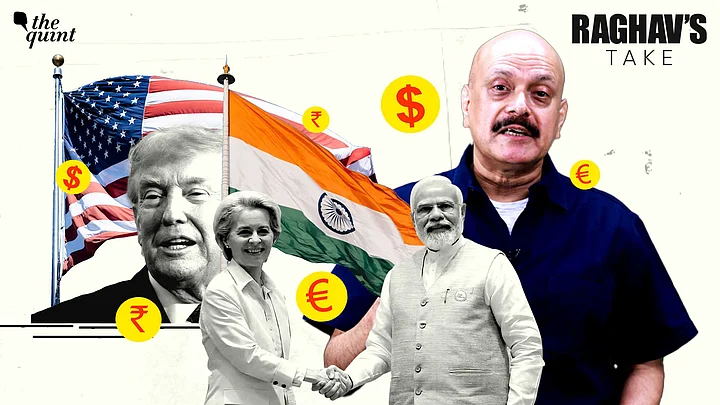
I had used ghamasan, the graphic Hindi adjective that organically combines violent verbiage and nettlesome turbulence, to describe the slugfest over a crumbling rupee and record GDP growth.
But now, a much bigger ghamasan has broken out over the “framework” within which America and India intend to close an Interim Agreement followed by the final, legally binding Bilateral Trade Treaty.
The naysayers are having a field day, accusing the government of a weak-kneed sell-out to Uncle Sam:
India has thrown open industry, agriculture, and energy sectors, while the Yanks have simply removed the punitive tariffs of 25 percent, retaining the levy at 18 percent vs the 2-3 percent that existed in the pre-Trump era. So, they’ve increased tariffs six-fold, while we have dropped to zero across a range of sensitive items.
India is going to treble its American imports, from $50 bn to $150 bn every year, while America has made no reciprocal commitment to buy beyond the $85 odd billion that they currently purchase from us. So, we’ve hung an annual $65 bn trade deficit/millstone around our neck.
America will “police” India’s Russian oil imports; if we fail to cut, the Yankee policeman can handcuff us again with punitive tariffs.
India shall remove licensing restrictions and non-tariff barriers, including the price cap on critical medical devices, but Washington has given no concession on our agricultural and pharma exports.
Critics keep on digging up new infirmities, while supporters herald it as the revolutionary dawn of “India, the global manufacturing powerhouse”.
What both sides refuse to acknowledge is that the impact/outcome of a Free Trade Agreement (FTA) is notoriously difficult to predict or quantify.
Super Opportunity or Crippling Threat?
The pro-Modi cohort believes the US and UK/EU FTAs are an unmitigated win-win (the father and mother of all trade deals!), i.e, a foregone conclusion of mutual prosperity. But that’s naive. An FTA is both a super opportunity and a crippling threat.
So, whether a country scoops up a big export surplus or gets drowned under an import deluge is a challenge that must be taken head-on by creating efficiencies, competitive tax policies, and a climate of unbridled de-regulation/reforms. If a country fails to do that, an FTA can break its back.
Here’s an enchantingly squiffy example of Brut sparkling wine (exotic white wine, to explain to the unfortunately uninitiated):
The top-end locally produced stuff from Nashik is priced at about Rs 1,500 per bottle.
Prior to the EU trade deal, a middle market, ie neither supermarket nor premium grade, French Brut sparkling wine cost about Rs 3,000. But now the 150 percent duty has been slashed to 20/30 percent.
So, its price will crash to about Rs 1,500, equal to the locally produced wine! And it gets worse for the domestic guys since the duty on Californian wine could plummet to zero, allowing it to be priced at Rs 1,000.
Almost every tippler I know will opt for the Californian or French wine, ignoring the similarly priced Indian concoction. Which will force the Indian producer to sell at Rs 750 to remain competitive. But is that a viable ask? Will the local guy increase efficiencies to such an extent that he can drop the price by half, and yet remain profitable? Or will he simply shut shop?
That’s the conundrum of an FTA. It’s either a super opportunity or a crippling threat. It’s naïve to believe it’s always, automatically, a win-win proposition for both trading countries. Ask the poor wine producer in Nashik!
Since I am not a prophet, I am unable to take sides in this ghamasan over the American trade deal. I prefer to look for answers by pivoting to history, i.e, to those historical situations when India “gambled” with a seismic inversion of economic policies—how did we cope when threatened by a commercial apocalypse? Did we capitulate or triumph?
Lessons From Bombay Club, Badla Ban, and GST Profiteering
Do you remember the Bombay Club from the early 1990s, when India’s industrial titans carped at the dramatic liberalisation of foreign trade and investments? Rahul Bajaj was fearful about a “free for all”. Ratan Tata begged for “proper safeguards”. Kumar Birla felt “vulnerable”. Hari Shankar Singhania thought our domestic champions would lose to “foreign domination”.
But look what happened. Bajaj Auto exploded from Rs 1,500 crore to nearly Rs 50,000 crore, becoming a global leader in motorcycles. Bajaj Finance spun out from a tiny captive unit to a marquee non-bank finance company touching another Rs 70,000 crore in revenue.
The Tata Group took flight, multiplying revenues a hundred times, from Rs 15,000 crore to over Rs 15 lakh crore! Buying Corus, Jaguar Land Rover, and Tetley in the land of our former colonial masters. Kumar Birla, who was a tad more conservative, nonetheless blew the lid in aluminium, cement, and lifestyle retail. His Hindalco bought Novelis (US) for $6 billion, to leave competitors lagging way behind.
Now, let’s turn to another “dreaded” structural change. In 2001, the Securities and Exchange Board of India (SEBI) banned badla trading to separate the cash and forward stock markets. All hell broke loose. RH Patil, former Chairman of National Stock Exchange (NSE), bemoaned that it will “cause more harm than good”.
Hemendra Kothari, Chairman of DSP Merrill Lynch, felt choked as the ban “was taking away the oxygen from the market”. Rakesh Jhunjhunwala gasped at the “vacuum”.
But look what happened. Patil’s NSE has become the world’s largest derivatives exchange. Kothari’s DSP is a bell-weather investment bank. And the late Jhunjhunwala is feted as India’s Warren Buffet.
They had thought the badla ban would be Armageddon. What a delicious irony!
My third and final example. India’s tax system was radically overhauled by the introduction of GST (Goods and Services Tax) in 2017. Experts panicked that companies would not pass the price cuts to consumers. Finance Minister Arun Jaitley wanted to “carefully monitor”.
Raghuram Rajan, then Governor of the Reserve Bank of India (RBI), was scared that “prices will not fall as expected”. Nirmala Sitharaman, current Finance Minister, was alarmed that companies would “raise margins”. So, these worthies decided to create an anachronistic body called the National Anti-Profiteering Authority (NAA).
But look what happened. NAA failed miserably in detecting or penalising any “profiteering” by renegade companies.
India’s competitive markets did not allow any such distortion to sustain. Our policy pundits should have known better. Mercifully, and sheepishly, the NAA was wound down a few years later, obliterated from the policy books.
For me the above lessons of history are compelling. If the government “gets out of the way”, i.e, honestly/aggressively deregulates and transparently enforces fair/competitive policies, India’s entrepreneurs will take foreign competition head-on. Whether it’s the mother or father of all deals!
But if the government becomes intrusive and opaque, all bets are off.