
ADVERTISEMENTREMOVE AD

India Thought Mustafizur Rahman Was an Easy Scapegoat. But Was He?

India's cricket politics is spilling out of the boundaries.

Published
story-hero-img
i
Aa
Aa
Small
Aa
Medium
Aa
Large

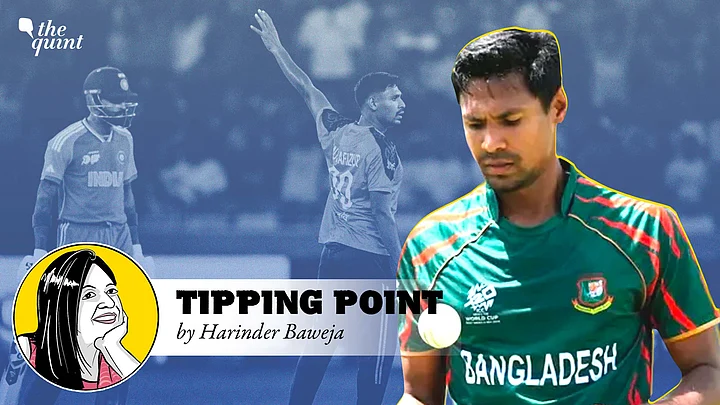
His name is Mustafizur Rahman, and he sure knows how to bowl. The left-arm pacer has statistics to back his prowess. He has played 60 Indian Premier League (IPL) games and taken 65 wickets in the Indian Premier League in the last decade. He suddenly finds himself at the centre of a controversy that is now spinning out of the cricketing arena.

A decade ago, Rahman won the ‘Emerging Player of the Tournament’ award but none of that counts. What counts, in 2026, is that he is from Bangladesh, where members of the minority Hindu community have been lynched. The moment news broke of Rahman being bought for Rs 9.2 crore by actor Shah Rukh Khan’s Kolkata Knight Riders (KKR), the decibel was raised—as it so nauseatingly is—on social media and the Board of Control for Cricket in India (BCCI) lost its nerve and its supine spine.

KKR was forced to let go of the bowler and the BCCI—and the government by extension—now finds that it has been ‘hit wicket’. Bangladesh has not taken kindly to India sourcing the nuances of foreign policy to social media outrage.

The Bangladesh Cricket Board has now stated officially—through youth and sports advisor Asif Nazrul—that its cricket team will not travel to India for the T20 World Cup, scheduled to begin in the first week of February. It wants to play the four matches against India in Sri Lanka.

ADVERTISEMENTREMOVE AD

Un-fair Play

Cricketing tournaments have always served as great ambassadors for people-to-people contact. Of late, however, they have become barometers on which hyper-nationalism is measured. The hyper-nationalism, in turn, is being honed as political ideology and also being crafted as electoral strategy. The elections in West Bengal—where Mamata Bannerji has stood steadfast against the Bharatiya Janata Party (BJP)—let’s not forget, are due in a few months. A new government will have to be in place by 7 May 2025.

But should sports become a pitch for politicians to play on? Should the 'gentleman's game’ (it now also belongs to women) be allowed to be hijacked by electoral arithmetic that allows communal divisions to be deliberately deepened?

BCCI secretary Devajit Saikia made no bones about why KKR had been instructed to let go off Rahman. “Due to recent developments,’’ he had said, referring to the violence against Hindus in neighbouring Bangladesh.

Saikia is only a functionary of the body that governs cricket. The game had already been converted into a blood sport during last year’s Asia Cup when India and Pakistan faced each other three times; when Indian captain Surya Kumar Yadav refused the customary handshake with his counterpart Salman Agha. And after winning the final, India refused to accept the trophy from Asia Cricket Council chief Mohsin Naqvi because he is also the chief of Pakistan’s Cricket Board (PCB) and Pakistan’s interior minister.

The political ‘sixer’ was hit by Prime Minister Narendra Modi who celebrated India’s victory through a tweet on 29 September 2025, that read, "#OperationSindoor on the games field. The outcome is the same—India wins! Congrats to our cricketers.” 

Modi was referring to the four-day aerial conflict between India and Pakistan after the brutal killing of 25 tourists at Pahalgam’s Baisaran meadow on 22 April last year.

A Political Pitch

Neither Modi, nor anyone from the BCCI or the International Cricket Council (ICC) were willing to answer the question of why India and Pakistan were allowed to play cricket when the Prime Minister had, while scrapping the Indus Water Treaty, said in no uncertain terms that “blood and water” cannot flow together. 

At the time, I had, in a column for this very platform asked why cricketers were being made to carry the weight of nationalism. “The men in blue take the field to play a good game of cricket. Getting them to keep their hands to themselves—while the BCCI has its hand in the till—lacks grace and sportsmanship. Converting cricketers into political missiles is plain wrong. That’s not why they chose to wield the bat or the ball,” I had written.

This time, it has become about the men in green and the ICC will have to decide whether Bangladesh can face off with India in Sri Lanka, just like India and Pakistan’s team will. Actually, it has become about more than just cricket because the sport is coming in the way of a complex India-Bangladesh relationship, at a time when it seemed like the two sides were treading carefully to end the standoff that started with Sheikh Hasina fleeing Dhaka and taking refuge in New Delhi, after a furious Gen Z uprising.

Only last week, foreign minister S Jaishankar had met and shaken hands with Bangladesh Nationalist Party’s (BNP) chairperson Tarique Rahman, son of former Bangladesh prime minister, Khaleda Zia. The son had, in fact, set the tone for rebuilding the frayed relationship between the two countries. He had spoken out against the attacks on minorities (Hindus in Bangladesh) and at a rally said, “This country is home to hill communities and people of the plains, Muslims, Hindus, Buddhists and Christians. We want to build a Bangladesh where everyone feels safe.”

Men in Blue, Green and Saffron

Both India and the BNP—as well as the interim government led by Dr Muhammad Yunus—appeared to be on the same page; each working towards bringing democracy back on the rails in Bangladesh, while also trying to repair the bilateral relationship. The diplomats and politicians were working hand-in-hand to keep the radical Jamaat-e-Islami at bay in the forthcoming elections to be held in Bangladesh on 12 February.

The outrage over the selection and removal of Mustafizur Rahman has queered the pitch. That’s the problem with outrage: it is quick to manufacture and difficult to contain.

In an interview with The Indian Express, Congress Parliamentarian Shashi Tharoor called the pacer’s exclusion, “absolutely appalling”. When asked if cricketing ties between India and Bangladesh would also reach a stage where the two would not compete in one-on-one bilateral series, just like India and Pakistan, Tharoor was vocal.

Tharoor, who also heads the Parliamentary Committee on External Affairs, said:

“No, Bangladesh is not Pakistan. Bangladesh has not been dispatching terrorists across the border. It’s not a comparable situation at all. And besides, our relationship with the two countries is also different. And the stage of our negotiations or our diplomacy with Bangladesh is different from our relationship with Pakistan. You cannot make a simple equation between the two."
Shashi Tharoor

The irony is inescapable. India cited global protocols and the need to play by the rules when it came to international matches with Pakistan, even after the Pahalgam attack. Let us not fool ourselves. Let’s call a spade a spade.

India thought Mustafizur Rahman was an easy scapegoat. But is he? The answer to that question will also determine the future of India-Bangladesh’s sporting and political ties. 

Postscript: India needs to look at the mirror. All hate crimes are abhorrent. Let the BCCI, the ICC, and its political masters tell us how they might react if a cricketing nation gets up tomorrow and points a finger at how we treat members of our minority communities.

Let it answer another question. Bangladesh’s T20 cricket team is led by the talented Litton Das, a Hindu. Would the outrage have been the same if he was available and had been chosen for the IPL?

(Harinder Baweja is a senior journalist and author. She has been reporting on current affairs, with a particular emphasis on conflict, for the last four decades. She can be reached at @shammybaweja on Instagram and X. This is an opinion piece and the views expressed are the author’s own. The Quint neither endorses nor is responsible for them.)

Speaking truth to power requires allies like you.
Become a Member
Monthly
6-Monthly
Annual
Check Member Benefits
×
×