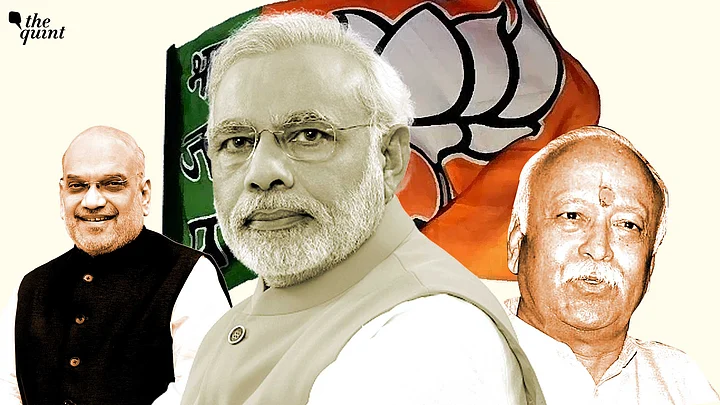
History has a nasty way of coming back to bite. The Bharatiya Janata Party (BJP) would do well to remember this as it attempts to puncture the Opposition’s campaign against the Election Commission’s flawed Special Intensive Revision of electoral rolls with accusations of destabilising the country through demands for "regime change."
Here’s a strong reality check from the BJP’s own past. Perhaps the biggest and most well-known protest movement in independent India was led by Jayaprakash Narayan in the mid-1970s.
India Isn't Indira
The BJP in its earlier avatar of Jan Sangh, the Rashtriya Swayamsevak Sangh (RSS) and its student wing Akhil Bharatiya Vidyarthi Parishad (ABVP) were an integral part of the JP movement (as it was popularly known), with many of their leaders thrown into jail after midnight raids on their residences following the imposition of the Emergency by then prime minister Indira Gandhi on 25 June 1975.
What began as a student protest against mess fees hike in Gujarat in December 1973 quickly snowballed into a movement across north India for regime change.
The BJP must surely remember the defining slogan of those heady times, coined by poet Ramdhari Singh Dinkar containing a dire warning for Indira Gandhi: "singhasan khaali karo, ki janta aati hai."
The slogan rent the air at a mammoth rally addressed by JP in Ramlila Grounds on 24 June (the day before Emergency was imposed) where he called on the public to surround Indira Gandhi’s house and prevent her movement. He also urged the police and armed forces (police aur sena, were his exact words) to disobey orders that were unconstitutional.
Top Jan Sangh leaders Atal Bihari Vajpayee and Nanaji Deshmukh were present at the rally along with RSS and ABVP workers as well as leaders from other opposition parties.
The Modi That Was
Meanwhile in Gujarat, Narendra Modi, then a young RSS pracharak assigned to mobilise the ABVP cadre against the Congress government, was right there in the thick of all the action.
His message to the youth of that era was recently reproduced in the Ahmedabad-based English daily, Ahmedabad Mirror.
"Children of Bharat Mata, think in what direction the country is being pushed into today. If you don’t act today, take a moment to ponder the consequences you will have to face tomorrow...
Today’s poverty, unemployment, illiteracy, corruption and oppression will be a cross you will bear...
The way democracy is being destroyed today in the country to pave the way for dictatorship, you will be the herd of sheep that will be walked head down...
You will have to pick up the appropriate weapons after identifying the opponents. If you don’t step up, this Indian revolution will be rendered directionless.’’
The Modi That Is
The irony is stinging and the contrast glaring. The messaging from the Modi government and the BJP to the Cockroach Janta Party and Gen Z during the the Jantar Mantar 1.0 and Jantar Mantar 2.0 protests has been ruthless: police brutality, heavy barricading, prohibitory orders, detentions and arrests.
Yet, in 1974-75, Narendra Modi himself was urging students and youngsters to take to the streets and do whatever is necessary to save democracy. Surely Narendra Modi has not forgotten his provocative words from that era.
And BJP leaders like union defence minister Rajnath Singh, who are slamming opposition parties, CJP leaders and Gen Z today as "anti-national" and accusing them of trying to topple the Modi government with their anti-SIR protests, should take time off to read a book bearing the title Sangharsh Ma Gujarat (Gujarat in a period of trial) which has reproduced the entire text of Modi’s hardhitting message to the youth of that time.
False Equivalences
The PM, Rajnath Singh and other elders of the BJP and RSS would also recall that the JP movement had many violent moments, quite unlike the largely peaceful protests today. In fact, the first spark which ultimately led to JP’s pro-democracy agitation was a violent eruption in the Morbi Engineering College near Ahmedabad.
Agitated over a steep hike in mess fees, students of the college went on a rampage, smashing classrooms and administrative offices and seriously damaging the laboratory. The college was shut down indefinitely and several students were suspended.
As protests spread from Gujarat to Bihar, they left a trail of destruction in their wake. Flash mobs of workers, student activists (including from the ABVP) and ordinary citizens set fire to buses, looted banks and vandalised government offices.
This scale of violence has not been seen in the current protests so far, although the BJP has been trying to draw comparisons with ongoing riots across Europe and labelling the anti-SIR agitation leaders "anarchists."
There is no limit to false equivalences. India is not Europe. Nor is it Nepal or Bangladesh, which saw governments toppled by violent street movements.
Still a Democracy
Regime change in India has always occurred through the ballot and there is no reason to suspect that this democratic tradition will change. Neither Bangladesh nor Nepal have a long history of peaceful transition through elections like us.
There are strong echoes from the BJP’s past in the protests unfurling on the streets across the country. Ironically, the response of the BJP government is uncannily similar to Indira Gandhi’s.
She had repeatedly invoked the involvement of a "foreign hand" in stoking the JP movement. She was hinting at the CIA.
Today, Modi government leaders and spokespersons are trotting out the same line as they accuse Rahul Gandhi of taking directions from American billionaire George Soros who is a major donor to progressive and democratic causes around the world.
Indira Gandhi had no proof for claims of "foreign hand," much like the current government lacks any kind of evidence to claim linkages between Rahul Gandhi and George Soros.
The Ghost of Emergency
The protests of 1974-1975 toppled two state governments. Indira Gandhi bowed to public pressure and replaced her chief ministers in Gujarat and later in Bihar.
But it took nearly four years for the JP movement to achieve its ultimate goal of regime change at the centre. The protestors fought street battles with the police and finally suffered what must remain the darkest period in our history: the imposition of the Emergency on 25 June 1975.
Opposition leaders were imprisoned, democratic rights were suspended, the media was censored. Yet, the momentum the movement had generated before the Emergency did not fizzle out.
When Indira Gandhi finally lifted the Emergency on 21 March 1977 and called a general election, the Congress suffered a humiliating defeat. It was wiped out across north India and Indira Gandhi herself was routed from the family stronghold of Rae Bareli in Uttar Pradesh.
Is this what the Modi government and the BJP are afraid of, that history may repeat itself with tragic consequences for them?
(Arati R Jerath is a Delhi-based senior journalist. She tweets @AratiJ. This is an opinion piece, and the views expressed above are the author’s own. The Quint neither endorses nor is responsible for the same.)