In an assertion of an unprecedented electoral dominance, the Bharatiya Janata Party (BJP) is on the verge of uprooting the 15-year-long rule of the Mamata Banerjee-led Trinamool Congress (TMC) in West Bengal. With an unassailable lead in 192 Assembly seats at the time of writing, the BJP has succeeded in demolishing the citadel of the regional power centre in Kolkata.
For the BJP, the 2026 West Bengal Assembly elections came as a “now or never” opportunity to assert its sweeping dominance across the contiguous "west to east" of India.
While Mamata Banerjee, after her third term, seemed vulnerable to the BJP, the latter also appeared to be in do-or-die mode. Assured of its position after a strings of wins in state polls following its 2024 Lok Sabha slip-ups, the BJP was convinced from the start that 2026 would be the best opportunity to put a saffron colour on the streets of Kolkata.
Two to Tango: Team RSS-BJP Wins Bengal
The stage was set by Rashtriya Swayamsewak Sangh (RSS) Sarsanghchalak Mohan Bhagwat, who became a regular visitor in the state starting early 2025. The RSS also timed prioritising the issue of "demographic change" in the border areas almost 18 months ahead of the West Bengal Assembly elections.
The RSS has been keen to gain political alignment across the international border length—from Manipur to West Bengal. Some of the overt signs of the strategy came through the intensity of conferences in Assam, even as the RSS sought after intellectuals and public figures to shapen the narrative.
Prime Minister Narendra Modi fully backed the RSS, spotlighting the issue of demography in the border areas in his Red Fort speech last year.
The issue of demography, in fact, brought the RSS and the BJP working together as a team in West Bengal, with an aggression not seen in any other state yet.
Pivoting the Perception War
The BJP’s core team singled out its 2021 electoral loss in Bengal state polls to its lack of "people connect".
After winning big in the 2019 Lok Sabha elections, the BJP had given away the gains two years later in the state polls, with the party admitting internally that the people didn’t believe that it could indeed come to power in Kolkata. That kept the people away from voting aggressively in favour of the BJP, per the party’s poll strategists.
The Special Intensive Revision (SIR) undertaken by the Election Commission of India, according to the BJP leaders, finally brought a sense among the people in West Bengal that Mamata Banerjee could lose the elections.
Massing a substantial number of the paramilitary forces further added to the changing perception in the state.
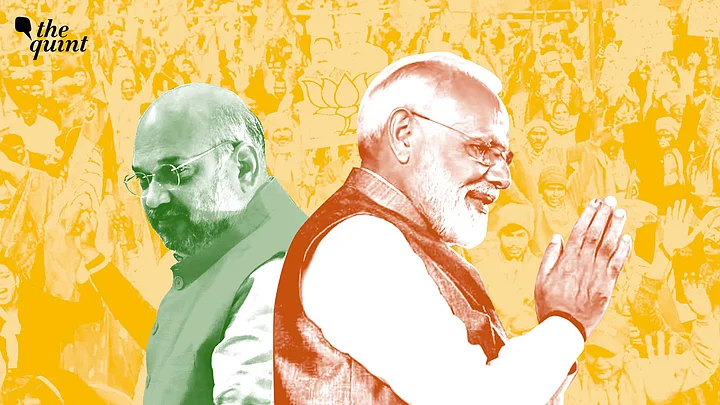
To further stamp the seal of an undiluted determination, Prime Minister Modi and Union Minister for Home Affairs Amit Shah almost made West Bengal their homes for the past month—electioneering in a manner that conveyed seriousness.
Closing the Ranks in a Faction-ridden State
The West Bengal BJP unit has gained notoriety within the party as a highly faction-ridden outfit. Shah’s backing of Suvendu Adhikari, a turncoat and saffron import from the TMC, had been facing resistance from the old hands of the party in the state. This worried the BJP the most. In the 2024 Lok Sabha elections, the BJP’s tally came down from 18 to 16 seats with about 39 percent vote share.
The faction-fighting was also explained as a reason for some of the leaders quitting the party to join the TMC.
To deal with the issue firmly, Shah took control of the poll preparations himself. A series of meetings at his residence in Delhi helped the party work out the unity mantra—Adhikari as the face, ticket distribution controlled fully by the central BJP, and the direct involvement of Shah in overseeing the affairs of the party in West Bengal.
Consolidating TMC's Core Voters
While the BJP put the party’s strategy into action, the dispatches it received from its leaders on ground from the state made it aware of a major gap in its vote banks—women voters. The BJP had marched into the West Bengal elections after scoring a big win in Bihar. The party’s central election strategists believed that Bihar and West Bengal presented a similar electoral turf. But, they found to their alarm, West Bengal and Bihar were poles apart in their political outlooks.
To deal with this, the BJP strategists tested the waters by trying to revive the women's reservation debate in Parliament and legislature, already passed by parliament, as an issue. The objective was to put the TMC in a spot if Mamata Banerjee were to oppose it.
The idea sailed. A package of three Constitution Amendment Bills came before the Lok Sabha. The BJP’s ploy was to portray the TMC as a villain in stopping the women’ reservation in legislature, and the verdict suggests that the party strategists may have been right in their calculations. The rest is history.
Overcoming the 'Bengali Identity' Question
The BJP first arrived in the West Bengal elections as a flagbearer of the Sanatana Dharma, which is usually invoked by hordes of fringe elements promoting vegetarian food habits.
Besides, the BJP’s lack of a leader of stature from West Bengal made the party’s leadership at the top unfamiliar with distinctive Bengali culture—in naturally relating with icons and their legacies.
To further make the BJP’s task more cumbersome, Mamata Banerjee brought the issue of fish eating to the centre stage. That left the BJP till the final days of electioneering in defence mode, with leaders partaking sumptuous rice and fish curry dinners.
Assam’s Himanta Biswa Sarma even challenged the West Bengal CM for a fish-eating competition. But the episode in the end proved to be an entertainment sidelight in West Bengal.
Indeed, Prime Minister Modi tried his best to take an upper hand in the war of perceptions. His outreach directly to the people with ‘Jhaal Murrhi’, Mandir Darshan, boat ride, and other antics were meant to put his personal signature on West Bengal’s election script and a means to counter Didi's 'anti-Bengali' narrative.
The Bihar verdict had already given a shot in the arm to his personal appeal in politics. In the end, the BJP succeeded in convincing the people that Modi and Shah will deliver on “double engine” slogan in West Bengal.
(The author is a senior Delhi-based journalist, with over two decades of political reporting for India’s leading English dailies. This is an opinion piece and the views expressed are the author's own. The Quint does not endorse or is responsible for the same.)