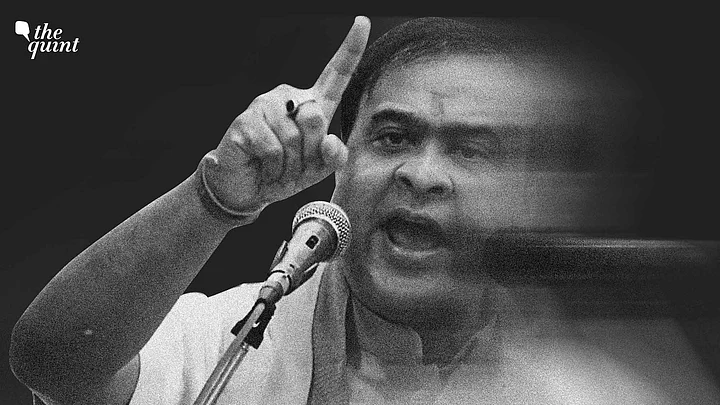
Assam is not merely waiting for an election result. It is waiting to see whether a particular style of politics has been rewarded again.
If Himanta Biswa Sarma wins again, the outcome will not simply mean another term for a chief minister. It will signal something deeper: that a politics built around suspicion, religious identity, and demographic anxiety, often accompanied by the repeated othering of minorities, has found electoral approval.
That is why the Assam result cannot be read only through the usual language of seats, alliances, and welfare schemes. It must also be read as a test of political morality. What happens when a campaign does not merely ask people to vote, but also asks them, subtly or explicitly, to imagine some citizens as threats?
Hate Speeches and Politics of Polarisation
Over the past few years, Assam’s politics has shifted from questions of governance to questions of belonging. Terms like "outsiders", demographic change”, and “illegal infiltrators” have not remained at the margins; they have entered the centre of political speech. The phrase “Miya”, often used pejoratively for Bengali-origin Muslims, has become part of everyday political vocabulary. Media reports also show that even some supporters of the government are uneasy with this language. That discomfort matters, not because it stops polarisation, but because it shows how little it takes for it to persist. Voters may not approve every remark; they may still reward the leader who makes them.
This is how polarisation works when it succeeds. It does not require unanimous agreement. It requires only enough acceptance.
Assam’s polarisation is also not a sudden, election-time invention. It has been built over the years, through a familiar vocabulary: land, migration, citizenship, identity, and loyalty. The minority citizen is repeatedly placed under scrutiny, asked, directly or indirectly, to prove that they belong, that they are not a demographic threat, that their presence is not a political problem.
The legal developments around alleged hate speech reflect the difficulty of responding to this shift. Petitions seeking action against statements by the Chief Minister reached the Supreme Court of India, which directed the matter to the Gauhati High Court. The case remains pending. This is not unusual. Courts move cautiously; procedure takes time.
But that gap between political speech and legal response is precisely the problem. When the law moves slowly and politics moves fast, the speech often does its work before it is examined. Narratives settle. Perceptions harden.
A recent Supreme Court ruling on hate speech makes the point sharper. The court has indicated that there is no clear legislative vacuum and that existing criminal laws can address hate speech, while also pointing to concerns about inconsistent enforcement.
In other words, the issue is less the absence of law and more the failure to apply it evenly. If the law exists but is not applied consistently, the question is no longer purely legal. It becomes political: whose speech attracts attention, and whose does not.
The Pawan Khera episode adds to this unease. Following remarks concerning the Chief Minister’s family, criminal proceedings were initiated in Assam. The Gauhati High Court declined anticipatory bail; the Supreme Court later granted him anticipatory bail, effectively overturning the Gauhati High Court’s refusal of pre-arrest protection. Whatever one makes of the merits, the episode raises a larger question. When speech against those in power invites swift action, while speech from power remains entangled in the process, enforcement begins to appear uneven.
Uninclusive Policy and Legislation
This unevenness is not confined to speech. It is also visible in the shaping of political processes.
Consider the debate around delimitation, the redrawing of constituency boundaries. At first glance, it appears to be a technical exercise. But as Yogendra Yadav has argued in his column in The Indian Express on Assam’s delimitation that the process can be used to tilt the political playing field in favour of the incumbent ruling party.
When population and geography are translated into constituency power, the effects are not neutral. They influence who speaks with greater force in the legislature, and whose voice is diminished. In a state where questions of demography are already politically charged, these shifts carry obvious political consequences.
Ground reportage helps translate these abstractions into lived experience.
Journalists such as Rokibuz Zaman of Scroll have documented how eviction drives, policing patterns, and administrative decisions disproportionately affect Bengali-origin Muslim communities. In some accounts, entire settlements face eviction while others remain untouched; in others, social media posts lead to arrests and serious charges. In a recent public discussion, he has also reflected on how changes to Assam’s political map and administrative decisions together shape electoral advantage and patterns of representation on the ground. Taken together, these accounts point to a broader pattern in which citizenship begins to feel conditional rather than secure.
This is what makes polarisation in Assam more complex than the usual understanding of the term.
Layers of Othering
It is not always loud. It does not always take the form of open confrontation. Often, it is administrative. It operates through decisions, procedures, and the quiet normalisation of suspicion. It allows development and division to coexist, sometimes even reinforcing each other.
That coexistence is what makes this model of politics effective. It does not ask voters to choose between welfare and identity. It offers both. It suggests that one can have roads, schemes, and stability, and also a politics that identifies an internal “other”. For many voters, this is not a contradiction. It is a workable balance.
But the burden of that balance is not shared equally.
For minorities, especially Bengali-origin Muslims, the experience of the state can begin to shift—from protection to scrutiny. The concern is not only about rights being denied. It is about rights becoming uncertain. It is about living in a political environment where belonging is repeatedly tested, where identity becomes a question, and where the consequences of failing that test are never entirely clear.
This is the future that many fear: not only open hostility, but persistent uncertainty. Not only visible exclusion, but the quiet sense of being a conditional citizen.
If Himanta Biswa Sarma wins again, the most important question will not be whether he has mastered Assam’s electoral arithmetic.
The real question will be whether Assam has entered a phase where polarisation is no longer a campaign strategy, but a governing logic.
Because once such a politics is rewarded, it does not remain confined to election speeches. It begins to shape administration. It influences policing. It affects whose homes are demolished, whose speech is prosecuted, whose fears are acknowledged, and whose are dismissed.
Assam’s verdict, therefore, may not simply decide who governs Dispur. It may decide what kind of politics is now considered legitimate in the state.
And if a politics built on suspicion is validated once again, the question for minorities will not end with the result. It will begin there: after the votes are counted, how much space remains for them as equal citizens?
(Sahil Hussain Choudhury is an advocate and constitutional law researcher based in New Delhi. Sayed Salim Ahmed is a practising advocate at the Gauhati High Court, Assam. This is an opinion piece. The views expressed are the authors' own. The Quint does not endorse or is responsible for them.)