
ADVERTISEMENTREMOVE AD

BJP's Catla Fish Outreach Endorsing Non-Veg for Bengal Polls Stinks of Hypocrisy

TMC's Framing: the BJP as a “cow belt” party that would impose vegetarian dietary restrictions if

Published
story-hero-img
i
Aa
Aa
Small
Aa
Medium
Aa
Large

It was mid-February when a journalist, during a press conference held by West Bengal Bharatiya Janata Party (BJP) chief Shamik Bhattacharya, asked him about his stand on Bihar Deputy Chief Minister Vijay Kumar Sinha’s suggestion for restrictions on the sale of meat and fish near schools and linking non-vegetarian food to “violent tendencies” among children.

Bhattacharya reacted strongly, saying“Bihar-e maach chhara banchte parbe naki? Bihari mangsho khabe na? Ki bolchhen? Prokayshe bikri na hole oprokayshe ki hobe? Oi je ki handi bole mangshota? Champaran meat? Kolkatay chheye gechhe. Maach Bangalio khabe, maach Bihario khabe. Okhane oder Champaran meat khaowa hobe, amader ekhane amra oder kochi panthar jhol khaowabo. Vivekananda bole gechen—Makali pantha khabe, Bangali pantha khabe, Bihario pantha khabe. Keu atkate gele bhenge guriye debe. Ke kothakar kon officer bole je... amra dorkar hole ekhan theke lok pathiye debo.” ("Can they survive in Bihar without fish? Won't Biharis eat meat? What are you saying? If it’s not sold publicly, what will happen privately? What is that meat cooked in a pot called? Champaran meat? It has taken over Kolkata. Bengalis will eat fish, and Biharis will eat fish too. There, they will have their Champaran meat, and here, we will feed them our kochi pathar jhol (tender mutton curry).

Vivekananda said—what will these headless ghosts say? Mahakali will eat mutton, Bengalis will eat mutton, and Biharis will also eat mutton. If anyone tries to stop it, they will be crushed. Who is this officer from wherever who says... if needed, we will send people from here."

This was the BJP's first high-profile statement of its kind in Bengal, coming from the state unit chief, clearly signalling that the party would not bow to any campaign portraying it as an imposer of vegetarianism.

As the 2026 West Bengal Assembly Elections approach, the BJP has integrated promotion of non-vegetarian food into its key campaign strategy across districts.

ADVERTISEMENTREMOVE AD

Fishing for Votes

The extent to which this narrative of promoting non-vegetarianism would feature in the saffron party's poll campaign remains unclear at the time, as does the answer to questions about whether it would evolve into a significant electoral angle for this round.

The trigger intensified following a December 2025 incident at Kolkata’s Brigade Parade Ground during a large Gita Path gathering, where a street vendor selling chicken patties was allegedly assaulted and humiliated by individuals linked to the event. The episode created significant uproar, particularly among urban Bengali bhadralok circles—the very demographic the BJP has been striving to penetrate with sustained effort.

Fish and rice remain central to Bengali identity—“machhe-bhaate Bangali”—intertwined with daily life, festivals, economy, and the livelihoods of fishers and vendors. The Trinamool Congress (TMC), under Chief Minister Mamata Banerjee, has long built a narrative framing the BJP as a “cow belt” party that would impose vegetarian dietary restrictions if it gained power. Banerjee responded sharply to the Bihar remarks: “If you vote for them (BJP), they will not allow us to sell fish and meat in the market. I have no problem with those who are vegetarian, but in Bengal, you can’t ban selling fish and meat.”

This cultural framing resonates deeply because dietary choices in Bengal intersect with regional pride, class, and community. The BJP has recognised the potency of this attack and shifted strategy dramatically, neutralising it by placing non-vegetarianism at the centre of grassroots outreach rather than remaining on the defensive.

Bid to Fight TMC’s 'BJP is Outsider' Narrative

The TMC has long weaponised food politics against the BJP. Chief Minister Mamata Banerjee responded to Sinha’s Bihar statement by warning voters: “If you vote for them (BJP), they will not allow us to sell fish and meat in the market. I have no problem with those who are vegetarian, but in Bengal you can’t ban selling fish and meat.” She framed the BJP as an external force ignorant of Bengal’s ethos, where fish and rice define daily life and cultural continuity. 

This narrative carries genuine resonance. For years, the TMC has depicted the BJP as a Hindi-heartland party that would impose vegetarian restrictions, aligning with broader accusations of cultural imposition.

Food in Bengal transcends sustenance; it anchors identity, from humble roadside stalls to festive tables. Incidents like the Brigade Ground patties assault amplified fears of vigilante “food policing,” even if not directly orchestrated by the party leadership. 

The TMC seized on Bihar’s restrictions—targeting open sales near schools and religious sites for public health, social harmony, and curbing “violent tendencies”—to extrapolate a statewide threat under BJP rule in Bengal. 

Such messaging exploits historical perceptions. The BJP’s national image, rooted in Hindu cultural assertions and cow protection in many states, clashes with Bengal’s syncretic, fish-loving traditions.

Vivekananda’s own references to mutton consumption by diverse groups have been repurposed by the BJP to counter this, but TMC’s “they will ban maach” refrain persists because it taps into emotional territory: Bengal’s pride in its plural, non-vegetarian heritage versus an alleged homogenising ideology.

With Assembly polls nearing, the BJP recognised this vulnerability. Its response shifted from defensive clarifications to proactive, visible embrace of non-veg at the booth level, aiming to dismantle the “outsider” tag through tangible cultural signaling. The strategy decentralises outreach, allowing local leaders to demonstrate affinity rather than relying solely on central figures.

ADVERTISEMENTREMOVE AD

Targeted Approach: Fish for Bengal, Biryani for Kerala

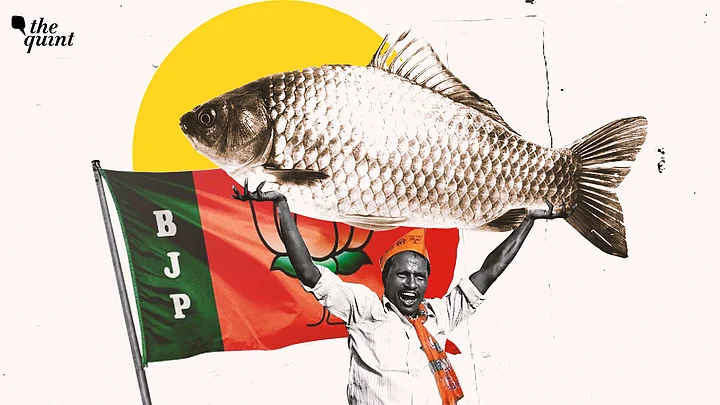
The BJP’s counteroffensive manifests in literal and symbolic acts. In Bidhannagar, candidate Dr Sharadwat Mukhopadhyay (also referred to as Mukherjee), canvassed neighbourhoods holding a large 5 kg Catla fish, a popular variety in Bengal, telling voters the TMC was spreading lies. He declared a BJP government would never interfere with choices involving fish, mutton, or chicken, promising to uphold Bengali culinary traditions. The image went viral, turning a routine door-to-door effort into a cultural statement. 

Similar scenes have proliferated: BJP workers distributing chicken biryani at local gatherings, candidates and leaders photographed enjoying fish meals, and social media amplification of non-veg preferences.

These gestures aim to make the message visceral and relatable at the grassroots. In a state where fish symbolises auspiciousness and everyday normalcy, parading a Catla signals “we eat what you eat.” The party has extended this to district-level campaigns, normalising non-vegetarian fare alongside vegetarian options at rallies and events.

This tactical shift addresses the Bihar trigger while countering the Brigade Ground fallout. By foregrounding fish and biryani, the BJP seeks to reframe itself as embedded in Bengal’s food culture rather than antagonistic to it.

Distribution of non-veg items at gatherings reinforces accessibility and respect for local habits contrasting with TMC accusations of future bans.

The approach is pragmatic: in rural and semi-urban areas, where economic pressures already strain access to protein, assurances against interference carry weight. Yet its success hinges on whether voters view these acts as authentic cultural alignment or mere electoral optics amid deeper governance debates.

ADVERTISEMENTREMOVE AD

Strategic Media Messaging to Win Over the Bhadralok

The non-veg offensive carries a pronounced urban tilt, targeting Kolkata’s Bengali bhadralok strongholds—longstanding TMC bastions. Constituencies like Rashbehari (where TMC’s Sovondeb Chattopadhyay or successor Debasish Kumar has held sway since the TMC’s formation in 1998) and Chowringhee exemplify entrenched opposition control. Here, the BJP has deployed figures like former Rajya Sabha MP Swapan Dasgupta, an intellectual face with urban appeal, to breach the fortress. 

In Bidhannagar, a high-end area with significant Bengali urban populations, Mukhopadhyay’s fish walk directly addressed this demographic. Media coverage, including interviews on prominent Bengali channels, amplified the effort: leaders such as Samik Bhattacharya, Swapan Dasgupta, Tapas Roy (Maniktala candidate), and others discussed their love for fish at length. Bhattacharya’s session featured extended kitchen-to-table conversations about Bengali cuisine, contrasting with more formal interactions elsewhere. Dasgupta and Roy similarly highlighted personal affinities for fish during on-camera meals, creating a choreographed counter-narrative of shared tastes.

Public events reflect this curation. Rallies and gatherings often feature egg, fish, or chicken options, projecting pluralism. The strategy decentralises focus from central leaders like Prime Minister Narendra Modi or Amit Shah—who speak primarily in Hindi and, in Shah’s case, adhere to vegetarianism—to local and state figures better positioned to embody Bengali bonhomie.

Earlier attempts to showcase Shah eating at supporters’ homes gained limited traction on this front; the current approach leverages candidates’ relatability.

It is interesting to note that, in an evident attempt to project non-vegetarianism within the BJP as a pan-India phenomenon, Somik remarked in his interview that former Prime Minister Atal Bihari Vajpayee was fond of fish. He even recalled how Vajpayee would struggle with the fine bones of ilish maach (hilsa), yet persist and finish the meal—such was his fondness for it.

This urban-centric focus acknowledges electoral math. While the BJP has grown in rural pockets, cracking Kolkata’s bhadralok vote banks requires dismantling perceptions of cultural alienation.

By showcasing leaders relishing maach and discussing recipes, the party constructs an image of a “more Bengali” outfit than the TMC alleges—one that respects dietary diversity rather than seeking uniformity.

Interviews and visual symbolism aim to humanise the BJP, bridging the gap with skeptical urban voters who value personal freedoms in food alongside other liberties.

ADVERTISEMENTREMOVE AD

Hypocrisy of Selective Sanatani Posturing

The Bengal BJP’s theatrical embrace of catla fish, mutton curry, and biryani is nothing but rank electoral opportunism that lays bare the party’s flexible Sanatani conscience. In states it has ruled for years, the same BJP has relentlessly pushed militant vegetarianism through repeated ban demands and enabled a culture of food-related vigilantism.

Senior leaders have frequently pitched for curbs on non-vegetarian food. In Uttar Pradesh, BJP MLA Nand Kishore Gurjar has repeatedly demanded the closure of meat shops near temples, calling their operation “rashtradroh” (treason) during Navratri.

Delhi BJP MLAs, like Karnail Singh and Tarvinder Singh Marwah, have written formal letters urging food chains and authorities to shut meat sales and stop serving non-veg items throughout the nine days of Navratri, citing “religious sentiments.” Similar calls have echoed in Madhya Pradesh, where local BJP figures pushed bans on meat, fish, and eggs in temple towns like Maihar during festive periods. Bihar also witnessed the same kind of push for vegetarianism.

These rhetorical pitches have translated into policy action and violence. Meat shops face seasonal shutdowns in temple towns of Uttar Pradesh and Madhya Pradesh; Gujarat and Haryana have seen stricter curbs on slaughter and sales.

The result is a grim trail of lynchings: Mohammad Akhlaq was murdered in Dadri, Uttar Pradesh, in 2015 over rumours of beef; Pehlu Khan was lynched in Rajasthan in 2017 while transporting cattle; Alimuddin Ansari was killed in Jharkhand for alleged meat trade. Cow-related violence surged post-2014, with the overwhelming majority occurring in BJP-ruled states, often with perpetrators enjoying tacit impunity.

This is not consistent cultural assertion—it is selective majoritarianism. In Bengal, where fish defines identity, non-veg suddenly becomes a vote-winning prop to dodge the “outsider” label. In the heartland, the same ideology polices plates through bans, fear, and blood. The catla photo-ops cannot mask this duplicity.

A party that demands dietary surrender elsewhere while waving mutton in Bengal exposes itself as pragmatic hypocrites, not principled Sanatanis. True pluralism demands consistency, not convenience dictated by electoral arithmetic.

Top Leadership’s Vocal Defence and Broader Implications

From state president Shamik Bhattacharya and downward, BJP leaders have vocally defended non-vegetarianism while invoking Bengali pride. Bhattacharya repeatedly asserted that “Bengal will have its fish and meat,” clarifying opposition only to open beef sales, not general consumption. He framed restrictions as impractical in a fish-loving state and tied the party’s stance to Swami Vivekananda’s inclusive spirit, positioning the BJP as protector of choice rather than imposer of uniformity. 

This assertive positioning sets the Bengal unit apart from perceptions shaped by the national leadership or states like Bihar. The party foregrounds its regional roots—invoking founder Shyama Prasad Mookerjee’s Bengali identity—to counter the “outsider” narrative. A degree of decentralisation allows local leaders to foreground culturally resonant practices, thereby avoiding the constraints of the central leadership’s personal choices.

Notably, at Prime Minister Narendra Modi’s Brigade rally, the BJP permitted organisers to cook and serve dim-bhaat (egg curry and rice)—a first-of-its-kind move that underscored this localised approach.

Hypocrisy of Selective Sanatani Posturing

Events feature mixed menus, and leaders’ public fish-centric interviews build a consistent tableau of cultural empathy. Whether this offensive dismantles the TMC’s entrenched narrative is uncertain. Food politics intersects with larger issues: governance, economy, and identity. Symbolic catla-holding may resonate emotionally but must pair with credible assurances on the livelihoods of fish, and meat sellers, who form a significant informal sector.

The Brigade incident lingers as a cautionary tale of how fringe actions can undermine messaging. Success depends on translating plate-level gestures into trust that a BJP government would safeguard Bengal’s plural dietary landscape without ideological overreach.

Ultimately, the strategy reflects adaptation. In a culturally distinct state, the BJP is betting that embracing maach, mutton, and biryani can win hearts where abstract appeals fell short. By holding catla high, it seeks not just votes but a redefinition of its Bengal persona—one rooted in shared plates rather than perceived prohibitions. The coming polls will test if this culinary counteroffensive can tip the scales in the battle for Bengal’s soul.

(Sayantan Ghosh is the author of two books, Battleground Bengal and The Aam Aadmi Party, and teaches at St. Xavier’s College (Autonomous), Kolkata. Views expressed are the author's own. The Quint does not endorse or is responsible for them.)

Speaking truth to power requires allies like you.
Become a Member
Monthly
6-Monthly
Annual
Check Member Benefits
×
×