In a country where youth protests are now moving from state to state, why would a small frontier region in India's Northeast matter?
For the past few months, the nation’s attention has been fixed on the Cockroach Janta Party (CJP). It started with its fight against the NEET exam fiasco and the demand for the resignation of the then Education Minister.
When the Modi government succumbed to that demand, the CJP tasted blood, and then took on the case of the Special Intensive Revision (SIR) of electoral rolls that left nearly 13 crore voters out of the list of eligible voters. Amidst all this turmoil, the attention of the Modi government has been to tame the CJP, first by labelling them as “dimagi naxals”, and then alleging they are "foreign-funded".
With so much happening in the “mainland,” how can the Northeast—with its multiple problems, be it in Manipur or Arunachal Pradesh—find a niche in the mindspace of the Modi government?
A Unique Ecological Problem
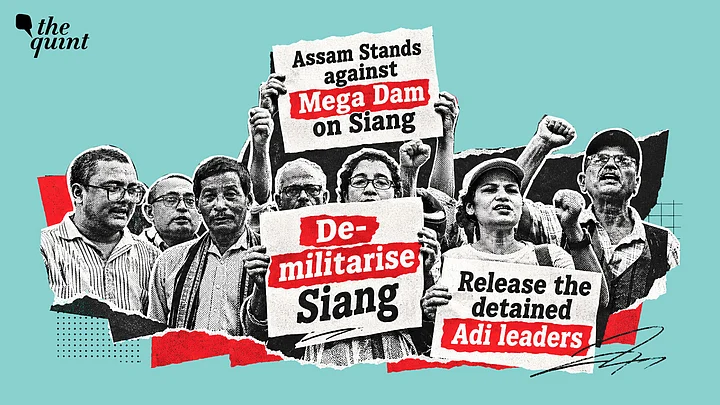
In Arunachal Pradesh, a protest has been brewing against the Siang Upper Multipurpose Project (SUMP), a 11,200 MW power project.
The opposition from the protesters is driven by deep-seated fears involving large-scale displacement of communities from their ancestral lands. At the same time, there are fears of flash floods in case the dam exceeds its carrying capacity given China is also involved in a similar project that could have serious repercussions not only for Arunachal Pradesh, but for downstream areas like Assam.
The Adi tribe has been at the forefront of the protests but they are now joined by activists afrom across the state. In fact, the students of Arunachal Pradesh studying in Delhi also protested in the national capital. They were manhandled by Delhi Police—just as the other CJP protesters were given a taste of what is now seen as repressive measures against all forms of public protests.
The public protests against the SUMP is not without reasons.
The Northeastern region falls under the fragile Himalayan ecosystem, biodiversity, and riverine environment. Large parts of the region also fall in seismic zone 5, with highly active seismic fault lines that raise genuine concerns about what would happen to such reservoirs, and the catastrophes that would follow in case a dam bursts.
Also, in indigenous people’s lands, there is such a thing as getting "free, prior, informed consent" (FPIC) before any project is undertaken. But these are being rudely cast aside as if the state has the right to ride roughshod over people’s consent. State action across this country is increasingly high-handed.
In Arunachal Pradesh, there was heavy state security deployment and police crackdowns on protestors or those standing in solidarity with them. They included lawyers and senior journalists like Tongam Rina, who was earlier shot for reporting on some of the scams in the state.
Increasingly, the Indian State has given up the idea of public consultation before undertaking any project, especially those that are ecologically sensitive.
Take, for instance, the Ropeway Project in Meghayala's Shillong by the state's Tourism Department. This project involves cutting down 543 standing trees in catchment areas that provide water to hundreds of households in and around Shillong. The eco-restoration for the 543 trees is some 90 km away in West Khasi Hills, which is absurd as the ropeway project is based in East Khasi Hills.
In all of this, what comes to the fore is a conflict of interest. How can the same state, which is a project proponent, also give environmental clearance for such projects? In such a case, it is inevitable for the state to push through the projects despite ecological threats. This is where an independent agency needs to be brought in for environmental clearances henceforth.
Manipur Still Burns
Meanwhile, Manipur continues to report deaths every single day, as if those deaths don't matter. That they are, irrespective of which community the dead belong to, mere dispensable bodies. Their names and the families they come from hardly seem to matter. If at all the dead are missed, it is only by their family members. Life goes on with its cruel fangs touching those most vulnerable.
An RTI disclosure in June 2026 reported that 731 internally displaced people had died in relief camps on account of various illnesses and lack of accessible health care services. The best government and private hospitals are located in the Imphal Valley which is out of bounds for the Kukis living in the hills.
For the Kukis in Kangpokpi, seeking medical care means travelling long distances through Nagaland to other cities. For those living in Churachandpur, it means travelling through dilapidated roads over nine hours to reach Aizawl and then travel onwards for treatment.
The conflict since 2023 has itself claimed about 306 lives, and each day, someone or the other is killed in the ethnic clashes. What was in 2023 a clash between the Meiteis and Kukis has now also drawn in the Nagas who accuse the Kukis of transgressing into their territories.
It is also a fact that the ongoing conflict in Myanmar since 2021 has only added to Manipur’s existing problems. The two crises are connected by geography, ethnic ties, refugee movements, armed groups and the circulation of weapons.
The central issue is that Manipur is dealing with an internal ethnic conflict while facing instability just across its international border. Since the military coup in Myanmar beginning February 2021, fighting between the military and resistance forces has displaced millions of people inside Myanmar and driven many across international borders.
Othering Northeast and its People
Manipur has become the shelter for people fleeing violence, particularly from the Chin State of Myanmar, whose people share cultural and ethnic roots. In September, the Home Minister of Manipur informed the Assembly that 24,475 undocumented Myanmar nationals had been detected in the state, of whom 14,992 had been pushed back.
How the Manipur government has come up with these figures remains a contentious matter, but the fact remains that there are significant numbers of people who have fled from the Chin State to Manipur as well as to Mizoram.
In Mizoram, the state government has created a separate relief camp for them. Despite their cross-border ethnic ties, such large numbers of displaced people create pressure on the states providing the displaced with basic humanitarian assistance such as shelter, food, and health care.
The Modi government’s indifference to Manipur’s problems is now well-documented. The different warring communities have to keep travelling to Delhi to meet the Home Minister and seek his intervention on addressing their claims and counter-claims. Inside Manipur, the groups only train guns at each other. No attempts at peace-building have been tried despite the incumbent Chief Minister’s repeated call to end the violence.
When ethnic communities have burnt their bridges behind them, how can they be expected to sit across the table and talk peace? So will peace ever return to Manipur? That’s a question few would dare to answer.
Beyond issues of safety, security, identity and rights, the people of the Northeast, especially those speaking up, have to constantly fight racism, on ground and online. Since the Siang Dam protests, the media and "influencer" network of "mainland" India has been actively discrediting voices from the Northeast.
A host of influencers—with practically very little lived experience or even knowledge about the socio-political, territorial, and environmental complexities of the Northeast—have been targeting Northeastern voices dissenting against Siang Dam and trying to portray the protests as "anti-development" or against national security, citing the Chinese dam for scale.
Just as a reminder: India’s Northeast has over 238 ethnic groups that practise their own cultures and traditions.
Many groups don’t see eye to eye on issues. This region shares just one percent of its boundaries with India and just 8 percent of the landmass constituting this country.
With a population of about 4.4 crore, the people of this region are of Tibeto Burman and Austro-Asiatic origin. Perhaps this is the reason why we seem strange to “mainland”—and are still treated with disdain in that mainland. Ironically within the region people can't even form a united front to deal with common issues. That's our eternal malady.
(The writer is the Editor of The Shillong Times and former member of NSAB. She can be reached at @meipat. This is an opinion piece and the views expressed above are the author’s own. The Quint neither endorses nor is responsible for them.)