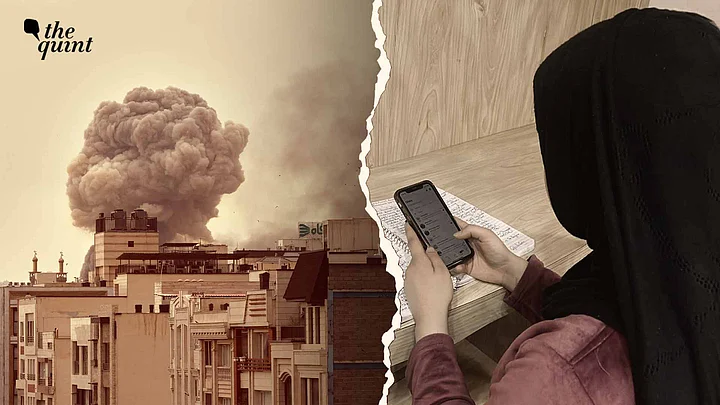
“I’ve been studying in India for eight months. It’s the longest I’ve ever stayed away from my family,” says Alra, a 22-year-old Iranian student who's pursuing a degree in pharmacy at a college in New Delhi.
For the past 10 days, Alra has been anxiously waiting for any sign that her family back home in Tehran is safe amid the US-Israeli attacks across Iran, in which hundreds of people have been killed.
One of the last messages Alra received was from her mother, who sent her a short voice note on WhatsApp on 27 February, shortly after reports of an attack on a girls’ school in southwestern Iran. The voice note described explosions, power cuts, and shortages of essential supplies.
Soon after, when the news of Ayatollah Ali Khamenei's assassination broke, Alra panicked.
“When the news broke, I froze,” she recalled to The Quint. “I was in my hostel room late at night when I saw the news about Khamenei’s assassination. I knew things were tense back home, but that moment made everything feel so much heavier.”
She bolted her room and dialled her mother. The call connected for 47 seconds—long enough for her mother to say that they were "trying to figure out the situation and did not know what was going on". That was on 28 February. She hasn’t heard her mother’s voice since.
"The hardest part is that I haven’t been able to reach them for over 10 days," she says.
Just like Alra, with each news report of US-Israeli forces bombing Iran, leaving trails of destruction and reducing residential buildings to rubble, the hearts of Iranian students studying in New Delhi have grown heavier. Far from home, they watch helplessly as their families remain trapped under the shadow of relentless bombardment.
Panic and Uncertainty
The communication blackout since the US-Israel strike on Iran has remained almost total.
“I have been trying both messaging and calling, but there's just silence,” Alra said. “It's terrifying.”
She added that she has not received any specific updates about any strikes near her neighbourhood. “That’s the scariest part—just not knowing what’s happening right now.”
For Sahar, also 22 and from Tehran, the emotional toll has been severe.
“I hugged my family goodbye at the airport eight months ago, thinking I would see them again soon,” she said. “Now I can’t even hear their voices.”
Sahar said she chose India for her studies because pharmacy programmes here are "well-regarded and far more affordable than in Europe".
The idea of studying in India first came to Sahar from a cousin who had studied engineering in Pune. Sitting with her parents late one night, she went through several Indian university websites and watched videos about education in India.
“My mother kept asking me if the food would be too spicy in India,” she said with a faint smile. “But she was also proud that I was going abroad.”
“Iran’s economy was already struggling with sanctions, so studying abroad felt like a practical step for my future. I never thought it would turn into this endless separation.”Sahar
“My phone stays silent. Every failed call feels like another piece of me breaking,” Sahar added.
Sahar’s family in Tehran includes her parents, her 16-year-old younger brother, and her grandmother, who lives with them. What she misses the most are her family rituals.
On weekends, her family often visited her grandmother’s apartment across town, where relatives gathered for long lunches and tea.
In India, she is largely relying on fellow Iranian students for support. “The other Iranian students here are the ones I lean on the most. We talk, share whatever little news we hear, and try to keep each other going,” she said.
She added that some Indian classmates and faculty members have also been supportive.
“My classmates sometimes check in quietly or sit with me when I’m feeling low. The faculty have been understanding about attendance and deadlines without making a big issue out of it.”Sahar
The anxiety has seeped into everyday life. Many students said they struggle to concentrate on classes, complete assignments, or maintain a normal routine.
“I try to study, but my mind is always back home,” Sahar says. “Some nights I can’t sleep because I keep imagining the worst.”
Economic Woes Grip Iranians
Beyond the emotional strain, practical challenges are also emerging. Banking disruptions, sanctions, and wartime instability have affected the ability of families in Iran to send money abroad.
“I’m living off the savings I had and the last remittances that came before things got worse,” Alra said. “It’s tight. I’m cutting back on everything.”
“I used to buy dates for suhoor during Ramadan,” she says. “Now I count how many I have left.”
Students say they are relying heavily on each other for emotional support. Informal gatherings and group chats have become spaces where Iranian students share updates and comfort one another.
“We cry together, pray together, and try to support each other,” Sahar said. “Knowing others are going through the same helps a little.”
Before the crisis escalated, both Alra and Sahar were focused on building careers in pharmacy. Alra hopes to specialise in clinical pharmacy someday and work at a hospital, while Sahar dreams of opening a small pharmacy with her brother back in Tehran.
“Mum used to say, ‘Study hard, come back and open a pharmacy with your brother—we’ll be partners,’” Sahar says. “We used to talk about the future a lot. Now it’s hard to think that far ahead.”
With Eid al-Fitr approaching, the distance from home feels even heavier.
Both Alra and Sahar had hoped to travel back to Iran to celebrate with their families. Those plans are now impossible to implement due to the conflict and restrictions on travel.
“I was counting the days until Eid,” Sahar says. “I just wanted to hug my parents again.”
Instead, they plan to spend the festival quietly with other Iranian students in Delhi, sharing a small meal and attempting calls that may never connect.
Sahar wonders:
“Do you think it’s going to be normal anytime soon?”
"At the end of the day," she says, “common people like us and our families are left to suffer.”
At least five or six other Iranians in the same college study across different medical courses. However, most students were reluctant to speak to this reporter. Several declined interview requests, saying they feared potential repercussions and did not want their names to appear in the media.