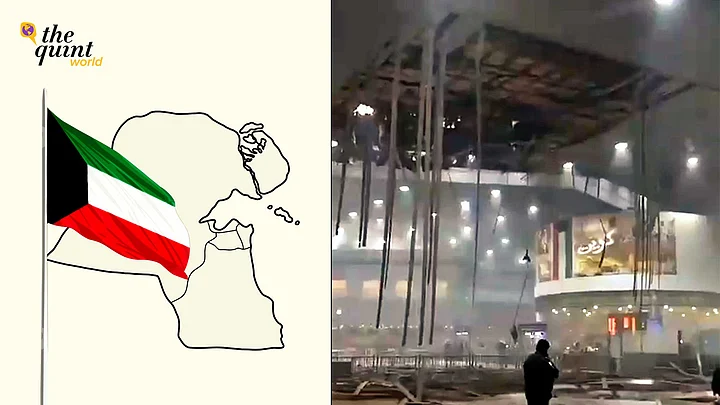
Late on Saturday night, as sirens echoed across parts of Kuwait and reports of strikes near Camp Arifjan began circulating, Sadik Khan was at Terminal 1 of Kuwait International Airport. Sadik, who works as an assistant for airport operations, had just completed several exhausting days of work and was looking forward to finally resting.
“I thought yesterday (28 February) I would sleep properly,” Sadik Khan from Uttar Pradesh told The Quint. “I was about to have dinner and then take some rest. But then the strikes happened at the airport.”
Within minutes, what had been an ordinary evening shifted into confusion and fear. Sirens wailed for hours. Workers ran across terminals. Announcements were unclear. Outside, the sky carried the distant sounds of what many described as drones and missiles.
“Drones and other projectiles kept coming for a long time,” Khan said. “The sirens were so loud and constant that by morning, my ears felt swollen from the noise. People were running in different directions. No one knew where it was safe.”
Strikes reported near Camp Arifjan, a US military base in Kuwait, have triggered anxiety among Indian migrant workers across the country. According to official data, over 1 million Indians live and work in Kuwait.
Videos circulating on social media appear to show drone activity near key installations, including areas close to the airport. While there has been no detailed public briefing explaining the full extent of the developments, workers describe movement restrictions, sudden security measures, and a tense atmosphere that has spread rapidly through labour camps and residential buildings.
For thousands of Indian migrant workers employed in construction, logistics, engineering, airport operations, and industrial facilities, what began as a routine workweek has turned into uncertainty.
Confusion And Silence
“We have been shifted to a nearby hospital since yesterday,” Abhay Singh from Uttar Pradesh told The Quint. Singh works as an excavator operator for a private company contracted in Kuwait. He left his village three years ago to earn a steady income and support his parents and siblings back home in India.
“We keep hearing loud sounds,” Singh said. “Nobody is telling us clearly what is happening.” According to Singh, tension began building since late morning the previous day (28 February). Rumours about possible strikes spread quickly through WhatsApp groups and social media posts. By afternoon, workers said security had tightened in several zones.
“Since 11 am yesterday, everything has been tense,” Vishwas, another Indian worker in Kuwait, told The Quint. “Many of my friends had plans to return home and were already at the airport. When they saw drones overhead, they ran out immediately. Flights are uncertain. Nobody knows what will happen next.”
Several workers said they have been depending more on social media updates than official communication from employers or authorities. The lack of clarity has amplified anxiety, especially for those whose families are thousands of kilometres away.
Back home, phones have not stopped ringing. “My mother keeps asking if I am safe,” Singh told The Quint. “I do not know what to tell her.”
‘End Doesn't Seem To Be Near’
For Khan, the psychological toll has lingered beyond the noise. “I was already exhausted,” Khan told The Quint. “In the last week, I did not get enough rest because of work. I thought I would finally get some rest. But instead, I was kept on duty the whole night.”
As explosions echoed intermittently, phone vibrated continuously. “My family made nearly 100 calls,” Khan told The Quint. “I answered none. What could I say to them?” He said the sound of the sirens felt overwhelming.
“When it continues for hours, it goes inside your head,” he said. “Even when it stops, you still feel like it is there.” Workers said the airport has since operated under heightened alert. Some flights have reportedly been disrupted, and uncertainty surrounds departures.
Missiles Every Few Hours
“My father told me to come back,” Ahmed told The Quint. “He said he would gift me a piece of land back home if I just returned. He reminded me that he had told me not to leave India.” Ahmed said he feels trapped between fear and responsibility.
“Even if I want to leave, I cannot,” Ahmed said. “The airport is closed, and a high alert has been issued. It feels like it is in my destiny, I will survive.”
He added that what troubles him most is the absence of proper communication. “We are waiting to hear from the Indian Embassy for their plans for our evacuation,” Ahmed said.
Other workers echoed similar concerns, saying they are unsure what steps to take if the situation escalates further.
Salaries, School Fees, and Sudden Fear
For many migrant workers, the timing of the escalation has added another layer of distress.
“I had just received my salary yesterday after it was stuck for two months,” Akshay, a worker from Himachal Pradesh, told The Quint. “I thought Sunday I would rest and on Monday I would send money home.”
Akshay said his daughter’s school fees have been pending for months.
“I was thinking especially about her fees,” he said. “Now everything feels uncertain.” With each reported strike, he said, the walls of his room tremble.