
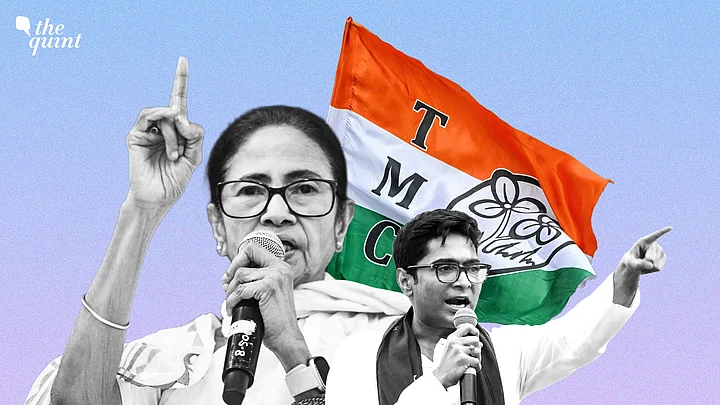
More than two weeks have passed since the Bharatiya Janata Party (BJP) took over the driving seat of West Bengal from Mamata Banerjee's Trinamool Congress (TMC). Yet, on Kolkata's streets, the tea-stall debates have showed no sign of slowing.
In these discussions, "bhaipo" (nephew) remains a hot topic—and a popular point of contention for many who argue that Abhishek Banerjee's rise caused Mamata's fall.
For years now, Mamata's alleged preference for her kin over other senior TMC leaders has seen seething discontent within the party. At the same time, Abhishek's coterie of ministers and party cadres had, for some time now, projected him as Mamata's "successor".
So, who's to blame for the TMC's rout in the recent Bengal election—Mamata or Abhishek?
Abhishek's 'Corporate Style'
Even before the recent Assembly election, not all within the TMC were in agreement with Abhishek or his ways.
The campaigning saw him in an aggressive, indomitable mood. Even Mamata—known for her fiery speeches in the political arena—seemed subdued in comparison.
During one such campaign, Abhishek had (now infamously) declared that on counting day, "along with Rabindra Sangeet, there will be a bit of DJ in the villages", adding a cautionary rejoinder, "Be ready. I'm not as liberal as Mamata Banerjee."
He had further said, by way of a challenge to Union Home Minister Amit Shah, "After 12 o'clock on 4 May, I will see how much power any executioner has left, and whose superior from Delhi comes to save whom."
After the TMC's rout in West Bengal, many of these statements he made before the results have now come back to haunt him, with an FIR also being filed against him now for his comments against Shah.
As soon as the results came in, Abhishek's leadership also came under scrutiny.
The BJP not only gained significant ground across Bengal's electoral landscape, its votes in the Assembly segments nearly doubled in seats like Diamond Harbour—in the heart of Abhishek's own constituency—as compared to the last Lok Sabha election.
In that Assembly segment, the BJP had got 43,176 votes in the Lok Sabha polls. This time, it crossed 88,000. Votes also rose in Budge Budge and Bishnupur. In Satgachia, BJP candidate Agnishwar Naskar defeated the TMC's Somasree Betal by 401 votes.
It wasn't just that the TMC performed poorly in Abhishek's stronghold. Sources say the party gave tickets to at least 70 candidates handpicked by Abhishek. Most of them lost.
The Leadership Question
Sources within the TMC tell The Quint that following the party's decisive loss, many workers and supporters are unwilling to accept Abhishek's leadership. Even in this crisis period, at a closed-door meeting on 14 May, many MPs did not turn up.
Shubhrangshu Roy, former MLA from Bijpur and son of Mukul Roy, had joined the TMC holding his father's hand. He defected to the BJP for sometime in between but returned to the TMC with his father. Shubhrangshu and Abhishek grew up together, and their families had deep ties. This time, Shubhrangshu was not given a ticket. He tells The Quint:
"The people in Bengal's villages have not accepted Abhishek's corporate style. Didi built the party on the ground, starting from scratch. Suvendu Adhikari did the same. But Abhishek has done politics from air-conditioned rooms. You can't run a party in Bengal like this."Shubhrangshu Roy
Many others don't solely blame Abhishek, but the Election Commission-mandated Special Intensive Revision (SIR) of the electoral rolls. TMC councillor Arup Chakraborty opines:
"Abhishek and Mamata are not separate. The showroom and the godown are not different. The methodological difference in their leadership is not the reason for our defeat. We lost in 34 seats due to the misuse of SIR. Add to that various malpractices on counting day."
A former MLA, unwilling to reveal his name, adds: "We trusted Abhishek's strategy in previous elections. When we won, we called it our victory. Now that we are losing, calling it Abhishek's defeat isn't right."
Newly elected MLA, TMC spokesperson, and senior leader Kunal Ghosh tells The Quint that although there's room for self-criticism post the election results, "we won't pit Didi against Abhishek."
"For us, the matter is one and the same. We do not create a divide between Didi and Abhishek, nor do we want to. Didi started alone. Emotion, struggle, and sacrifice were everything. The new generation also has dedication. They have a modern approach, the habit of working in a corporate style. This time, there was misuse of the election machinery," he adds.
The 'Prince' vs The Architects
Mamata Banerjee had been laying the groundwork for the TMC as early as 1992. The party began its formal journey on 1 January 1998. In the next year's Lok Sabha election, the TMC won 8 seats. Abhishek was only 11 then.
Mamata slowly took the party from zero toward dominance. Her shadow companions were Subrata Bakshi, Mukul Roy, Saugata Roy, Sisir Adhikari, Suvendu Adhikari, Partha Chatterjee, Madan Mitra, Dola Sen, and others.
The two main pillars of Mamata's rise were the Singur-Nandigram movements. People's spontaneous participation in those movements was striking. It elevated her to the status of a mass leader. Mamata and her associates emerged from mass movements, from crowds of people.
Abhishek's political initiation happened after the 2011 shift, when the TMC had already captured power. For the first few years, Abhishek was treated like any other mid-level leader. There was affection and bias towards him as Mamata's nephew from leaders like Mukul Roy, Subrata Bakshi and others.
Abhishek's importance in the party grew after Mukul Roy left. It took Mukul Roy three years to join the BJP, but even before that, in the 2019 Lok Sabha election, the party's unprecedented performance made it clear that his organisational network was working for them.
Mukul Roy's son Shubhrangshu tells The Quint with regret, "Someone was removed that day just to hand over the throne to another."
Politics does not allow for any vacuum. After Mukul Roy's exit, a tug-of-war began over who would take charge of the party's organisational expansion. As an organic leader, Suvendu Adhikari's name came up. But those biased in favour of Abhishek pushed his name forward.
After its poor performance in the 2019 Lok Sabha election, the TMC tied up with I-PAC. In the face of the Abhishek-I-PAC duo's dominance, party insiders lament to The Quint that Mamata's grassroots TMC gradually faded. The optics and politics built by Mamata were overshadowed by corporate stylisation of the party through what insiders described as a "survey-based understanding and learning model", they add.
"Mamata Banerjee was blinded by her affection for her nephew. Taking advantage of that, Abhishek built his own network in every neighbourhood and locality. The TMC slowly started getting controlled by non-political people," says Sajal Ghosh, another turncoat BJP MLA.
Abhishek started clipping Suvendu's power, removing him from observer posts in East and West Midnapore, Malda, Murshidabad, and North Dinajpur.
On 17 December 2020, Suvendu left the TMC. His close associates started leaving too. Leaders like Jitendra Tiwari could not be retained even after personal phone calls from Mamata. In that period, Suvendu wrote to the then Governor, alleging that criminal cases were being fabricated against him and his followers through police and administration out of political vendetta.
Recalling that time, Kunal Ghosh says, "I cannot comment on this while holding a party post. I can only say that there comes a time when one has to let go."
Shubhrangshu Roy adds:
"Suvendu da was the mass leader, Didi's successor in the party. If he had been kept, we wouldn't have had to see this day."
Mamata's failure to retain Suvendu that day made it clear that the party's reins were no longer solely in her hands.
In the 2019 Lok Sabha election, the BJP won 18 seats. In 2021 Assembly polls, the TMC got 215. This apparently proved Abhishek's path was right. A new power structure was established. Formally, Abhishek was made the party's all-India general secretary.
Internal TMC sources say that, at least among a large section of workers, it was an established fact—Mamata was the head of the government while Abhishek was the head of the party.
From candidate selection to IT cell narratives and party PR, many decisions were controlled from Abhishek's Camac Street office.
The Final Meltdown
On 8 August 2024, the rape incident at RG Kar Medical College shook the state administration to its core. At that time, every step of Mamata sparked anger across society.
Inside the TMC, Mamata and Abhishek were reportedly on completely opposite stands. From Sandeep Ghosh's transfer to ignoring the victim's mother's complaints, Abhishek could not accept Mamata's passive position. Since then, Mamata and Abhishek ran on two parallel lines. As per insiders, an unwritten question allegedly hung before all leaders: "Whose man are you?" A leader's fate depended on the answer.
Today, as the TMC stands before a massive debacle, only a handful old vanguards, known as 'Mamata Banerjee's cadre', remain in the field. Some are no more. Some are waiting in political exile. One of her beloved former loyalist defeated her and has become Chief Minister. A large section of the new generation known as 'Abhishek's men' are busy quarreling with each other on social media.
Abhishek's TMC or Mamata's TMC—who absorbed whom? Everyone has a guess about the answer, but no one wants to say it out loud yet.
Meanwhile, for people in West Bengal, it's business as usual. Recalling the previous "regime change" in 2011, former journalist and Little Magazine editor Susnato Chowdhury, who witnessed the TMC grabbing power, says, "There were thousands of common people gathered in front of Writers' Building. From the balcony, Mamata waved towards them. The crowd greeted her with cheers."
He further adds, "We were in charge of production that day, handling things from the office. We went to Writers' Building just out of excitement. The change that day was expected—it was the people's longing. For most people today, this regime change doesn't carry any uniqueness. It's just a political shift."
(Arka Deb is an independent journalist covering news and politics in West Bengal. He is the editor of Inscript.me.)
