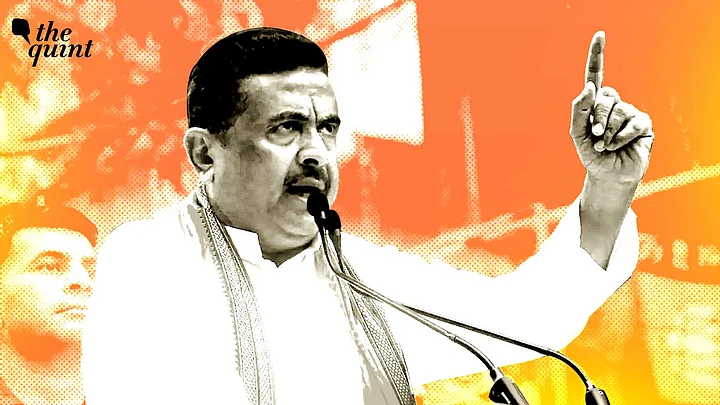
West Bengal had been an ultimate test of saffron ideological prowess for years, and Suvendu Adhikari proved to be a key catalyst to realise the aims of the Bharatiya Janata Party (BJP) and the Rashtriya Swayamsevak Sangh (RSS). There was no hesitation on the part of the BJP leadership to fulfil the ultimate ambition of Suvendu Adhikari in becoming the Chief Minister of West Bengal.
Fifty-six years old Adhikari, a bachelor, was a key strategist, if not the architect, of the Nandigram agitation that had launched Mamata Banerjee on the path of uprooting the 34 years of the Left rule in West Bengal. Suvendu Adhikari had learnt the fine arts of politics from his father, Sisir Adhikari, who was a Union Minister of State for Rural Development in the Manmohan Singh-led government. In over two decades, Sisir Adhikari carved out a distinct political identity in West Bengal, becoming an MLA first in 2001 and a Lok Sabha MP (2009-24).
Over the years, Suvendu Adhikari, who had joined the Trinamool Congress after quitting the Congress, rose in the ranks to eventually gain the description of the number two in the Mamata Banerjee-led outfit. He hoped to inherit the political legacy of Mamata Banerjee, but to his dismay, he saw the arrival of Abhishek Banerjee and he knew that his political mentor had chosen her nephew as heir and not him.
Adhikari had decoded the West Bengal verdict in the 2019 Lok Sabha elections when the saffron outfit had stunned the TMC by winning as many as 18 seats, a mercurial jump from just two in the 2014 general elections. He sensed that the BJP had emerged as a party of prospects even while it lacked a face in the state which could take on Mamata Banerjee. In late 2020, Suvendu Adhikari made the bet on the BJP, seemingly with the hope to fill the leadership void in the saffron outfit.
Amit Shah Backs Suvendu Adhikari
Union Minister for Home Affairs Amit Shah had been taking a keen interest in West Bengal while he was the BJP president. His sherpa was then BJP national general secretary Kailash Vijayvargiya. With Dilip Ghosh in the state, Shah and Vijayvargiya launched a major campaign in West Bengal as part of the strategy of the BJP to win more than 300 Lok Sabha seats for which eastern states were crucial. The success came in 2018, and that spurred it to make a big splash in 2021 Assembly elections in West Bengal.
As is the strategy of Shah, he picked his best fighter against the most powerful opponent, Suvendu Adhikari fielded against Mamata Banerjee from the Nandigram Assembly seat. Suvendu Adhikari proved Shah right, as he defeated his former political boss in Nandigram. Shah knew that he had found his man against Mamata Banerjee.
But Shah soon found two major challenges crippling the BJP’s progress in West Bengal — a massive surge of faction-fighting in the party ranks in the state, and Vijayvargiya and others slapped with scores of FIRs to almost prevent them from visiting the state.
Shah chose to back Suvendu Adhikari to the hilt as an answer to the two challenges. The strategy was: the campaign against Mamata Banerjee has to be led locally.
The Script and the Execution
The Citizenship Amendment Act has been widely known as a political sledgehammer to break open the demographic gridlock for the BJP in West Bengal. Shah scripted the CAA, passed by parliament in 2019. The move stirred the Ghuspaithiya (illegal immigrants) narrative of the BJP. It didn’t work in the 2021 Assembly elections in West Bengal, and also proved inadequate in the 2024 Lok Sabha polls in the state.
But Suvendu Adhikari will soon embark on a journey that will make the script the most lethal weapon in 2026, as he transformed himself into a Hindu poster boy.
His attacks on the “Muslim vote bank of the TMC” became frequent. His statements were unapologetic, as he began attacking the TMC for protecting the alleged illegal immigrants. His foot soldiers, who chanted ‘Jai Shri Ram’, grew in strength. In the last two years, by the time West Bengal warmed up for the Assembly elections, Suvendu Adhikari had taken on the identity of a Hindu poster boy. He had seen the potency of the transformation politically in Assam where Himanta Biswa Sarma not only replaced Sarbanada Sonowal as the state CM but also became a key figure in the BJP-RSS ecosystem.
With Suvendu Adhikari in the lead, the BJP strategists worked the Hindutva laboratory in full steam as the Bangladesh crisis unfolded with the exodus of Sheikh Hasina from Dhaka and the subsequent attacks on Hindus there amplified to the maximum in West Bengal. Suvendu Adhikari proved to be peaking at the right time within the BJP, as West Bengal turned into a fertile ground for the politics of polarisation.
The Hindutva Laboratory Finds Its Bengali Face
With hardliner image gained, Suvendu Adhikari takes charge of Nabanna, the administrative headquarters of West Bengal, with clear tasks on hands — identify and evict illegal immigrants (political) and reboot the governance to vindicate the support of the Bhadralok (the middle class). Shah himself has taken up the issue of “identifying and evicting” illegal immigrants. This has been his key taking points in Bihar and West Bengal Assembly elections.
Securing the border, from Manipur to West Bengal, has also been the top agenda of the RSS (in the sense of demography), which has already been spoken by Prime Minister Narendra Modi in his Independence Day speech last year. Suvendu will know from the example of Himanta Biswa Sarma that a visible commitment to the top RSS agenda of the day will not only cement his position but also make him a key figure in the BJP. He will be counting on the PMO to deliver on the governance plank — 7th Pay commission and DA promises and industrialisation of West Bengal.
Unlike 2021 when Suvendu Adhikari faced internal challenges within the BJP, he begins a new innings with a house perfectly in order and the party top brass fully backing him up. At the age of 56, he may sense that he has to play a long innings.
(The author is a senior Delhi-based journalist, who has worked for India’s leading English dailies while reporting on Indian politics This is an opinion piece and the views expressed are the author's own. The Quint does not endorse or is responsible for them.)