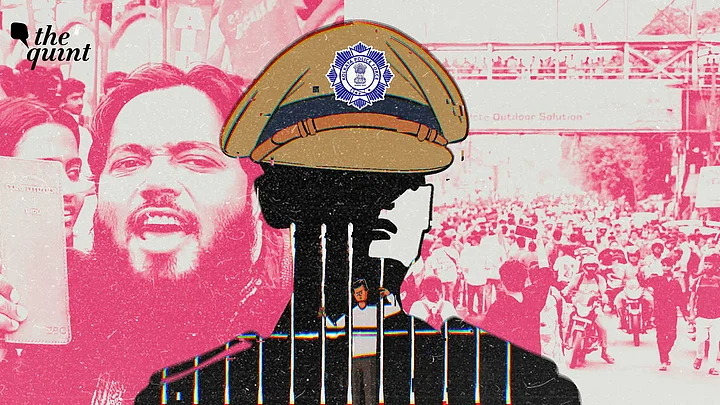
Sheikh Salman Hussain, a 29-year-old political activist who runs a garments business in Kolkata's Matiabruz neighbourhood, was among the thousands of protesters who joined a student-led march in his city, expressing solidarity with the Cockroach Janata Party (CJP)-led Jantar Mantar protests.
The 24 July march—organised by Left student groups like Students Federation of India (SFI), All India Students Association (AISA), and Democratic youth Federation of India (DYFI)—proceeded peacefully from Sealdah to Dorina Crossing in Kolkata's Esplanade (Dharmatala) area. However, it ended in clashes between the protesters and the police, with some journalists reportedly facing unprovoked attacks from those in the protest.
Despite this, on 25 July, Saturday, when news of Education Minister Dharmendra Pradhan’s resignation flashed on his phone, Hussain was overjoyed.
"It felt good to be part of something that brought change in the system."
Hussain's joy, however, was short-lived. At 10 pm that night, a police officer knocked on his door and told him he had been summoned to Hare Street Police Station.
"I have been in involved in grassroot-level political work for some time, and this march had been called by the Left groups, so I knew about it. But I was there in my capacity as an Indian citizen... I had been on clean-up duty, ensuring the waste thrown on streets was picked up.”Sheikh Salman Hussain
Certain he hadn't been involved in any violence, Hussain accompanied the cop to the police station on his own bike. But, once he got there, he wasn't interrogated. Instead, he was straighatway given an arrest memo. "They asked me to sign a document, clicked (my) photos, and sent me to lock-up," he recounted.
Hussain was among the 18 persons arrested by Kolkata Police in wake of the march. Incidentally, 17 of the 18 arrested persons were Muslim.
On 27 July, Hussain and four others were taken to Dorina Crossing by the police to “reconstruct” the incident. Hussain alleges that he and the others were paraded barefoot on the streets.
While a local court has since granted bail to all the defendants, the charges against him and the others remain in place. Some fear the worst may not be over yet, as the FIRs filed against the protesters are still pending.
Communalising the Protests
A total of seven FIRs, accessed by The Quint, have been lodged pertaining to the incidents of 24 July. The first was filed suo motu by Hare Street PS based on a forwarding report by the police.
An eyewitness, who spoke on condition of anonymity, told The Quint, "The march had been going peacefully until one chunk of the protesters reached Dorina Crossing. The police used lathi charge, batons, and tear gas to disperse the crowd. It was chaos, and several persons got injured."
Other FIRs were filed by journalists from Ei Samay, R Plus News, Aaj Tak, TV9, and News18 channels who sustained injuries and were treated at SSKM Hospital. Defending lawyers pointed out that the alleged assault of the journalists wasn't mentioned in the original FIR.
Police alleged that some protestors also threw footwear and water bottles at police personnel, reportedly injuring some. According to other eyewitnesses, the protest was “hijacked” by certain groups.
“I saw a journalist get heckled and harassed by a group of protesters—not visibly identifiable with any group, and without any visible provocation on the former’s part. But he was also saved by other members of the protest itself, not the police,” independent photographer Shubhadeep Dey, who had been covering the protests, told The Quint.
Dey and others who attended the protest believe these "outsiders" were politically motivated to cause ruckus at the protest. "Many of us strongly feel there were agents of the ruling party in the crowd who instigated the agitation."
The Bengal government, in turn, has said at least 70 persons have been identified via CCTV footage and social media for the incidents of the march, which saw a large number of Muslim protesters take part.
The 18 protesters have been booked under several sections of the Bharatiya Nyaya Sanhita (BNS), pertaining to rioting, obstruction in public way or line of navigation, voluntarily causing hurt to deter public servant from duty, punishment for unlawful assembly and being armed with a weapon, among others.
“We have gone through photos, videos, and CCTV footage. Thorough forensic investigation has been done. Some people who are known anti-establishment elements were part of the march. We are only after them, not students,” an officer from Hare Street PS said, requesting anonymity.
However, the political response to the arrests immediately took on a communal colour, raising questions on the neutrality of the investigation.
Announcing the names of the first five accused, West Bengal Chief Minister Suvendu Adhikari alleged in the state Assembly that those arrested were not "students" or related to the CJP protests, but “anti-national elements” and “foreign-funded Jamatis” who were behind the clashes with police. He also called the protesters “shukravar-vari” (Friday community), a reference to the fact that the protests were being held on Friday, the weekly day of Jumma prayers for Muslims.
“I am naming these five goons. We will take action against them under the Goonda Act in a way that, not just them, but three generations of their families will remember it."Suvendu Adhikari
Who are the Arrested Men?
The Adhikari government further claimed that the "anti-social" elements had been "brought" from the Muslim-density neighbourhoods of Kolkata, including Kidderpore and Matiabruz, to foment trouble against the Bharatiya Janata Party (BJP). But most of the defendants and/or their advocates and families The Quint spoke with said they attended the protest in solidarity or just happened to be there. Some, in fact, were not even present there.
Police said that one of the accused, Mohd Afroz, a Rajabagan local and content creator, had links with the Trinamool Congress (TMC)'s Matiabruz MLA Abdul Khaleque Molla, based on images of Afroz with the leader during the recent poll campaign. In an interview with ABP Ananda, Molla denied personally knowing Afroz. He said Afroz was not an "active member of the TMC", adding that "many people get photos with politicians during elections."
A video shared by Afroz on his Facebook page shows him in the crowd that drove away some of the journalists. Afroz, who is recording the clip, can be seen chanting slogans but not physically attacking the scribes. In the video, protesters can be seen trying to contain the attack and making announcement against attacking journalists as they were "doing their job".
A perusal of Afroz's pages on Facebook and Instagram show that he regularly posts "gangsta" reels in which he acts in skits, often with fake guns. The images from these videos have since gone viral on social media.
Hussain, on the other hand, runs a group called All India Touhidi Janata and runs a Facebook page where he promotes his works and activism. The page has over 95,000 followers. He, too, posted videos of the protest on his Facebook page.
Another defendant, Mohd Zohiruddin Mal, has been involved with local Left groups like DYFI and SFI for over a decade since he himself was a student. He had recently contributed to the election campaign of the Indian Secular Front (ISF).
Advocate Yasin Rahaman, part of the defence team, said most of the arrested persons belonged to working-class Muslim families, with some owning small businesses.
Mohd Alamgir, a fruit vendor at Burrabazar, was picked up from his home even though he did not attend the Sealdah to Dharmatala protest at all. "I just rallied a little outside my house, to respect the protest, and then I was at home. My older daughter attended the main protest," Alamgir told The Quint, hours after he reached home post his release. As per reports, Alamgir has worked for the Congress in the past as a ground-level worker.
Another defendant, Shahbaz Khan, is a butcher who sells fish. Khalid Reza runs a footwear shop, while Mohsin Khan, Wakar Azam, and some others are unemployed graduates and job-seekers.
Families of the defendants who spoke with media amid the bail hearings corroborated that their kin were innocent, with many stating they had become inspired to join the protests after seeing the month-long demonstrations in Delhi and other places. Some families were not even aware that their son or daughter was attending the protest.
Bail Granted but Fear Remains
On 28 July, amid high drama at Kolkata's Chief Metropolitan Magistrate’s Court where all 18 were produced for a bail hearing, the defendants were first denied bail and remanded to judicial custody till 30 July, only to be released on bail following a second hearing the same day.
The development came in wake of a Supreme Court direction on Tuesday, stating that no "coercive action" be taken against protestors involved in the recent student protests in Jantar Mantar and other places. The SC order came a day after a news conference held by CJP members, wherein the group said it would be “forced to sit in protest again” if the FIRs against protesters in BJP-ruled states, including Bihar, Assam and West Bengal, were not withdrawn, and the students not released, as promised by the Central government.
However, on Tuesday evening, CJP chief Abhijit Dipke and spokesperson Saurav Das further said the SC order was not what the government promised since the court allowed investigation in cases involving accused with “criminal antecedents”, without clarifying the term. Incidentally, five of the 14 defendants have prior history, though it remains unclear if they were convicted for any crime, The Indian Express reported.
Protesters like Hussain, as well as their lawyers, dubbed the bail as a “rare win”. Speaking to The Quint, Shamim Ahmed, Secretary, All India Lawyers’ Union, and one of the lawyers representing the protesters, called it a “highly unusual” occurrence.
"The same judge who first denied the protesters bail called for another hearing and passed their bail order,” he said, adding,
“We are hopeful that the charges would also be dropped now.”
Defending lawyers also brought to the court's notice the dropping of similar charges by Bihar and Delhi police as precedents.
As per sources, the Adhikari-led BJP government in Bengal, despite coming down strongly against the protests, was under pressure from the Ministry of Home Affairs to tide over popular pushback against any action on student protesters. As per media reports, the West Bengal government has dropped the suo motu case lodged by the police inwake of SC's directions. The protesters' defence team, howebver, refutes this, claiming the FIRs are very much intact. "All 7 FIRs are still in force. We are working on how to best move the case forward so as to mitigate harassment for the defendants," Ahmed said.
Targeted Arrests Under a Controversial Law
Critics point out that while many states in India saw NEET protests, the Adhikari government managed to give the protests a familiar communal spin. Moreover, the bail and dropping of charges in other states has given the BJP a bad rep among some of its supporters, who feel the party is being too "lenient".
The arrests, touted to be the first under the newly passed West Bengal Maintenance of Public Order (Amendment) Act, 2026, controversially dubbed the “Goonda Act” which allows up to one year of preventive detention and denies accused the right to private legal counsel, among other provisions, have drawn flak for this as well.
"This Act is in itself an anomaly as there is no formal notification yet on any government website or anywhere at all. It is only invoked, apparently, when alleged perpetrators are from the minority, as seen in the Baruipur lynching case as well where a Hindu man was lynched on suspicion on killing and raping a Muslim minor," Ahmed said.
"The Chief Minister keeps mentioning the Act, but the FIRs didn't mention it," he added.
Referring to the "parading" of the accused, advocates Ahmed and Rahaman reminded that the SC has previously spoken against the shaming or intimidation of the accused on multiple occasions. Speaking to The Quint, one of the five persons taken for the on-site reconstruction said the process was "humiliating".
While police claim the arrests were made based on visual forensic evidence, advocates deny it, arguing that all the evidence was circumstantial. "We have not yet been shown any forensic evidence yet that directly pins these individuals to any crime per se," Ahmed said.
“A video of me cleaning the protest site, clearing discarded packets, and empty bottles was being circulated. I think it was one of those videos that led the police to arrest me, assuming that I was hurling plastic bottles at them."Salman Hussain
Lawyers further point out that there were procedural errors, pointing to the arbitrariness of the arrests.
“Police did not record the facts correctly. The arrest memos mention that all arrests took place from Hare Street PS, but that is not true. Some were arrested from road, some were picked up from their homes. There must have been some motive for this 'error'. BJP leaders and the Chief Minister have given a direction of investigation, and according to them, whoever was committing chaos, were from a specific community. The police was clearly following that direction."Shamim Ahmed
One of the seven FIRs was filed from Entally PS, and the rest six from Hare Street PS—all pertaining to the same incident under similar sections.
“The SC has repeatedly said there should not be more than one FIR for the same incident. In reality, so many FIRs have only been filed to harass the accused. In case one gets bail in one case, they can be arrested again or kept behind bars for another.”
Rahaman said while the FIRs paint a different picture, the vandalism on ground was minimal.
“It was overall a peaceful protest. In fact, eyewitnesses claim it was the police that started throwing stones from a fire brigade vehicle when the protest reached Sealdah station. Then, near Esplanade, police resorted to lathi charge even when the protest was peaceful, and the protesters were sitting on the road. The FIRs do not reflect this.”Yasir Rahaman
Hare Street PS refused to comment on the particulars of the incidents of the day or on the status of the FIRs, stating the matter is currently under investigation.
Islamophobic State Response?
The incident has yet again led to questions about rising Islamophobia of the Indian State, especially in West Bengal where communal rhetoric has deepened since the BJP came to power.
Responding to the comments made by Adhikari in the state Assembly, senior CPI(M) leader Mohd Salim said he was reminded of the time Rajiv Gandhi had infamously said of his detractors, “Nani yaad dila denge”.
“The Chief Minister is acting like a chief gangster himself, using the Goonda Act as a guise to issue open threats against protesters in the Assembly, and unleashing state force and police against dissenters. It it fair to name and shame persons taking part in democratic protests like this, even before any of the charges against them are proved in a court of law?"Mohd Salim, CPI(M) Leader
Addressing the media at The Press Club of India in New Delhi on 28 July, AISA activist Neha Bora, who had been on a hunger strike alongside Sonam Wangchuk and others at Jantar Mantar for 23 days, asserted that the nature of the state’s response to the protests "clearly has an anti-Muslim angle".
"Even in this time when state repression is happening throughout the country, there are Muslim students who are more vulnerable than other protesters. Even the intimidation... in Bihar and West Bengal is largely directed at Muslims," she said.
While protesters in Bengal have roundly condemned any attack on journalists, some eyewitnesses like artist and Left activist Laboni Jangi, CPI-ML (Liberation) 2026 poll candidate, clarified that only those seen as "Godi media" were heckled.
"The reaction to the media was perhaps also an encapsulation of the angst being felt by the minority community in the past few weeks," she said.
"This protest was the first major expression of people's displeasure and anger with the new Bengal government, which has made a point to constantly alienate Muslims, be it through divisive statements or arbitrary legal action. Many in the state are scared to speak up."Laboni Jangi, Artist and Activist
Some pro-establishment mediapersons were also seen and heard asking baseless and provocative questions to the protesters. “Many women, mothers had come with their children to join the protests. Many protesters were “visibly” Muslim, as in they wore burqas or skullcaps. Only these people were targeted by journalists. I myself saw some journalists asking protesters pointed questions about 'funding', asking older women whether they were students to provoke the crowd,” Jangi said.
For protesters like Hussain, the fight isn't over. "I have faith in the law and want perpetrators of any mischief to be brought to justice. But it also important to clear the names of those falsely accused," he said.