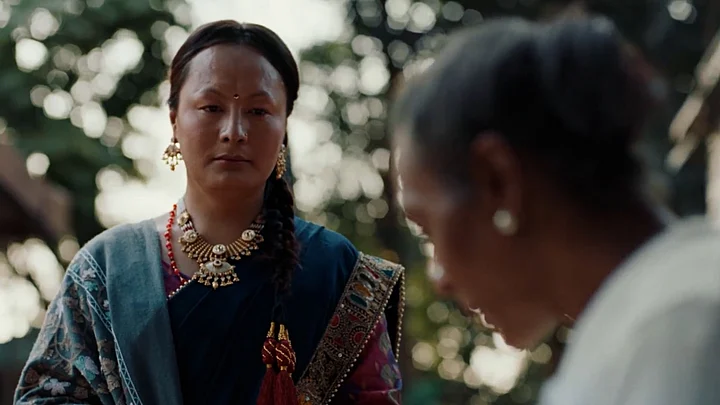
In Abinash Bikram Shah’s Elephants in the Fog, Apsara (Aliz Ghimire), the youngest member of a Kinnar household in rural Nepal, disappears during a night patrol to protect the village from wild elephants. The police show little urgency in investigating her disappearance, and the villagers offer little help. It falls to Pirati (Pushpa Thing Lama), the household’s matriarch, to search for her.
In Hindu and Buddhist mythology, Kinnar refers to semi-divine celestial beings from the Himalayas. It is also the name of a community of transgender women who are invited to offer blessings at weddings and other auspicious occasions, yet cannot be accepted as neighbours, family, and fellow human beings.
The Nepali-language film, which won the Jury Prize in the Un Certain Regard section at the 2026 Cannes Film Festival, asks: How can someone go missing if they already do not exist in the eyes of society? Who is expected to care enough to look for them?
A conventional Hindi film with this premise might centre on a cop who, against all odds, finds Apsara while exposing the intense discrimination Kinnar women face. But Elephants in the Fog instead places Pirati at the centre of the search, so the audience sees the village through her point of view.
This is a major milestone in trans representation and a powerful, deeply moving indictment of the conditional acceptance afforded to trans women in Nepal—a country whose record on transgender rights has long been held up as comparatively progressive in South Asia.
A Family, Before a Disappearance
Trans characters in cinema globally are often introduced through narratives of violence, exclusion, or tragedy. In Elephants in the Fog, Shah takes his time immersing us in the lives these women lead among themselves.
Early on, Apsara and Pirati spend time together in the forest, picking flowers. Apsara rubs her hands together and presses them against Pirati’s face, trying to warm her. Later, Pirati drops the blue flowers they have collected into a bucket of warm water. “A flower needs warmth to spread its colour,” she tells Apsara.
This moment is imbued with intimacy. The two women tease each other, laugh, sing, and share the small rituals of a life they have carefully built together. Pirati is Apsara’s mother in every way that matters. Shah’s investment in their relationship makes Apsara’s disappearance hit with the force of watching a family we know—and deeply care about—rupture.
The early scenes simultaneously offer a critical view of the community and its own power structures. During a ceremony inducting a new daughter into the household, her hands are painted red, and she takes vows of chastity and obedience to her elders. Shah allows the ritual to unfold at length, drawing us into its rhythms and significance.
The reverence society accords to these women rests on their celibacy, which distinguishes them from other trans women, many of whom turn to sex work to earn a living and face stereotypes about promiscuity. For those rejected by their birth families, the household offers shelter, care, and traditions through which to make sense of a hostile world. But the community’s own restrictions also reproduce some of the constraints society imposes on them.
Pirati’s Main Conflict
Pirati knows this better than anyone. Her relationship with a local drummer violates her vows and threatens the position she has built within the community. She plans to elope with him to Delhi, where she hopes to begin a different life.
Shortly before Apsara disappears, Pirati tells her she intends to leave. Apsara begs her to stay. The scene is staged with breathtaking intimacy. Shah’s camera moves close to the women, allowing their faces and gestures to carry the weight of the exchange. Apsara embraces Pirati, who pulls away. “I can’t hear your heartbeat,” Apsara cries.
The line is devastating. Apsara hears in her mother’s withdrawal the possibility of abandonment and the loss of the warmth and reassurance she has come to depend on. Yet Pirati has spent her life caring for others while repressing her own desires. Their love does not spare either woman from hurting the other.
Pushpa Thing Lama, a trans activist making her acting debut as Pirati, delivers a brilliant lead performance. She balances Pirati’s authority in the household with her vulnerability as a woman who wants more for herself. Yet her longing does not diminish her responsibility towards her family, particularly Apsara.
A Landscape of Fear and Belonging
As Pirati continues searching for Apsara, Elephants in the Fog gradually acquires the shape of a crime thriller. Her pursuit takes her through darkened roads and into tense encounters, while the village grows increasingly hostile to the Kinnar women once they cross the rigid boundaries of acceptability.
Noé Bach’s cinematography and the film’s atmospheric sound design manifest the women’s anger physically. The forest, with its darkness and proximity to the village, creates an atmosphere of unease that gradually seeps into the women’s domestic space. The recurring blue tones lend a particular melancholy to quieter moments. Natural sounds and music gather in intensity as the story progresses, bringing the rage beneath the film’s surface to a boil in a magnificent final scene.
In an interview with Film Fest Report, Shah traced the title to a parable about blind men and an elephant: each one encounters only one part of the animal and mistakes that partial understanding for the whole. Shah connected this to the narrow categories through which society perceives Kinnar women, from religious figures to sex workers, without recognising the fullness of their lives.
The contradiction extends to how people revere Ganesha, the elephant-headed Hindu god, while fearing actual elephants and driving them away from human settlements.
Clearing the Fog
Throughout the film, the villagers try to keep the elephants away, constantly patrolling the forest and fortifying the boundaries between the animals and their homes. Yet the elephants have always been there, just beyond the limits of what the villagers can see or are willing to acknowledge.
The fog has only obscured their persistent presence, much like the Kinnar women.
Elephants in the Fog asserts their full humanity. They have built lives, relationships, and a family within a world that accepts their presence only on its own terms. Pirati’s search unravels the violence of those terms.
The heartbeat motif returns in the final stretch, giving Pirati and Apsara’s earlier exchange—the gesture of trying to hold on to someone who is slipping away—a painful new significance. This reminds us that the film’s politics ultimately reside in the bond between these two people. It understands that a home can be a refuge and also a site of constraint, that love sustains and still hurts us, and that survival often requires compromises no one should have to make.
Who gets to “go missing,” then? In Elephants in the Fog, the more disturbing question is who gets to decide that someone was never there at all.
(Kaashif Hajee is a writer, researcher, and educator based in London. He is Assistant Editor at The Polis Project and a film critic for The Quint, with bylines in The Caravan, Screen Rant, and SAAG Anthology. A graduate of NYU Abu Dhabi and SOAS, his work spans culture, politics, and media. He also mentors students worldwide as a college admissions counsellor at Crimson Education.)