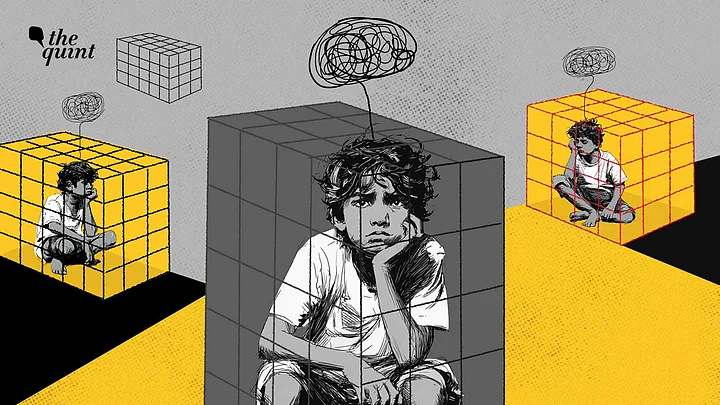
“I had to change my daughter's school because the school didn’t step up or address the bullying she was being subjected to,” recalls Myra Agarwal (name changed), a Mumbai-based film director and mother to a 10-year-old.
When Agarwal's daughter was seven, she would often say, "I am a boy." That led to relentless teasing from her classmates. If she wore pink, they sneered, asking why she had chosen a “girl’s colour.” They mocked her glasses, ridiculed her long hair, and insisted that because she saw herself as a boy, she couldn’t possibly look the way she did.
She eventually cut her daughter’s hair short, hoping the taunts would stop. They didn’t.
The bullying soon turned physical. After months of silence, her daughter finally fought back.
“When I took it up with the school, they refused to acknowledge that she was being bullied. They only focused on the fact that she hit someone back. They didn’t offer the support a school should. My daughter was miserable, and we had to move her out,” Agarwal says.
Two years on, her daughter still avoids the lane leading to her former school, a reminder of how deep the trauma remains.
Child psychologist and parenting counsellor Riddhi Doshi Patel, who has worked with children for over 20 years, says this is far too common. “Schools are not equipped, and many simply do not want to get involved. They cannot tell a child to ‘just ignore it.’ They cannot wash their hands off something like this.”
She adds that she has treated children as young as eight who suffer from depression and suicidal thoughts because of bullying.
In the recent months, bullying has been linked to at least three tragic incidents. In Jalna, Maharashtra, 13-year-old Aarohi Bidlan allegedly died by suicide in her school. Her father, a sanitation worker, alleges mental harassment by teachers. In Jaipur, a nine-year-old girl allegedly died by suicide after she was bullied by classmates. In Mumbai's Vasai, a 13-year-old succumbed to death after a teacher allegedly forced her to do 100 sit-ups as punishment.
"Children are being bullied not only by peers, but also by teachers. I see it every day. Comments like, ‘your handwriting is dirty,’ or ‘you will never score well in math,’ or ‘tell your mother to cut your hair... you look like a gorilla’ are far too common. When such remarks are made in a classroom, other children pick it up."Riddhi Doshi Patel
According to the 2023 National Crime Records Bureau (NCRB) report, 13,892 students died by suicide in 2023—the highest in a decade. Students accounted for 8.1 percent of all suicides that year. In the last 10 years, student suicides have risen by nearly 65 percent, increasing far faster than the national suicide rate.
'Schools Who Ignore Bullying Are Bullies Themselves'
Educationist Swati Popat, president of the Early Childhood Association and the Association for Preparatory Education and Research, says, "Schools who continuously ignore bullying are bullies themselves. They need to have an anti-bullying policy in place. It should be considered a crime within schools—whether done by teachers or by children."
"BEd programmes don’t prepare teachers to understand that authoritarian teaching styles are not acceptable. Many principals, too, believe they can do whatever they want with children. Parents also often use authoritarian styles at home. There is a big difference between authoritarian and authoritative. We have not been able to explain this difference well to educators or to parents."Swati Popat, President of the Early Childhood Association
Shaista Mehta (name changed), a Mumbai-based media professional, shared that her daughter was bullied for over a year in Grade 3 when she was eight. Her daughter was friends with a boy in her class, but three other girls didn’t like it—they considered him “their friend.”
What started as jealousy quickly turned into bullying. They mocked her for being slow in studies, and even body-shamed her.
"They turned the entire class against her. They isolated her. From verbal teasing, it escalated to both boys and girls physically hitting her in chest."Shaista Mehta
Mehta didn’t learn about the bullying from her daughter, but from another parent who witnessed other kids being unkind to her. Only then did the changes she had noticed in her daughter made sense. She had grown quieter, withdrawn, and didn’t want to go to school. When Mehta approached the class teacher, she realised the teacher had no idea what was happening. It left her feeling helpless and angry.
“All they did was tell the kids not to do it. They couldn’t find a way to resolve it. The kids started staying away from her so they wouldn't get into trouble, leaving her feeling even more isolated," she adds.
The school counsellor was not helpful either. They suggested she get help from a therapist.
She did, and more than a year later, her daughter continues to go for therapy.
'Bullying is Far More Complex, Disturbing'
According to Patel, the forms of bullying she sees today are far more layered—and disturbing—than most adults realise.
“Children are being targeted for everything,” she explains. “From the brand of their compass and school bag to the car they come to school in. From body parts—penis size or breast size—to weight, and skin tone."
What shocks her the most is how young this begins. She recalls Grade 1 students discussing skin creams, tanning, spa parties, and telling their friends not to play outside because they might “get dark”.
The bullying isn’t limited to peers. Many children, she notes, are also suffering inside their own homes. “Parenting bullying is real,” Patel says.
She recalls a 17-year-old boy who came to her before the pandemic. He spoke often about “life beyond death.” His parents pushed him relentlessly to win races. When he didn’t, he would be dragged to early morning practices at 5 am. In Grade 2, after he lost a race, his father told him he was “hopeless”, and should not have expected anything more, and that stayed with him, and became a part of his personality.
"By 17, he had already built and sold two mobile apps... he was financially well-off—but he believed he was nothing. He would say, ‘I’m hopeless. I haven’t achieved anything."Riddhi Patel Doshi
While we often talk about bullying in schools, kids also experience this at home.
Parents Play an Important Role
As a mother to a 10-year-old, I’ve often noticed that many parents simply refuse to accept that their child might be a bully. Even as the instinct to protect your child is understandable, being in denial is one of the biggest disservices a parent can do—not only to the child being hurt but also to their own child.
When parents dismiss complaints, minimise incidents, or respond with, “My child would never do that,” they unintentionally shut down the opportunity for their child to learn empathy, accountability, and for them to understand what's bothering their child.
That denial, says Marilyn Correa, Head of the CARE Centre at Bombay Cambridge International School, is where the real damage begins.
“I’ve seen that when we speak to parents, many find it very hard to accept that their child can do something like this. The problem is that we’re trying to fix the blame, but we’re not trying to fix the problem."Marilyn Correa
She emphasises that schools and parents need to approach these conversations differently—not with shame or accusation, but with collaboration.
According to Correa, the most effective approach is one where both families and schools shift the focus away from punishment and toward understanding the root cause.
It’s important to speak not just to the child who has bullied, but also to the child who has been hurt. It's important to extend help to both, the bully and the victim.
Understanding the Bully is Important
Popat explains that adults, both at home and in school, shape how children treat one another.
“Sometimes, bullying stems from a teacher's actions. Sometimes, a teacher may not listen to you or give you the attention you deserve. I know bullies who don’t like partiality, so when they see a teacher being partial to some children, they go and bully those children, because they feel those children are getting the attention they also deserve," she says.
But, Popat says, focusing only on the child’s actions misses the deeper systemic issue.
"It sometimes related to something happening to a child. It could be a parent or a teacher causing it. A child may not feel valued at home, so they come to school and assert power over others. Or they may have observed teachers bullying, or seen other children bully while the teacher did nothing. So the child starts bullying because they think it is acceptable. It’s a ripple effect."Swati Popat
The fact that children are so reactive, impulsive, and unable to regulate their emotions is often an indicator that something deeper is going on.
“Many times, children witness violence at home, come from abusive or neglected environments, or are exposed to domestic disharmony. When children display these kinds of behaviours, including bullying, it is usually a reflection of an internal struggle. They need guidance, support, and a safe space to process what they are experiencing,” she explains.
According to experts, bullying often emerges as a fight-or-flight response, and many choose “fight” because they themselves have been bullied or threatened elsewhere. Without understanding this cycle, it continues to trickle down from one child to another.
Signs Your Child is Being Bullied
Sometimes the first alarm is subtle. In my son’s case, it showed up as three consecutive Tuesdays when he refused to go to school in Grade 3. Every week, there was a new reason—a stomach ache, a headache, feeling “too tired.”
When I gently asked if he was trying to avoid a particular class, it became clear: his art teacher was belittling him and other kids. Fortunately, when the school was informed, they took corrective action and replaced the teacher the following year.
Popat says that these early behavioural shifts are the signs parents must pay attention to.
"If a child is a victim, the first thing they do is stop making eye contact. They feel responsible for their bullying. They move away the minute you come close to them. That’s an indicator something is wrong."Swati Popat
According to her, a slight withdrawal, reduced excitement, a change in tone when they speak are signs to watch out for. As the bullying intensifies, the symptoms become more visible: difficulty in concentrating, change in appetite, becoming unusually solitary, and loss of interest in things they previously enjoyed.
“Even if you’re a working parent or see your child once a week, you should be able to sense it in their voice. Their excitement drops. Their tone changes. These are subtle signs every parent can pick up."
How Can the School and Parents Help?
Popat explains that the foundation of any meaningful anti-bullying effort is a clear, visible, and transparent policy. It needs to be present on the school’s website and communicated openly to parents and children.
Children must know what behaviour counts as bullying, why it is unacceptable, and why kindness matters. “This cannot be a set of rules forced upon them; it has to be a process in which children actively participate," Popat says.
She adds that an effective policy recognises three clear stages of intervention. The first is awareness—children must feel safe to report bullying without fear of being labelled as tattletales. Anonymous systems or buddy systems, whether through teachers or fellow students, can help create this fearless atmosphere.
"Once a child does come forward, two parallel supports must be activated: the emotional well-being of the victim needs immediate attention, and the behaviour of the bully needs to be understood, addressed, and warned. The bully must know these are limited chances before suspension is enforced. But equally, their emotional health must be checked, because without resolving the root cause, they simply move on to another victim."Swati Popat
Further, if a parent reaches out, it is the educator’s responsibility to respond, meet them, and engage.
"Administrative tasks can wait. Human touch cannot," she explains.
"'Why didn’t you tell me sooner?' is a wrong reaction. Firstly, thank the child for opening up. Tell them you’re in it together to resolve the problem. Don’t let the child slip into complacency—equip them to face their bully the next day."Swati Popat
Harpreet Singh Grover, who has been researching parenting for the last four years, believes the home environment is equally crucial.
"The number one thing a parent can do is allow a place where the child can communicate. If a parent has created that space and is noticing the child, I don’t think the outcome will be as bad as what we are seeing. For that you have to leave the office in the office and be present. For that you have to know our child,” Grover says.
At the same time, equip children by helping them build assertive skills, the confidence to express what they feel, and the clarity to recognise when something isn't okay.
“Often, children tell me they are scared: 'What if the bully targets me even more if I report it?' That’s where assertiveness, confidence, and trust come in. There is always at least one adult in school they can approach. The important thing is to ask for help. Children shouldn’t try to resolve repeated incidents on their own,” Popat says.