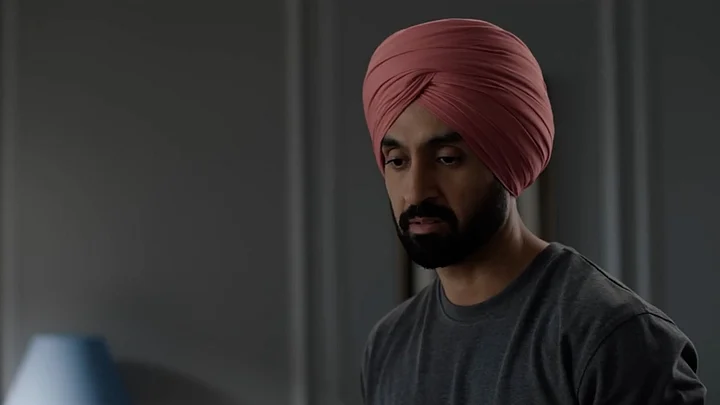
Nothing in Vedang Raina’s previous two films (Jigra and The Archies) prepares you for his deeply moving performance in Main Vaapas Aaunga. Playing Keenu, a young Sikh boy in Sargodha, pre-Partition Punjab (now in Pakistan), Raina gives a full, big, memorable performance, charting Keenu’s growth from a lovestruck teenager to a young man nursing the wounds of Partition. (And he also sings beautifully!)
In his old age, Keenu (now played by Naseeruddin Shah) is the ancient 95-year-old patriarch of a large family in Chandigarh. Shah is stirring as Dadaji, as he is now known, whose descent into dementia displays itself as a sudden desire to go back to Sargodha, visit his hometown and relive his youth, and chiefly reunite with his love, Afsana/Jiya (played with bounce by Sharvari).
Past and Present Cut Smoothly Together
These two performances—Shah and Raina—animate a classic Imtiaz Ali structure: the past/present interplay. As in both the Love Aaj Kal films as well as Amar Singh Chamkila, there is a constant slipping between a present-day narrative and a past that informs, and then increasingly mingles with, the present.
In all these films, this interplay and intermingling owe as much to Ali’s conception as to genius editor Aarti Bajaj’s cutting (particularly in the breathtakingly put-together first Love Aaj Kal). In Main Vaapas Aaunga, see the way Ali and Bajaj begin to overlay past characters with present faces, even before these characters have been fully introduced, giving us a sense of the old man’s addled brain and tumbling memories.
There is a businesslike economy to the storytelling, too. Nirvair (Diljit Dosanjh), Dadaji’s grandson who lives in London, announces he’s going to India—we get a brief passing shot of clouds through an aeroplane window, and we cut to him at Dadaji’s bedside.
Equally, Bajaj knows when to hold a frame for maximum emotional impact. Take a moment of intense brutality before the climax: instinct commands us to flinch, but the scene goes on until its tragic and bloody point is fully made. (Dolly Ahluwalia anchors this scene with violent melodrama.)
A Strongly Coloured Romance
The portions in pre-Partition Punjab work very well, despite Ali’s tendency to avoid establishing characters beyond broad brushstrokes. Keenu and Afsana seem to be already in a kind of familiar flirtation when we first meet them.
Are they childhood friends? How do they know each other? We do learn later that their families are friendly, but initially their romance blossoms untethered to any backstory.
Instead, Ali gives their relationship strong colour. For instance, when Afsana is haltingly giving a speech at a Progressive Writers’ Association gathering (of which her father is a member), Keenu walks in and suddenly her confidence strengthens.
Otherwise, it is Afsana who is forthright and self-possessed, and Keenu who is shy and receding. But when Partition is announced, it looks as though Keenu’s Sikh family may be banished, while Afsana’s Muslim family will stay behind, and the two switch roles again: Afsana becomes scared about the future and Keenu becomes reassuring.
These dynamics go some distance towards making this central relationship seem real, shrouded as it is in communal politics, shifting recollections, and tragedy.
Sharvari and Raina play these people with an appealing open-facedness. I liked them both.
An Underdeveloped Family Life
In the present day, Dadaji sinks further into incoherence as Nirvair tries valiantly to extract memory and truth from his babbling. These portions are fairly unsteady, which renders them unsatisfying as a foundation for the rest of the film. Rajat Kapoor plays Nirvair’s father, Dadaji’s firstborn son, who is frustrated by his father’s inadequate parenting. Equally, he is frustrated by his son’s inability to hold down a job and make something of his life.
These feelings are expressed, but never really explored: our focus keeps returning to Dadaji’s experience of Partition, not his family life in the 78 years since.
Nirvair is a trained software engineer who’s trying his hand, so far unsuccessfully, at stand-up comedy. Once he arrives in India and begins to involve himself in Dadaji’s memories, he suddenly finds success making jokes about Partition. These jokes (co-written by Biswa Kalyan Rath) are embarrassingly on the nose and don’t really serve to illustrate more than the obvious facts of the Partition.
Dosanjh is competent, but handed a role whose conflicts are undercooked. He is unable to make a major impression.
Nirvair’s relationship with his on-again, off-again love interest Kaveri (a miscast Banita Sandhu) suffers both from a lack of grounding and because of Sandhu’s stilted, accented Hindi. The supporting cast is also a bit stranded: you’ll find names like Anjana Sukhani and Sanjay Suri in the credits, but these actors are wasted, with little to do.
After the interval, there is a sense of unravelling, and Dadaji’s repeated anguished mumblings begin to get overwhelming in their meanderings. Perhaps this is the point—to show the burdensome anguish of a Partition survivor in his foggy old age—but it made me fidget in my seat.
Too much time is spent on Dadaji prattling about Martians as a shorthand for communal forces, and too little time is devoted to examining crucial family dynamics.
A Powerful Third Act
And then Main Vaapas Aaunga surprised me with a third act that drives us into the thick of the violence, separation, and loss of Partition.
Here is where all the strands of the film come together in a tremendously moving way: Raina is particularly affecting as Keenu’s family is torn apart, the women forced to remain behind while the men cross the Radcliffe Line into India.
As past and present reveal themselves further, everything begins to make more sense and the central tragedy of Main Vaapas Aaunga begins to throb. Ali is helped in this by his other unstinting collaborators, AR Rahman and Irshad Kamil. The director’s instinct for musical cues remains strong: I won’t say what exactly happens, but when ‘Tere Paas Main’ began to play, I dissolved into tears.
The climax removes itself from logic and reason, but there is an emotional heft that carries us along to the very last frame of the film. (There’s a bit of a miscalculated music video over the end credits though.) The film’s impact comes through in the pathos of Partition and its aftermath.
The argument that old wounds, if left unattended, are handed down through the generations gives the film its charge and ultimately explains its ending. The title acquires multiple meanings: the stories come back—and live on.
Main Vaapas Aaunga releases in theatres on 12 June.
(Sahir Avik D'souza is a writer based in Mumbai. His work has been published by Film Companion, TimeOut, The Indian Express and EPW. He is an editorial assistant at Marg magazine.)