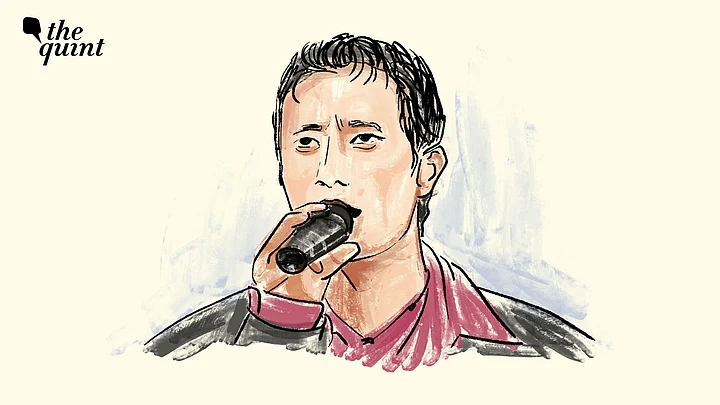
The year was 2007. Reality TV shows like Indian Idol, a spin-off of the British show Pop Idol, were gaining huge popularity. The format of the show went like this: aspiring singers would have to appear for an audition, where judges would ascertain their vocal capabilities. If a contestant impressed, they were met with an exhilarating affirmation, "Aap Mumbai aa rahe ho!" (you are coming to Mumbai).
Prashant Tamang burst onto the scene during season 3 of this famed TV show. A lanky 24-year-old from the hills of Darjeeling, Tamang was a constable with the Kolkata Police. He took up the job after his father’s early death, taking on the responsibility of supporting his family.
Tamang came from a modest background, had no formal training in music, and honed his musical skills while working in the police.
His story echoed that of almost every youth in the hills who grew up in the shadow of the violent Gorkhaland movement of 1986 (a campaign for the creation of a separate state), in which over 1,200 people are reported to have lost their lives.
Community Representation Through Music
Darjeeling, a town with a rich tapestry of musical heritage, has managed to nurture creativity despite a stark lack of infrastructure for children’s development, such as schools or centres dedicated to music and the arts. The youngsters in the area often learn music on their own, and it is not uncommon for every household to have at least one child who knows how to play an instrument like the guitar or drums.
This mountainous region has gifted the world remarkable artists, including Louiz Banks, revered as the godfather of Indian jazz, and the internationally acclaimed band Mantra.
Tamang’s story captivated audiences. However, in the Darjeeling and Sikkim hills—especially among Nepali-speaking communities in India and abroad—his progression through the show came to mean much more. Here was someone from their own backyard, showcasing his talent on a national platform.
It marked a first for a community long relegated to the margins, frequently subjected to jokes and stereotypes, and often viewed with suspicion over questions of belonging and national identity—conditions shaped by colonial legacies and popular culture, among other things. Hindi films and advertisements have routinely misrepresented Nepali people, confining them to roles as security guards, servants, or marginal comic figures.
Mobilising Nepali-Indian Identity
Projecting their hopes onto Tamang, Nepalis rallied behind him with remarkable intensity. Fan clubs sprang up, voting booths were set up to facilitate mass SMS voting, and students willingly spent their pocket money to support him. Donation drives followed, and even Nepalis living abroad sent money home, united by a shared determination to see him win.
One figure, however, was conspicuously absent from the hysteria surrounding Tamang: Subhash Ghising. Ghising, the then “hills’ political supremo,” publicly refused to support the campaign—an omission that did not go unnoticed by the people.
Then the ultimate happened: Tamang won. “The moment John Abraham announced Tamang’s name as the winner, my whole family had tears streaming down our faces. He became the role model our community had been missing for a long time,” a friend recalled.
Yet back home, unbeknownst to most, a quiet storm was brewing—one that would soon reshape the politics of the hills, which had remained calm for nearly two decades.
A Catalyst For A Turning Point
A day after his victory, a radio jockey on a private station made a racist remark targeting Tamang’s Nepali origins. The comment implied that now that a Nepali had become an Indian Idol, there would be no one left to guard homes, malls, and restaurants. All hell broke loose. The remark sparked violent protests across the Darjeeling hills and neighbouring Siliguri.
Driven by ethnic pride and long-standing grievances, thousands took to the streets, unwilling to endure a racist slight against their newly minted icon in silence. This was a different generation—more educated, more politically aware, and less willing to accept such indignities without resistance.
In Siliguri, a procession of around 2,000 people marching to submit a protest memorandum clashed with locals and police. Shops and vehicles were set ablaze, and more than 30 people were injured. A curfew was imposed in Darjeeling, Kurseong, and Kalimpong (which later became a separate district).
The army was called in to restore order. Tamang appealed for peace.
Political Upheaval
The unrest, however, exposed the deep rot in the existing leadership. One name that emerged during the mobilisation drive for Tamang was Bimal Gurung, a onetime trusted aide of Ghising.
Capitalising on his massive SMS voting campaign for Tamang, Gurung broke away and launched the Gorkha Janmukti Morcha on 7 October 2007, reigniting the demand for a separate Gorkhaland state. His rationale was straightforward: Nepali-speaking Indians, he argued, could attain dignity and recognition only through statehood, as Darjeeling and its people, he claimed, could not truly flourish within West Bengal.
Gurung, the chela, turned against his own guru. Ghising was forced to resign from the chairmanship of the Darjeeling Gorkha Hill Council and fled to Siliguri, where he lived for the rest of his life until his death in 2015.
Tamang remained popular in the community. He composed music, travelled the world performing at shows for the Nepali-speaking diaspora, dabbled in movies and shows, including the second season of Paatal Lok starring actor Jaideep Ahlawat.
Gurung has since been relegated to the margins, his political standing diminished by his failure to deliver on the promise of a separate state.
Outbound migration from the region has increased, driven by the closure of tea estates—once among the area’s largest employers—and by limited industrial investment, underscoring that the structural conditions which fuelled the unrest remain largely unchanged.
Prashant Tamang passed away at the age of 43 at his home in Delhi on 11 January 2026.
(The writer is researcher and guest lecturer of Mass Communication and Journalism at St Joseph's College, Darjeeling. This is an opinion piece and the views expressed are the author's own. The Quint neither endorses nor is responsible for the same.)