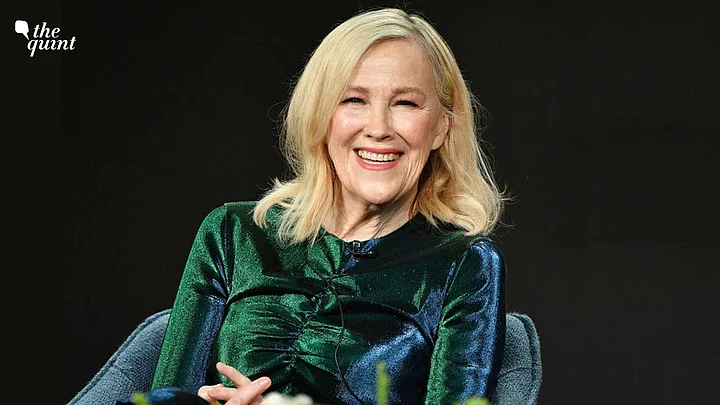
Who is this diva—I thought to myself as I watched Home Alone in the ‘90s. Catherine O’Hara’s Kate McCallister leaves her son behind as she jets off to a vacation. Once is a mistake. Twice? That’s commitment. Unhinged excellence, even.
“KEVIN,” she exclaims when it dawns upon her that her forgetfulness may have inflicted life-altering trauma on her son. But then, you know she truly loves him—even if she momentarily forgot about his existence.
Kate was a mother like all mothers: the kind who would cancel a vacation and head back home urgently when her son is in danger, even if it was she who put him in danger by leaving him alone in the first place.
It is flawed motherhood—the kind that rushes to make amends when tragedy strikes. To bring such complexity to a somewhat one-note character like Kate was typical O’Hara.
Studio Survivor With A Conscience
Then there’s Patty from The Studio (2025). I would be lying if low-key I didn't want her to burn down the Continental Studios building when she was fired from her job by Bryan Cranston’s Griffin. Boy, did Patty hate Griffin’s guts—and rightfully so, even if her vengeance was deeply humane. She almost tips off an investigative journalist about Griffin being a public nuisance while on drugs—a move that would cause irreparable damage to his image—but decides not to. It is a striking moment; one where she chooses restraint when cruelty would have been both obvious and justified.
Patty isn’t merely a studio relic, embittered by the movie business. She is someone who remains deeply committed to making good films, even as the industry works against her. She rails against Hollywood power brokers who privilege box-office returns over meaningful cinema.
She hates that she must write checks to undeserving nepo-babies in beanies while looking promising directors in the eye and refusing to commission their dream projects. Yet, she continues to play her role in the industry—the role of a somewhat consequential, yet largely powerless cog in the wheel—in the hope that she will get to make a ‘good movie’ someday.
From Camp Excess to Hard-Won Grace
Perhaps no character in O’Hara’s oeuvre is as monumental as Moira Rose in Schitt’s Creek (2015–2020). The once out-of-touch millionaire-wife, who gave her children the nastiest reads, donned outlandish couture wigs all while sipping champagne, and being blissfully unaware of how the real world works, evolves into a well-rounded figure who learns a thing or two about being human.
Her vanity is replaced by community spirit; her disdain for motel life by a reluctant acceptance at first, and later an embrace that seemed highly unlikely. She is still as campy, eccentric, and bougie towards the end of it all, but indisputably more human—her arrogance, born of living the high life, is beaten into a pulp and remoulded into genuine affection for the townspeople in a way only a few riches-to-rags stories can manage.
Last year, as I mindlessly deleted old pictures from my phone gallery after a glow-up, almost as an act of disowning my less-handsome old self, I was instantly reminded of Moira’s wisdom on taking “a thousand naked pictures of yourself” because you will “look at them with kinder eyes” one day.
When not urging me to be kind to myself, Moira quietly empowered me to embrace my eccentricity and display it unapologetically, instead of concealing it like an embarrassing secret.
It is crazy how much a performance can shape an individual’s trajectory, at times radically altering their self-perception. Such was Moira’s magic—she left an indelible mark on viewers, who lived a bougie life vicariously through her while owning their follies.
Perils of Vanity; Power of Restrain
And wouldn’t it be blasphemy if we didn’t address Delia Deetz, the narcissistic, emotionally distant artist mother from Beetlejuice (1988), who embodied performative disdain and cultural elitism? She was the vain matriarch cut from the same cloth as Moira but is far more delusional and dangerously unaware of just how shallow she is. O’Hara embodies this character, whose vanity has vanity, with just the right amount of airheadedness and performativity, which underscores—and later mocks—her self-seriousness.
Her role as Gail Lynden in The Last of Us (2022) saw the same maternal instincts manifest, albeit it was a departure from the campy characters she plays. Gail was grounded in restraint demonstrating O’Hara’s tremendous range—the doyen can far excel playing characters not as flamboyant and arguably more sentimental than the ones she plays.
O’Hara defied typecasting even while knowingly flirting with it throughout her five-decade-long career.
A Career That Outran Time
Catherine O’Hara mastered comedy without ever chasing it. There was an effortlessness to the way she essayed characters—donning their traits like a second skin—with an ease so instinctive that an unskilled eye might mistake it for nonchalance.
It is like the Gods of comedy bestowed on O’Hara a skill so evolved, a craft so masterful that the actor was not just the best part of any scene; she was the pulse that gave it life. She was the gravitational center, an animating force that enlivened every film, almost as if the cameras rolled and the production crew gathered on the day of the shoot only to see her brilliance unfold.
To say that O’Hara has left Hollywood poorer in terms of talent and grace would be an understatement. She boasts an enviable career, starting in a decade which saw the advent of television and stretching to one where Instagram Reels and TikToks reign supreme.
She survived tumultuous periods in pop culture, her relevance tested by ever-evolving industry standards, and yet she managed to reinvent herself enough times to hold her ground.
O’Hara is mother. A diva, and a certified baddie. If heaven ever has a shortage, it will never be of Catherine O’Hara’s grace.
Catherine O'Hara passed away at age 71 on 30 January.
(Deepansh Duggal is a film critic based out of New Delhi. His work has appeared in Hindustan Times, OPEN, Outlook, Frontline Magazine and The Economic Times. He has a particular interest in anti-capitalist narratives and films that lie at the intersection of power and ideology.)