Shashi Tharoor Exclusive: 'By Banning Mustafizur, BCCI Have Incited Bangladesh'
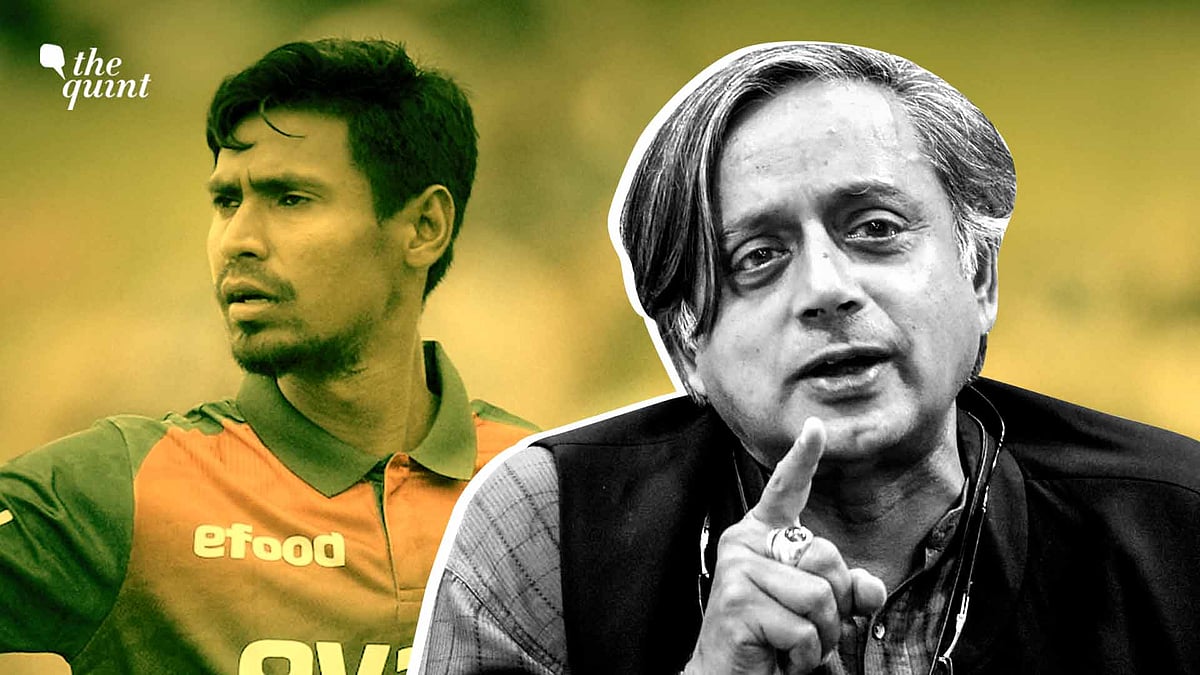
In an interaction with The Quint, Shashi Tharoor shares his thoughts on the BCCI's IPL ban on Mustafizur Rahman.
advertisement
The ICC Men’s T20 World Cup — one of cricket’s premier global spectacles — will commence in just 26 days. In an ideal world, the contours of the tournament would by now be firmly in place. The players would be fully aware of where and when they will take the field, the stadium administrators would be operating on a war footing to meet the highest standards, and fans would be locking in tickets and travel plans to support their teams.
Following BCCI’s decision to cave in to pressure from certain groups protesting Rahman’s participation, against the backdrop of violence against Hindu minorities in Bangladesh, the T20 World Cup has been plunged into disarray. Acting on a directive from Bangladesh’s interim government, the Bangladesh Cricket Board (BCB) has now indicated that it is unwilling to travel to India. Officially, the stance has been framed as a matter of security, but unofficially, it is widely seen as a symbolic protest against Rahman’s exclusion. While the ICC is understood to have explored alternative venues within India, the option of relocating Bangladesh’s matches to Sri Lanka has reportedly been ruled out.
In that scenario, will Bangladesh even show up at the World Cup? Will Kolkata, who were supposed to host three of Bangladesh's matches and have already started selling tickets for the first two, will be deprived of their quota of games? Or will their matches be, ultimately, held in Sri Lanka?
Some answers may emerge soon, with a meeting between the ICC and the BCB scheduled for Tuesday, 13 January. Yet the broader fiasco, argues Dr Shashi Tharoor, need never have arisen in the first place.
Edited excerpts:
How do you view BCCI's decision to ban Mustafizur Rahman from participating in the 2026 IPL?
My argument is very simple. The decision revealed BCCI’s pettiness, and we should be much bigger than that as a society. The BCCI had cleared the pool of players, Mustafizur Rahman was deemed eligible to be enlisted for the auction, and Kolkata Knight Riders picked an eligible player in good faith. Once that process was complete, the amount was announced and the player was preparing to turn up for the franchise. At that stage, to suddenly pull the plug raises serious questions. Why are you banning him now? On what grounds? And, ultimately, whom are you punishing through this decision?
Supporters of the move justify BCCI's decision by highlighting the killing of Hindu minorities in Bangladesh. What is your argument against that?
Yes, some people in Bangladesh are doing bad things. That is undeniable, and we have all spoken out against it. No one, anywhere, wants innocent people to be killed or targeted purely on the grounds of religion. I am also certain that India is using every appropriate diplomatic channel to convey its concerns and to press for restraint and accountability. However, at the same time, we must recognise that our own actions matter. By doing what we have done, we are making the situation worse.
One argument, which has been put forth by some former cricketers, state that a player becomes a collateral when his nation commits extremist violence. What is your take on it?
But has Mustafizur ever said anything to condone hate speech? Has he ever expressed anything anti-Indian or anti-Hindu? He is, quite simply, a professional sportsman. So why are we making him bear the burden of the lawless thugs on the streets of Bangladesh — people over whom he has no control whatsoever? And when we take such a step, what exactly are we punishing? Are we punishing a criminal, a wrongdoer, or are we, in effect, punishing a nationality?
Also, if you are going to ban one Bangladeshi player, does that logic then extend to all Bangladeshis? In a previous edition of the IPL, Litton Das played for KKR. He is a Bangladeshi too, but he is a Hindu. Would he have been banned under this logic? Suppose Soumya Sarkar had been picked this year, who is also a Bangladeshi Hindu cricketer — would he have faced the same fate? Are we now going to ban players just because they carry the wrong passport? What kind of a message are we sending to the world?
Is cricket becoming a soft target for political one-upmanship?
What troubles me most is that cricket alone is being made to bear this burden. We continue to have all kinds of relationships with Bangladesh. There are trade ties, we have embassies in each other’s countries, and we are even supplying them electricity. We are engaging with them at the highest diplomatic levels as well. Our External Affairs Minister, S Jaishankar, was recently in Bangladesh to attend the funeral of Begum Khaleda Zia, and rightly so, and to meet her son, Tarique Rahman, who could well be the country’s next leader. All of this is taking place, and yet cricket is suddenly being singled out as the one sphere where engagement must cease. That is fundamentally illogical. If morality becomes selective — invoked only in sporting contexts while economic and diplomatic engagement continues unchanged — it ceases to be moral and becomes merely symbolic.
Do you see this episode as one driven by immediate public sentiment and social media pressure?
Clearly, this was not a decision well thought through. This episode has the unmistakable sense of a decision taken in haste, shaped more by social media sentiment than strategic thought. It reflects poorly on us, and now we immediately have the backlash of Bangladesh, who are saying they don't want to travel to India for the T20 World Cup. As a host nation, we have to ask ourselves whether we are comfortable with the perception that India is not a safe or welcoming place to tour. This needs to be thought through in a calm and reasonable way, and an amicable solution needs to be found. Let the diplomats do the work of diplomacy, and let the cricketers play cricket.
How do you assess the optics and consequences of singling out a Muslim cricketer?
If the stated concern is the safety of minorities in Bangladesh, then singling out a Muslim cricketer is not merely illogical — it is actively counterproductive. You do not protect vulnerable communities by signaling intolerance elsewhere, or by projecting selective outrage. Real protection comes through sustained diplomatic pressure and consistent advocacy for human rights. Actions like these do not defend values, they end up diluting them, while handing extremists precisely the narrative they seek to exploit.
More broadly, Bangladesh's developments have been likened to that in Pakistan. Do you subscribe to this theory?
There is a worrying tendency to flatten South Asia’s complexities into convenient binaries. Bangladesh is not Pakistan — historically, politically, or diplomatically. Our disagreements with Dhaka, however serious, exist within a framework of dialogue and shared regional interests. To impose a Pakistan-style lens on Bangladesh ignores decades of engagement and risks damaging a relationship that is fundamentally different in character and consequence.