Mustafizur, BCCI & KKR: If a War Is Fought on 22 Yards, Cricket's the Collateral
Perhaps, the moment has arrived to equip sports journalists with tools of war reporting. Minus bulletproof vests.
advertisement
Even in 2026, George Orwell’s relevance is growing.
Indeed, on odd occasions, sport has served as a unifier. The most enduring example remains table tennis, which, in the 1970s, helped thaw the frost in relations between the United States and China.
But wait, how could one say it, when S Jaishankar, Minister of External Affairs, was recently in Bangladesh to convey his condolences over former Prime Minister’s Khaleda Zia’s death?
Because, unfortunate as it may be, the war is restricted only to cricket Much like the paradox that allows Jaishankar to warmly greet Sardar Ayaz Sadiq, the Speaker of Pakistan’s National Assembly, while the Indian cricket team remains conspicuously absent from post-game greetings. If there existed a more efficient instrument of soft power than cricket, this argument could end here.
Where else does one find a Pakistani fast bowler so inept that he single-handedly gifts victories to India on multiple occasions, yet feels emboldened enough to celebrate with gestures of shooting down aircraft? Or, where else would you find an Indian captain who took more jibes at his counterparts in interviews than the number of runs he accumulated in the entire year?
But this is not an Indo-Pakistan story. Not anymore. We have a new player in the Orwellian game. Welcome aboard, Bangladesh.
Let’s dig in.
Trigger — The Auction
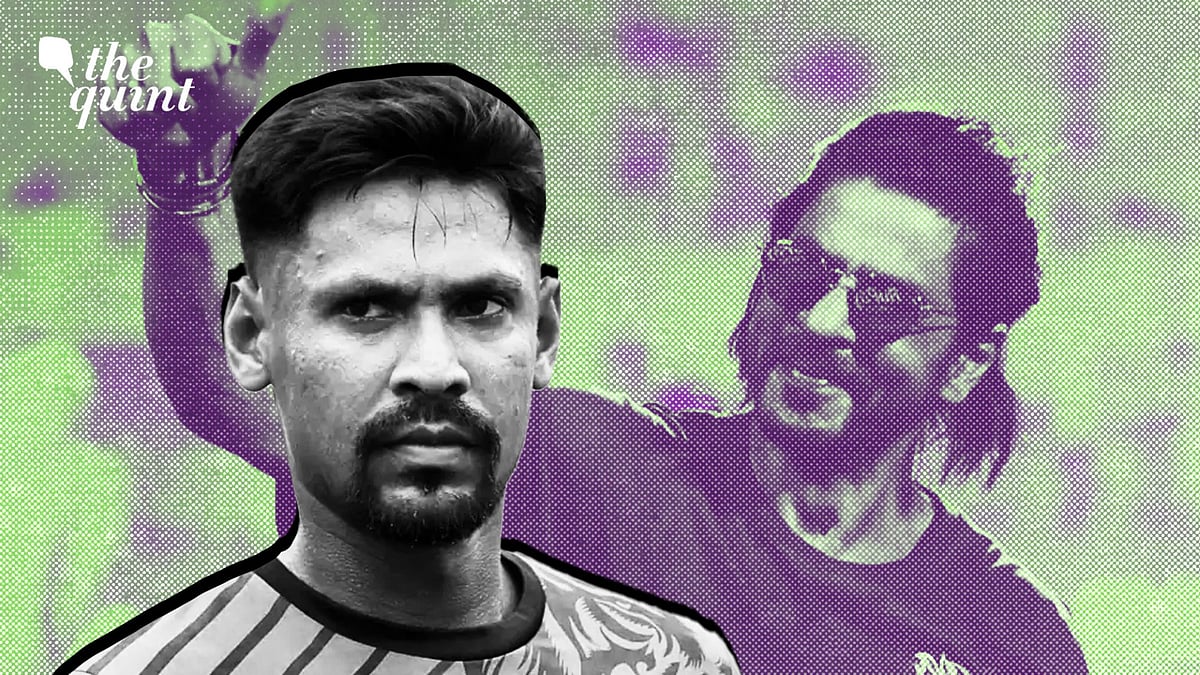
The entire saga commenced on 16 December, when Kolkata Knight Riders signed Bangladeshi pacer Mustafizur Rahman at the IPL auction. Almost immediately, far-right groups sought to frame the signing as moral complicity — casting the franchise as enablers of alleged atrocities against religious minorities in Bangladesh.
Fuel — Incendiary Speeches
The boycott calls intensified on 18 December — two days after the auction. In Mymensingh’s Bhaluka, Dipu Chandra Das, a 27-year-old factory worker, was beaten to death and set on fire by a mob that accused him of blasphemy. The incident became the accelerant that transformed an online murmur into a political rallying cry.
Sangeet Singh Som, a BJP leader from Uttar Pradesh and the former MLA from Sardhana constituency, demanded the actor’s deportation.
Politicians were not the only attendees of the party. The babas had their say. On Som’s like, Rambhadracharya deemed Shah Rukh Khan a traitor.
Another guru, Devkinandan Thakur, commented:
The agitation soon acquired a geographical immediacy. In Kolkata, where the franchise is based, BJP leader Kaustav Bagchi threatened street-level disruption if Rahman were to take the field at Eden Gardens.
Head coach Abhishek Nayar and analyst Nathan Leamon, who actually were involved in the squad building procedure, could consider themselves lucky that questions were not raised about their roles. Though, one is free to draw inference behind the owner’s singling out.
Explosion — Mustafizur Rahman Barred From IPL Participation
Amid unceasing protests, with eminent members of the ruling party getting involved, the BCCI opted to annul Rahman’s participation. Interestingly enough, the reason furnished was “recent developments,” without explicitly mentioning what eventually triggered the decision.
At that juncture, retaliation from Dhaka became inevitable. The Bangladesh Cricket Board, acting on the advice of the government, wrote to the ICC, informing it that Bangladesh would not travel to India for the 2026 ICC Men’s T20 World Cup, citing security concerns.
Per ESPNCricinfo, ICC have decided to reject Bangladesh’s request. They must, hence, play their matches in India, or risk forfeiting points.
Bangladesh’s final stance remains uncertain. But for now, they have opted not to telecast IPL in Bangladesh this year, whilst on a humanitarian level, anchor Ridhima Pathak, who was contracted for the Bangladesh Premier League, will now not be seen at the tournament.
What Could Have Been Done Differently?
Cricket, once again, had done what diplomacy could not — escalate a dispute far beyond its point of origin.
Did a cricketing acquisition have to trigger mass hysteria? It should not have — had it been handled with greater institutional clarity.
For instance, when the Bangladesh cricket team toured India in September 2024, many had threatened remonstrations. Hindutva leader Yati Narsinghanand Saraswati had openly threatened disruption at a match in Delhi, while in Gwalior, Bajrang Dal came up in numbers with black flags — only to be detained by the authorities. Them aside, Sakal Hindu Samaj and Hindu Mahasabha also threatened protests during that very series.
This is not unfamiliar terrain for Indian cricket administrators. If anything, boycott rhetoric reached a crescendo whenever India played Pakistan—most notably during the Asia Cup. Yet, the BCCI neither withdrew participation nor recalibrated policy. India played Pakistan thrice in that tournament, undeterred by the din.
So, could they have stuck to their usual policy of not letting threats affect the game? They could have.
Or alternatively, they could have opted to ban the Bangladeshi cricketers from registering at the auction in the first place, armed with a proper justification. Shah Rukh Khan, for one, would have had at least four fewer allegations of being a traitor that way.
No Winner, Losers Aplenty
In this game of one-upmanship, there is no winner, though both sides will claim that they won. When a cricket board attempts to solve a diplomatic crisis, the individual players become collaterals.
The ramifications now extend beyond symbolism. Should Bangladesh refuse to travel, Kolkata stands to lose three international fixtures — two of which already have tickets on sale. Should Bangladesh, despite the ICC’s directive, choose withdrawal, its players will forfeit a rare global stage.If an incendiary rhetoric is acted upon, it gets unintentionally validated.
Perhaps, then, the moment has arrived to equip sports journalists with the tools of war reporting. Minus the bulletproof vests.
This is war without the shooting, and reportage without armour. And cricket has agreed to become the collateral.