
'Need To Be Prepared': Kolkata Turns Into Fortress Amid Anti-Bangladesh Protests
A five-tier police deployment has been set up around the Bangladesh Deputy High Commission in Kolkata's Beckbagan.
advertisement
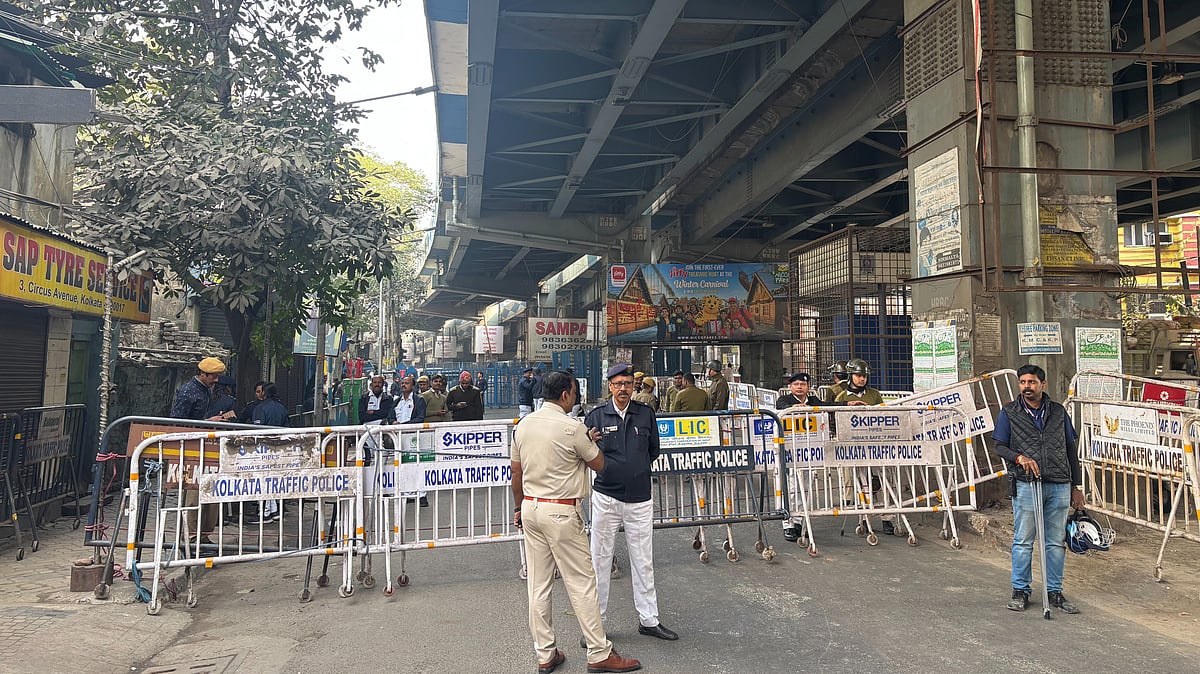
Circus Avenue, which is situated in the heart of Kolkata and houses the Bangladesh Deputy High Commission, wore the look of a fortress on Friday, 26 December, amid concerns of large-scale protests by the Bharatiya Janata Party (BJP) and right-wing groups over the death of a Hindu man in the neighbouring country.
Police officials in full riot gear guarding the Bangladesh Deputy High Commission in Kolkata's Circus Avenue on Friday, 26 December.
(Photo: Sakshat Chandok/The Quint)
While no protests have been held over the last two days, the area is still heavily fortified. The reason is the incidents that unfolded on Tuesday, 23 December, when demonstrators broke barricades to reach the high commission.
Kolkata Police riot gear lining the walls of the Bangladesh Deputy High Commission building.
(Photo: Sakshat Chandok/The Quint)
Tensions have been running high since 18 December, when Dipu Chandra Das was lynched in Bangladesh's Mymensingh over alleged blasphemy. His death came after the killing in Dhaka of student leader Sharif Osman Hadi, who was shot on 12 December and succumbed to injuries six days later.
5-Tier Police Deployment, Water Canons On Standby
Amid the tensions, a five-tier police deployment has been put in place to protect the Deputy High Commission building.
"I don't know when or even if protesters will come here today, but we need to be prepared for anything. We are on high alert," says one of the hundreds of police officials stationed in the Beckbagan area of Kolkata, while speaking to The Quint.
Women police officials stand guard in front of one of the gates put up to halt demonstrators marching towards the Bangladeshi mission.
(Photo: Sakshat Chandok/The Quint)
Traffic has been diverted from both sides of the road: from Minto Park on one end to the 7-point crossing in Park Circus on the other.
Beckbagan, one of the busiest areas of Kolkata, wears a deserted look amid high tensions.
(Photo: Sakshat Chandok/The Quint)
Large gates have also been put up at several points, guarded by armed men and women in riot gear, to prevent protesters from moving forward. A water canon truck has also been parked under the AJC Bose Road flyover in case the situation spirals out of control.
A water canon truck stationed just a few metres away from the Bangladesh Deputy High Commission.
(Photo: Sakshat Chandok/The Quint)
"I have been deployed here over the last four days," says a woman police official, taking rest on the steps of a nearby residential building just a few metres away from the Bangladeshi mission. "We have been told to keep a strict vigil and not let our guard down for the time being," she added.
'Police Unleashed Hell On Protesters': BJP's Suvendu
Following the altercation between the police and protesters on Tuesday, BJP leader Suvendu Adhikari said the force used by authorities "proved" that there was no difference between the governments of Mamata Banerjee and Muhamad Yunus.
"They (the police) unleashed hell. Barricades smashed, lathis swung like swords on defenceless protesters, women and elders dragged like criminals into prison vans, and blood spilled on Kolkata’s streets," the state's Leader of the Opposition said.
Apart from the BJP, a number of Hindutva groups had joined the demonstrations, including Bangiyo Hindu Jagran, Hindu Sanhati, Vishwa Hindu Parishad, and Bajrang Dal.
Among the several demands of the protesters are the strictest possible punishment for Dipu Das' killers and police officials who allegedly "turned a blind eye" to the murder. They have also urged the Bangladesh government to crack down on those spreading "rumours" against members of the Hindu community in the country.
A senior police official briefing authorities in Kolkata on Friday, 26 December.
(Photo: Sakshat Chandok/The Quint
The Kolkata Police, meanwhile, hit back against Adhikari's allegations, saying that claims of a peaceful demonstration having been conducted on Tuesday were incorrect. Sharing visuals of protesters purportedly breaking through barricades and setting fire to effigies, the Deputy Commissioner of Police of South East Division said:
Tensions have further been inflamed due to the the death of yet another Hindu man in Bangladesh. Local media reported that Amrit Mondal had allegedly been beaten to death by a mob in Rajbari over an extortion bid on Wednesday, 24 December.
While the Bangladesh interim government condemned the killing, they urged people not to view the incident through a "communal" lens.
"Based on police information and the preliminary investigation, it is evident that the incident was in no way a communal attack. It arose from a violent situation stemming from extortion and criminal activities," a statement from the government read.
Police trucks parked in front of the Bangladesh Deputy High Commission in Kolkata on Friday, 26 December.
(Photo: Sakshat Chandok/The Quint)
Anti-India Voices Rise in Bangladesh
Meanwhile, confrontational voices have arisen not only in India, but in Bangladesh as well where some have raised allegations, without any evidence, of India's backing of Osman Hadi's killers, who they say are from Sheikh Hasina's Awami League.
On the other hand, Hadi's brother implicated the Muhamad Yunus government of orchestrating the former's murder in a bid to destablise the country's electoral process and justify delaying the 2026 elections."It is you who had my brother killed, and now you are trying to foil the election by using this as an issue," local media quoted Omar Hadi as saying on Tuesday, 23 December.
He also issued a threat to the interim government, saying that if Osman Hadi's killers was not brought to justice, "you too will be compelled to flee Bangladesh one day".
Bangladeshi Hindus Caught in the Middle of Tensions
In all of this political turmoil, Bangladeshi Hindus are caught in the middle.
"There's no doubt that Bangladeshi Hindus have been living in an environment of fear," a Dhaka-based journalist told The Quint, requesting anonymity.
The Quint also spoke to a number of Indians and members of the minority Hindu community living in Bangladesh regarding their fears after the lynching of Dipu Chandra Das last week.
While some say that they do not fear for their personal safety, they argue that an atmosphere of gloom has been created because of the happenings of the last few days.
"I don't fear for my life here, but neither do I see a positive future for myself in this country," says Jatin (name changed on request), a Bangladeshi Hindu living in Dhaka.
Jatin says that while the recent attacks weren't particularly targeted against Hindus as such, the community is far more vulnerable than other sections of society.
Sahil (name changed on request), an Indian student pursuing BTech in Dhaka, agrees.
"While we do feel safe in the capital, there's always this fear hovering over us that until a proper government comes to power, this lack of stability will continue," he told The Quint.
- Access to all paywalled content on site
- Ad-free experience across The Quint
- Early previews of our Special Projects
Published: undefined