ICC T20 World Cup 2026: Pakistan Boycotts Match vs India. What Happens Now?

T20 World Cup 2026: Pakistan's boycott of the match against India marks the beginning of another geopolitical saga.
Shuvaditya Bose
Cricket
Published:
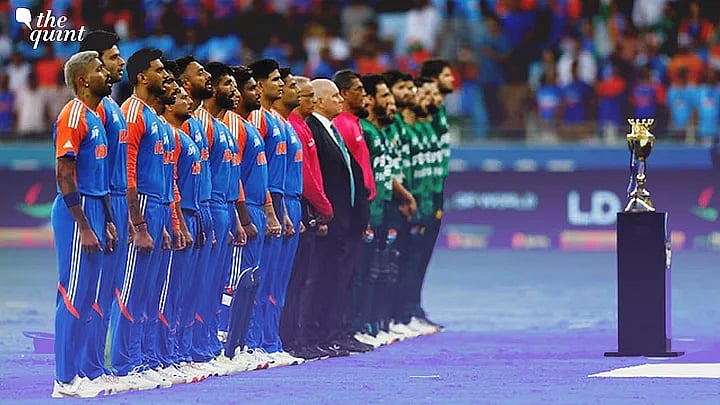
<div class="paragraphs"><p>Pakistan have announced a boycott of the T20 World Cup 2026 match against India.</p></div>
i

Pakistan have announced a boycott of the T20 World Cup 2026 match against India.

(Photo: X)

advertisement

The ICC Men’s T20 World Cup 2026 has taken yet another dramatic turn after the Government of Pakistan announced that its national team will not play India in the upcoming tournament. On Sunday, the government’s official social media accounts confirmed that while the team has been granted the permission to compete at the tournament, they will not be taking the field on 15 February, when they were scheduled to face rivals India at the R Premadasa Stadium in Colombo.

The post read:

The Government of the Islamic Republic of Pakistan grants approval to the Pakistan Cricket Team to participate in the ICC World T20 2026, however, the Pakistan Cricket Team shall not take the field in the match scheduled on 15th February 2026 against India.
Government of Pakistan

The announcement raises two immediate questions: why has Pakistan taken this step, and what consequences might follow? There's a lot to unpack.

Why Will Pakistan Not Play Against India?

While no official reason has been cited by either the Pakistan government or the Pakistan Cricket Board (PCB), the decision appears closely linked to Bangladesh’s recent suspension from the tournament. Bangladesh were removed after refusing to travel to India for security reasons, a move that Pakistan publicly opposed.

Notably, Pakistan were the lone supporter of Bangladesh in this issue, and even accused the ICC of showing double standards. At an ICC voting session, Pakistan were the only nation to vote in favour of Bangladesh, with 14 other countries voting against them. In that context, Pakistan’s boycott of the India fixture appears to be a symbolic protest, even if the connection has not been formally acknowledged.

Another explanation being discussed in sections of the media relates to recent terrorist attacks in Balochistan, which reportedly killed 18 civilians and 15 troops. PCB chairman Mohsin Naqvi — who also serves as Pakistan’s interior minister — openly blamed India for the attacks, alleging state-sponsored involvement.

The claims, however, remain unsubstantiated.

India is behind these attacks. I can tell you for sure that India planned these attacks along with these terrorists. At this time it is very necessary that the world knows that the main country that is behind terrorism is India, who not only financially supports terrorists but also supports them in their planning and strategy as well.
Mohsin Naqvi

What makes the decision particularly striking is that it has little direct bearing on logistics or security. Unlike Bangladesh, Pakistan were not scheduled to play any matches in India. Under the hybrid hosting arrangement, all of Pakistan’s group fixtures are set to be played in a neutral venue, that is, Sri Lanka.

What Has the ICC Said?

The ICC has acknowledged the government’s statement but, as of Sunday night, was awaiting formal communication from the PCB. In a strongly worded response, the world body expressed concern over the implications of selective participation.

The ICC notes the statement that the government of Pakistan has made regarding the decision to instruct its national team to selectively participate in the ICC Men's T20 World Cup 2026. While the ICC awaits official communication from the Pakistan Cricket Board (PCB), this position of selective participation is difficult to reconcile with the fundamental premise of a global sporting event where all qualified teams are expected to compete on equal terms per the event schedule. ICC tournaments are built on sporting integrity, competitiveness, consistency and fairness, and selective participation undermines the spirit and sanctity of the competitions. While the ICC respects the roles of governments in matters of national policy, this decision is not in the interest of the global game or the welfare of fans worldwide, including millions in Pakistan. The ICC hopes that the PCB will consider the significant and long-term implications for cricket in its own country as this is likely to impact the global cricket ecosystem, which it is itself a member and beneficiary of. The ICC's priority remains the successful delivery of the ICC Men's T20 World Cup which should also be the responsibility of all its members including the PCB. It expects the PCB to explore a mutually acceptable resolution, which protects the interests of all stakeholders.
International Cricket Council
ADVERTISEMENT
ADVERTISEMENT

Are There Any Precedents of Selective Boycotts at ICC Events?

Indeed, there are.

At the 1996 World Cup, Australia and West Indies refused to send their teams to Sri Lanka, to compete against the Lankans. Unlike the current scenario between India and Pakistan, neither Australia nor West Indies had any geopolitical rift with Sri Lanka. However, the matches were organised just a couple of weeks after the Tamil Tigers had bombed Colombo’s Central Bank, and hence, they cited security concerns.

The closest semblance to the current situation lies with England’s boycott of the match against Zimbabwe at the 2003 World Cup. Tony Blair’s government in the UK had a strenuous relationship with Robert Mugabe’s government in Zimbabwe. Notably, Henry Olonga and Andy Flower wore black armbands in their opening game to protest against Mugabe’s regime, and had to retire from Zimbabwean cricket.

On both occasions, the ICC did not ban the team altogether, but gave points to the other team — Sri Lanka and Zimbabwe.

What Happens Now?

Given that there is no precedence of the ICC entirely suspending a team from participation owing to the boycott of one specific match, it will be interesting to see if the global body resorts to that measure this time around.

If not, financial sanctions could be imposed. Industry estimates suggest that an India–Pakistan match can generate between ₹200 crore and ₹500 crore in advertising value alone, with recent Asia Cup encounters seeing 10-second ad slots sell for ₹14–16 lakh. Any loss of revenue could prompt the ICC to impose financial sanctions, including a reduction in Pakistan’s annual revenue distribution.

Though not explicitly, but ICC did hint at such a measure by stating: The ICC hopes that the PCB will consider the significant and long-term implications for cricket in its own country.

With the majority of ICC's revenue being distributed among the member boards, and a global event like the T20 World Cup being among the most significant sources of revenue, the impact of a financial hit will be felt by most teams. Perhaps, however, Pakistan will be the worst hit.

Published: undefined

ADVERTISEMENT
SCROLL FOR NEXT