‘Oli Didn't Order the Firing...’: Party Cadres Erupt Over Ex-Nepal PM’s Arrest
Oli was arrested on 28 March over his alleged role in the crackdown against Gen Z protesters in September last year.
advertisement
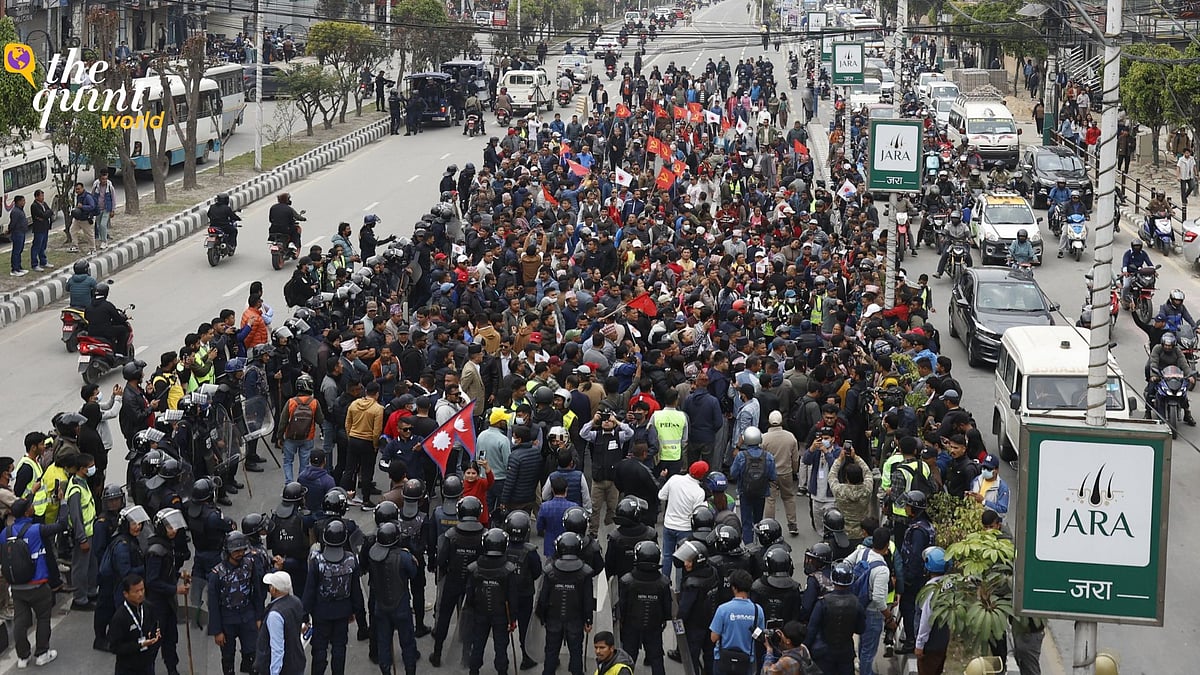
"KP Sharma Oli didn't order the security forces to fire at protesters during the Gen Z uprising last year. He should be released immediately," Birendra Madi, a member of Oli's Communist Party of Nepal (Unified Marxist–Leninist), who took to the streets of Kathmandu in protest on Monday, 30 March, told The Quint.
Apart from the capital city, fresh protests broke out in several districts of Nepal to oppose the arrest of the former PM on 28 March, a day after Balen Shah was sworn in as the country's new top leader.
The arrest followed the findings of a probe commission formed by the interim government under Sushila Karki.
(Photo Courtesy: Pratik Ghimire)
Approximately 300 demonstrators marched from Kathmandu’s Maitighar to the New Baneshwar area, chanting slogans such as ‘Dismiss Karki Commission Report’, ‘Release KP Oli’, and ‘Resign Home Minister Sudan Gurung’.
'Vindictive Move By Balen Shah Government'
Madi, a local UML leader in his 20s, claimed that the crackdown on the Gen Z demonstrations was not Oli's fault. "Security forces only opened fire in self-defense after demonstrators attacked the Federal Parliament building," he alleged.
After protesters set fire to the Parliament building on 8 September last year, the police were accused of brute force after they fired live ammunitions. According to local reports, at least 17-19 people died in the incident.
UML cadre Thaneshwar Basyal, who is in his 50s, described Oli's arrest as an "assault" on democratic values.
(Photo Courtesy: Pratik Ghimire)
Bimala BK, another local UML leader in her 40s who was at the forefront of the march, told The Quint that the party "entirely" rejects the findings of the report led by former judge Karki. “The overnight arrest of Oli is a vindictive move by the government. Our protests will continue until our chairperson is released."
Ganesh Pandey, another participant, warned that if Oli is not freed immediately, the movement will expand beyond the streets. “We will take our protest to the Parliament and the courts,” Pandey asserted, adding, “The schedule for the next phase of our protest will be released soon.”
Over the last three days of the protests, the Nepal Police has made several arrests. Abhi Narayan Kafle, primary spokesperson of the Nepal Police Headquarters in Kathmandu, told The Quint:
(Photo Courtesy: Pratik Ghimire)
Oli Remanded While Investigations Continue
The probe commission’s report had concluded that the deaths of more than 70 people during the Gen Z protests were a "direct result of negligence" by Oli and Lekhak. According to the findings, the commission recommended that the Criminal Code should be applied to both the leaders.
Under sections of the Criminal Code, which stipulate "negligent killing shall not be permitted", the charges against Oli carry a potential penalty of up to three years in prison and a fine of up to 30,000 Nepali rupees.
(Photo Courtesy: Pratik Ghimire)
In its ruling, the court had stated that the police's request appeared cogent. Consequently, it ordered the detainees to remain in police custody under Section 14(6) of the Criminal Procedure (Code) Act, 2074 BS.
Given Oli’s condition, the authorities have been directed by the court to ensure he receives all necessary medical care during his detention.
According to the hospital’s official statement, “KP Sharma Oli is a post-renal transplant patient currently being treated for hydronephrosis, diabetes mellitus, hypertension, hypothyroidism, and atrial fibrillation with APC. He also has a diagnosis of cholelithiasis."
The statement added that he's under observation, and is being managed by a medical team.
(Photo Courtesy: Pratik Ghimire)
Regarding the duration of custody, the police clarified that in murder investigations, a suspect can be detained for up to 25 days with court authorisation. While the court currently granted a five-day extension, the total period may be extended to 25 days depending on the evidence uncovered as the investigation progresses.
UML & RSP Trade Barbs Over Oli's Arrest
In the wake of Oli's arrest, several leaders of his party and Balen Shah's Rastriya Swatantra Party (RSP) traded barbs. UML General Secretary Shankar Pokharel, while speaking to The Quint, said the politics of "prejudice and revenge will turn out to be costly for the government". Similarly, another party leader Mahesh Bartaula said the RSP's actions are "malicious" and "extremely objectionable".
(Photo Courtesy: Pratik Ghimire)
During the protests against Oli’s arrest, Sajida Siddiqui, a UML Central Committee member and provincial MP, was among those injured. She alleged that the police significantly outnumbered the protesters—and suppressed the peaceful demonstration by charging them with batons.
Hitting back against Oli's party, Rachana Khatiwada—a federal lawmaker from the RSP and mother of a deceased Gen Z protester—said Oli's arrest exemplified justice for her son and others who were killed in the September 2025 unrest.
"This is just the beginning of justice,” she told The Quint.
Pukar Bam, a lawmaker and Central Committee member of the RSP, told The Quint that the Balen Shah government must work at "full pace to recover the 35 years of losses due to the ineffective and unstable governance of previous administrations".
”The foundation of this government is the Gen Z movement,” Bam said, adding, “We have begun the work mandated by the people through the ballot.”
(Photo Courtesy: Pratik Ghimire)
On the other hand, a lawyer The Quint spoke to said that the government's decision to arrest Oli was "hasty"—and that the law must be allowed to take its course.
"Even if legal action is pursued, a specific due process must be followed. I don’t think the situation warranted an immediate arrest," said Jagadish Dahal, senior lawyer and member of the Nepal Supreme Court Bar.
Dahal argued that rather than taking Oli into custody immediately, an investigation team should have been formed to move the case forward systematically.