
India's Davos Obsession Is Now a Vanity Project
The WEF has become so 1990s that it's like using a landline in the age of smartphones, writes Madhavan Narayanan.
advertisement
If the cheerleaders of Andhra Pradesh Chief Minister Nara Chandrababu Naidu have their way, the World Economic Forum at Davos might as well be renamed the World Telugu-pride Forum. Cynical jesters of Gen Z may well approve of that as having an appropriate abbreviation. Truly WTF!
While global leaders and policymakers meet at the Swiss Alps to discuss profound changes sweeping geopolitics and geoeconomics, Indian chief ministers, politicians, and industrialists are generating jibes, jabs, and memes in social media posts that lampoon a wannabe attitude and a waste of taxpayer money because a lot of what they do in the European jamboree may well be done in India.
“They allow state chief ministers to travel at public expense to sign MoUs or hold meetings that can be held right here—Mumbai, MP, Assam, AP— wherever. Worse, they publish photos to make us cringe! The world laughs!” read senior finance journalist Sucheta Dalal's well-crafted post on X.
Indian Chief Ministers Seek Spotlight
But Naidu was only one of the chief ministers present in Davos. State satraps cut across party lines to let themselves shine in the reflected light of golden rays bouncing off the snowy Alps.
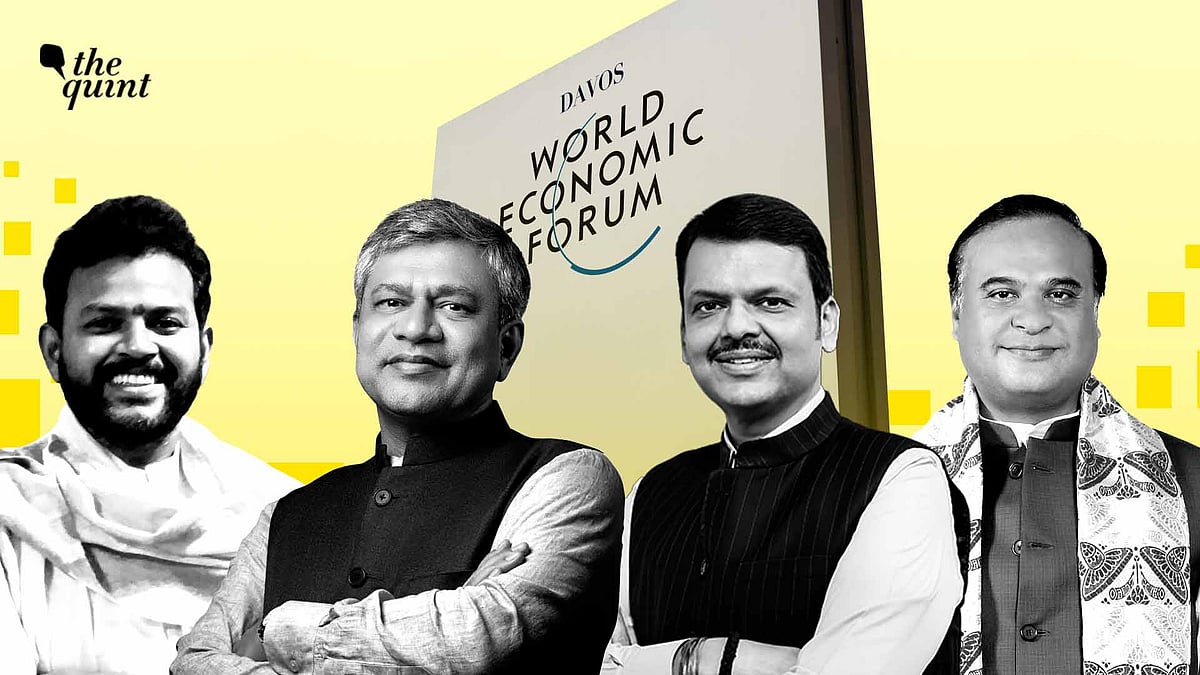
They were certainly breathing a mountain air a lot cleaner than the ones less fortunate Indians in Delhi and Mumbai were inhaling. Congress Chief Minister Revanth Reddy of Telangana was also present at the WEF as were the Bharatiya Janata Party (BJP)’s Mohan Yadav and Devendra Fadnavis, whose Davos meeting with his Assam counterpart Himanta Biswas Sarma from the same party became fodder for memes.
If they looked like also-rans in a glamorous global event, Jharkhand Chief Minister Hemant Soren looked like an also-ran in a race of also-rans. Reddy was smart enough to call for a mid-year follow-up meeting to take stock of Davos commitments, but that sounded vain enough.
When MoUs Mistake Intent for Investment
MoUs between business groups and governments on planned investments are often a showcase of intent rather than real plans, and mistaking them for real money on the table is like mistaking a coffee date for a wedding reception.
MoUs are routinely signed at catchily branded investment summits like Vibrant Gujarat, Rising Rajasthan, Magnetic Maharashtra, and Invest Madhya Pradesh.
But the fact that taxpayer money is at stake—or, for listed companies, the investment money of minority shareholders—there is a need to examine the spending on Davos dos.
For all its talk of ideas and impact, Davos increasingly resembles an expensive sideshow heavy on selfies and symbolism, light on outcomes, and funded by money that could arguably be better spent back home.
The Price of India’s Davos Fixation
Is it really worth it when all they do are sideshow meetings, media soundbites, and glorified selfies? Something in the way wannabe Indian leaders do at Davos reminds one of the increasing fascination of India’s new-rich for destination weddings. A Davos outing is a lot like a desi baraat in an Italian or Indonesian resort, but what hurts is that the expenses come out of the money that may be better spent on road repairs, metro lines or sewerages in India’s increasingly choking cities.
Global development agency Oxfam International reported ahead of the WEF that billionaire wealth jumped by over 16 percent in 2025, three times faster than the past five-year average, to $18.3 trillion—its highest level in history.
Davos became significant this year because of an open clash between the speeches made by US President Donald Trump and Canadian prime minister Mark Carney. While Carney called out the "rupture" in Trump’s quest for a new world order, Trump confirmed it later by slamming green energy as a scam, and mocking the immigration policies of Europe—not to speak of his direct security threat to Europe and the North Atlantic Treaty Organization (NATO) over the American greed to grab Greenland.
Did anyone even notice? A Hindustani proverb comes to mind: “Begani shaadi mei Abdullah deewana” (Abdullah goes crazy celebrating a stranger’s wedding).
How did we get here?
The 1990s Moment That Gave Davos Its Purpose
To know this, I take you back to the 1990s when the WEF became hot as a wave of reformist changes swept the global economy warming up to multilateral globalisation that starkly contrasts Trump’s Big Brother version.
The collapse of the Soviet Union, the rise of China, and East Asian “Tiger” economies, the reformist zeal of the former East Bloc countries and the liberalisation programme in India made the WEF a good place for what one might call FDI (foreign direct investment) shopping. Global business leaders found the Alps summit a good place to measure the seriousness in the chemistry of their meetings with emerging economy policymakers, while policymakers used the annual summit to learn the ropes of wooing FDI. Admittedly, Andhra’s Naidu was one of the early converts to this fold and did a pioneering job that now seems outdated.
We might as well say that with the willing support from shallow TV news anchors, the Davos summit helps state leaders become “world famous in India”. The WEF for Indian leaders is increasingly a vanity project packaged as a job and wealth creation forum.
As India faces new-age challenges based on a combination of a demographic explosion, technological disruptions, geopolitical upheavals and employment challenges, the WEF has become so very 1990s that it is like using a landline connection in the age of smartphones. Satirists and meme-makers are only giving a wake-up call to sleepy leaders living in the past.
(Madhavan Narayanan, a senior editor, writer, and commentator with over 30 years of experience. This is an opinion article and the views expressed above are the author’s own. The Quint neither endorses nor is responsible for them.)
- Access to all paywalled content on site
- Ad-free experience across The Quint
- Early previews of our Special Projects
Published: undefined