
Why Tamil Nadu Keeps Turning Film Stars Into Political Icons
The remarkable marriage of cinema, politics has produced some of South India’s most iconic political personalities.
advertisement
In most of India, movie stars merely flirt with politics. In South India, they often ascend to political royalty.
For more than half a century, the Southern states have witnessed an extraordinary phenomenon in which actors have not simply campaigned for political parties but transformed themselves into chief ministers, mass messiahs, and objects of emotional devotion bordering on the religious. Admirers have poured milk over towering cut-outs of their screen idols, built temples in their honour, prayed and fasted for their recovery, and voted for them with a loyalty many democracies reserve only for founding fathers.
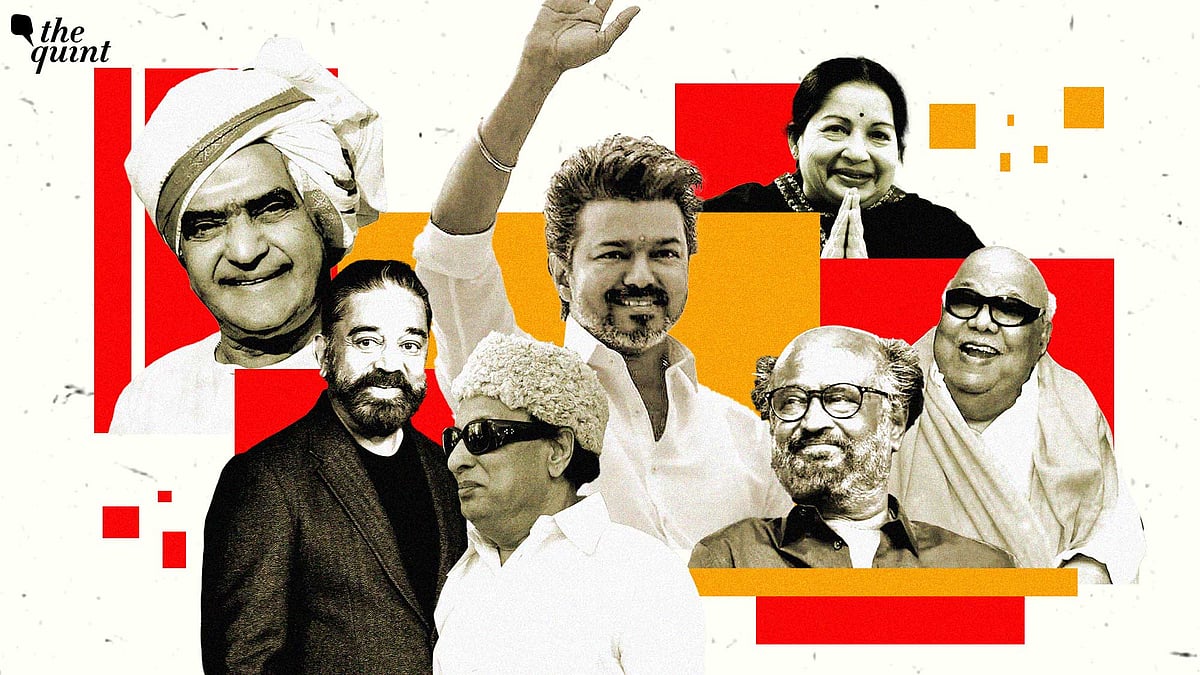
This remarkable marriage of cinema and politics has produced some of India’s most iconic political personalities—MG Ramachandran, M Karunanidhi, J Jayalalithaa, NT Rama Rao, Rajinikanth, Kamal Haasan, and now Vijay.
Why has this phenomenon flourished so spectacularly in South India while remaining relatively limited elsewhere in the country? The answer lies in a combustible blend of cinema, linguistic pride, social aspiration, hero worship, and emotional politics.
A Marker of Indentity
South Indian cinema—particularly Tamil and Telugu cinema—evolved very differently from Hindi cinema. In the north, Bollywood heroes largely entertained. In the south, film stars frequently emerged as moral guardians, social reformers, and defenders of regional and linguistic identity. Their films were not merely escapist spectacles; they carried political and social messages wrapped in melodrama, stirring songs, emotional dialogue, and thunderous monologues.
Films like Parasakthi, written by M Karunanidhi and starring Sivaji Ganesan, attacked caste oppression, religious hypocrisy, and social inequality through fiery courtroom speeches that later echoed as political slogans across Tamil Nadu. Movies such as Velaikari and Nallathambi championed workers, criticised feudal privilege, and promoted the social justice ideals of the Dravidian movement.
Then came MG Ramachandran—universally known as MGR—perhaps the greatest political superstar India has ever produced.
His films carefully cultivated the image of a compassionate saviour of the poor. In movies like Enga Veettu Pillai, Nam Naadu, and Rickshawkaran, MGR defended labourers, punished corrupt elites, protected widows and the vulnerable, and restored moral order with near-divine certainty. Over time, audiences stopped distinguishing between the cinematic hero and the real man. The screen persona dissolved seamlessly into political identity.
The same phenomenon later elevated J Jayalalithaa, MGR’s co-star and political heir. To millions, she was not merely a chief minister but “Amma”—mother. Her carefully cultivated maternal image and welfare schemes deepened the emotional bond between leader and electorate. Politics became intensely personalised and familial rather than ideological.
A similar drama unfolded in neighbouring Andhra Pradesh. NT Rama Rao —NTR— achieved near-divine stature through mythological films like Maya Bazaar, Lava Kusa, and Dana Veera Soora Karna, in which he portrayed gods and epic heroes such as Krishna, Rama, and Karna. For countless Telugu viewers, NTR ceased to be merely an actor. He became the living embodiment of virtue, justice, and Telugu pride itself. Villagers garlanded his photographs like religious icons.
When NTR founded the Telugu Desam Party (TDP) in 1982, he tapped into wounded Telugu identity and resentment against Congress centralism. But what truly propelled him to power was something ordinary politicians could never manufacture—instant emotional familiarity and mythic legitimacy. He stormed to power within months.
No conventional political apprenticeship could compete with that kind of emotional capital.
A Theatre of Democratic Aspirations
The sociological roots of this phenomenon run even deeper.
Cinema in South India became the great democratic theatre of aspiration. For the poor and lower middle classes, film stars represented success achieved against enormous odds. Many actors emerged from modest backgrounds, spoke the language of ordinary people, and projected themselves as self-made men and women rather than distant elites.
Fan associations organised food distribution, blood donation drives, welfare activities, birthday celebrations, and massive public gatherings. When a film star entered politics, these fan networks effortlessly evolved into booth-level political machinery.
This did not happen with the same intensity in North India. Bollywood actors certainly entered politics—from Sunil Dutt, Amitabh Bachchan, Vinod Khanna to Shatrughan Sinha and Smriti Irani—but largely as celebrities attached to existing political parties. They seldom built independent mass political movements rooted in their cinematic identities.
Rajinikanth generated almost messianic anticipation for years with hints of a political entry before eventually stepping away from electoral politics. His enormous popularity nevertheless demonstrated that the emotional fascination with film stars remains intact, even if translating charisma into governance has become more difficult in today’s fragmented political landscape.
Kamal Haasan attempted a different route, presenting himself as an intellectual reformer rather than a larger-than-life messiah. But in South Indian politics, rational reformism has rarely rivalled emotional mythology at the ballot box.
A New Era
And now comes Vijay.
Through films like Mersal and Sarkar, Vijay cultivated the image of a crusader against corruption, inefficiency, and social injustice—a familiar cinematic pathway into politics in Tamil Nadu. His political arrival has electrified his massive fan base, which is youthful, digitally connected, and emotionally invested in his rise. The excitement surrounding his entry shows that the ancient alliance between cinema and politics in South India is far from over.
To outsiders, this fascination may appear irrational. Why should acting ability qualify someone to govern a state? But that question misunderstands the emotional grammar of South Indian politics.
Voters are not merely choosing administrators. They are choosing symbols—protectors, embodiments of regional pride, and familiar faces who have inhabited their imaginations for decades. In societies where politics often appears cynical, corrupt, and emotionally distant, the cinematic hero offers reassurance, familiarity, and hope.
The actor first enters people’s lives as a saviour on screen.
Then, one day, he steps off the screen and asks for votes.
And millions—already emotionally prepared by years of devotion in darkened cinema halls—hand them over willingly.
(The author is a Fellow of the Royal Geographical Society and Explorers Club USA, and Editor of ‘Indian Mountaineer’. He is also the founder of Bharatiya Yuva Shakti, an organisation that ensures good leadership at the village level. He tweets @AkhilBakshi1. This is an opinion piece, and the views expressed above are the author’s own. The Quint neither endorses nor is responsible for the same.)
- Access to all paywalled content on site
- Ad-free experience across The Quint
- Early previews of our Special Projects
Published: undefined