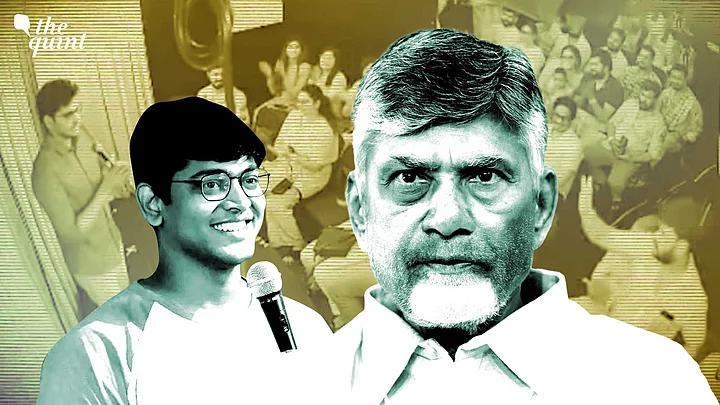
A stand-up comedy show by Hyderabad-based comic Sarat Uday in Bengaluru was recently disrupted by a group claiming to be supporters of the Telugu Desam Party (TDP). The group objected to political jokes Uday had made about Andhra Pradesh Chief Minister N Chandrababu Naidu nearly two years earlier.
During the show, several men came onto the stage and verbally abused the comedian. They demanded that the comic apologise again in public, even though he had already apologised in 2024 after backlash over the same jokes.
The groups also pressured Uday to chant pro-TDP slogans, which he refused to do. The confrontation reportedly included threats and warnings against repeating such jokes in the future.
The controversial jokes were part of a YouTube video titled “Andhra Politics,” in which Uday joked about leaders from multiple parties, including the TDP, the YSR Congress Party, and the Jana Sena.
Some remarks referenced the 2003 Naxal assassination attempt on Naidu and comments about Naidu’s son Nara Lokesh.
A Larger Pattern of Clampdown
The TDP officially distanced itself from the protesters. But its clampdown tactics perfectly fit into the larger pattern at play elsewhere in India, wherein political parties publicly deplore or disassociate with acts of hooliganism while the fringe elements they promote continue to perpetrate such unlawful acts with impunity.
Normally, radicalised right-wing groups indulge in such acts. But supporters of an established political party which has no such history in the past involving in such extreme acts, needs to be seen in its proper perspective.
The incident of political assault on a comedy show should, therefore, be seen in the context of the toxic political culture prevailing in Andhra Pradesh. The strangulation of political satire is just symptomatic of the larger malaise plaguing the state politics and society, which remains much out of the limelight of the national political discourse dominated by hardliner Hindutva intolerance.
The disastrous consequences of such political intolerance is for everyone to see in, say, West Bengal.
Is Andhra the Next Bengal?
Is Andhra Pradesh heading towards a "party society", a concept used by social scientists to describe the rural West Bengal?
A "party society" is a political concept describing a system where a political party permeates all aspects of social, economic, and local life, blurring the lines between the state, the party, and civil society. Drawing parallels between West Bengal and Andhra Pradesh may be some exaggeration at this point in time. But, certainly, the developments in Andhra Pradesh are towards that direction.
Andhra Pradesh is now completely polarised between two leaders, two parties and, to put it rather crudely, two caste loyalties. The state Deputy Chief Minister, Pawan Kalyan, himself regretted that the state is divided in caste lines unlike in Telangana.
This acrimonious polarisation is not just confined to election season. Both the TDP and the YSR Congress leaderships pursue politics as a relentless activity. No single opportunity is spared to mount attacks on each other. The political rhetoric on both sides is amplified and disseminated by subservient media outlets.
The loyal television channels run daily live discussions on petty political disputes with party spokespersons and so-called analysts who are promoted by respective parties taking a belligerent posturing. This further infuriates the loyal support base of both the political parties. The social media wings of both the parties run toxic posts often abusing the other party leadership in absurd language too.
The troll army is let loose not just on rival political parties but on even anyone and everyone who does not agree with them.
Recently, a noted constitutional expert and former Central Information Commissioner Madabhushi Sridhar penned an article on the ongoing debate over the Mavigun corridor proposed by YS Jagan Mohan Reddy as the capital of Andhra Pradesh in lieu of Amaravati. Sridhar has no history of analysing politics on a daily basis.
Yet, the TDP trolls ran a virulent campaign against him. How can a political party mount such an organised attack on a public intellectual simply for expressing his opinion on a current issue even if it is unpalatable for them? This is the level of non-state actors going berserk in Andhra Pradesh.
The state police are also filing cases for making social media posts. This is not the usual behaviour of the Naidu-led NDA government. Even the YS Jagan government harassed people for posting contrary political opinions in social media.
'My Way or the Highway'
Even this author is a victim of the TDP’s online attack, despite being critical of both the TDP and the YSR Congress, while even being appreciative of the TDP’s stand on some other occasions. They want everything to be "my (their) way or the highway".
Speaking to The Quint on condition of anonymity, a senior TDP leader said that the political stakes in Andhra Pradesh are so high that the party cannot afford to tolerate any dent into its image. He further stated, "When they cannot logically counter my analysis, the only option they have is to delegitimise me. Any difference of opinion is construed as deliberate adverse campaign."
Both the TDP and the YSR Congress have a huge online support base. The anonymous nature of online conversation encourages personally humiliating and rather preposterous attacks. The algorithms further promote such hate mongering and toxicity.
Even the first families of both the parties are the victims of such online political hooliganism. No one claims a monopoly over the phenomenon of online trolling.
Now, the online hate seems to be spilling over to the offline spaces. The attack of TDP supporters on a comedy show shows how online hate permeates into offline public spaces further vitiating the atmosphere.
The leadership is also complicit in this as they do not act on their extremist supporters. The reality is that the political parties believe that they are benefiting from these toxic acts of fringe elements.
The leadership when contacted said that they have no control over millions of their supporters. But the fact is that the organised trolling activity under the aegis of social media wings of political parties fuels unorganised supporters as well.
As a result, freedom of expression is throttled at the altar of political bullying. Independent journalists, political commentators, and even public intellectuals have to experience threats vandalising the public sphere.
In this sense, is the TDP starting to act more and more like the BJP?
(Prof K Nageshwar is a senior political analyst, faculty member of Osmania University, and a former MLC. This is an opinion piece, and the views expressed are the author’s own. The Quint neither endorses nor is responsible for them.)