
Vijay Sworn in as Tamil Nadu CM, Rahul Attends: How Cong Became Kingmaker Again
The Congress has been a kingmaker in Tamil Nadu for the better part of the last 50 years.
advertisement
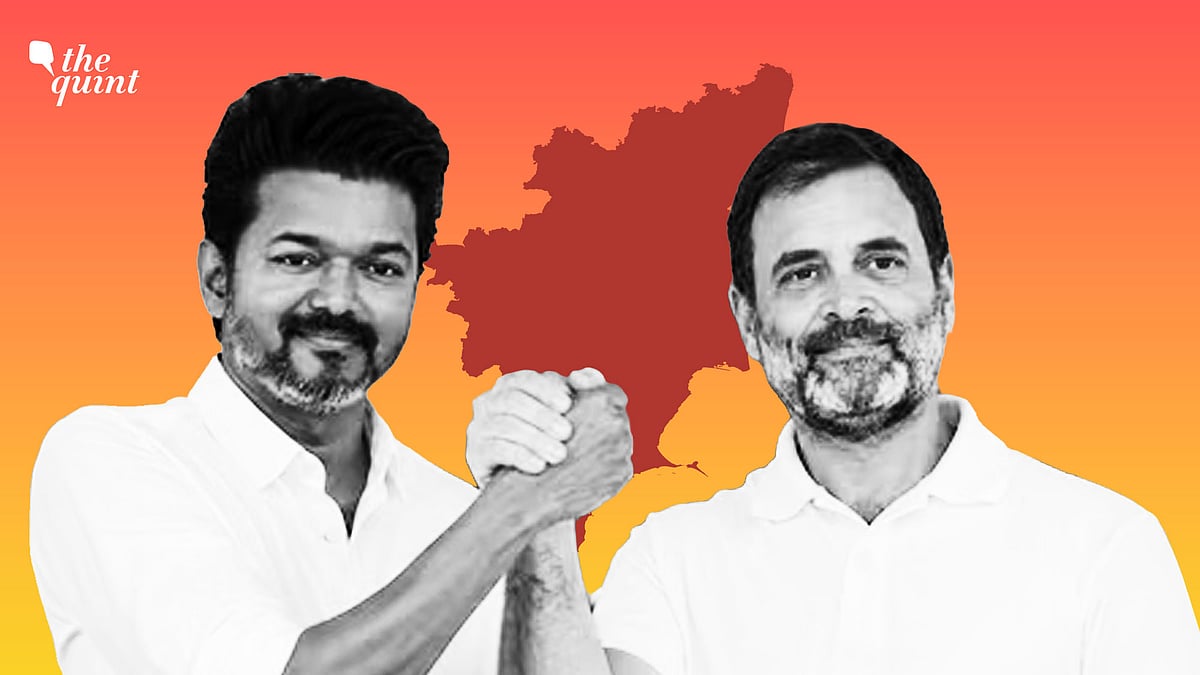
Filmstar-turned-politician Joseph Vijay was sworn in as the chief minister of Tamil Nadu on 10 May. His party the Tamilaga Vetri Kazhagam (TVK) will lead a coalition that is being supported by the Congress, IUML, VCK, and Left parties. Leader of Opposition in the Lok Sabha, Rahul Gandhi, also attended Vijay's oath-taking ceremony in Chennai.
Not only did the Congress support Vijay, the party is also said to have played a key role in bringing the other allies on board. The Congress' decision to support Vijay and snap ties with the DMK, considered one of its most solid allies, had surprised many. However, this switch is in line with past trends in Tamil Nadu politics.
Phase 1: 1967 to 1989
Tamil Nadu (then Madras state) was among the first states to vote out the Congress in 1967. The DMK won under the leadership of CN Annadurai and again in 1971 under M Karunanidhi. It established Dravidian politics' hegemony Tamil Nadu and marginalsed the Congress.
The Congress and AIADMK fought in alliance in the 1977 Lok Sabha elections. Despite being routed nationally after the Emergency, the Congress and the AIADMK swept Tamil Nadu, winning 34 out of 39 seats.
However, MGR shifted allegiance to the Janata Party and the Congress allied with the DMK in the 1980 Lok Sabha elections. The DMK-Congress alliance won 37 out of 39 seats. But MGR stormed back to power at the state level in the Assembly elections held a few months later.
By the next election, allegiances had shifted again.
In the 1984 Lok Sabha and Assembly elections, held simultaneously, the AIADMK and Congress fought together and won massive majorities at both the state and central level. So, except for MGR's win in 1980, the Congress had established itself as a kingmaker in Tamil Nadu. At the Lok Sabha level, it established itself as a party that could tilt the scales in favour of the DMK or AIADMK, giving it leverage in the state.
It was also clear that a chunk of people who voted for either of the two regional parties at the state level wanted the Congress at the Centre.
Phase 2: 1989 to 2004
The 1989 Assembly election was held in the shadow of two big events. First, MGR's death in 1987, which led to the AIADMK's split between the Jayalalithaa and Janaki factions. Second, a rise of anti-Congress sentiment due to the Rajiv Gandhi government's decision to send the Indian Peace Keeping Force to Sri Lanka as well as the 1986 anti-Hindi agitation. The Congress itself split over which AIADMK faction to support in the state, with Sivaji Ganesan forming his own party to support the Janaki faction of AIADMK.
The DMK won the elections comfortably but the Jayalalithaa faction was able to establish itself as the dominant AIADMK. This led to unification of AIADMK under Jayalalithaa and sealing of an alliance with the Congress for the 1989 Lok Sabha elections. The DMK was routed, failing to win even a single seat.
By 1996, a major faction of the Tamil Nadu Congress led by GK Moopanar split and formed the Tamil Maanila Congress. It allied with the DMK in the 1996 elections. They swept 221 Assembly seats and all the Lok Sabha seats in the state. P Chidambaram became union finance minister for the first time as part of the Tamil Maanila Congress.
Meanwhile, Jayalalithaa became part of the NDA at the national level in 1998.
By 2001, the Congress had reunited in Tamil Nadu and it fought in alliance with the AIADMK. Jayalalithaa won the state again. The DMK at that time was with the NDA.
(Photo Courtesy: The News Minute)
So yet again, in this period, the Tamil Nadu Congress (including the TMC breakaway) had established itself as the kingmaker in the state.
However, under Jayalalithaa, the Congress realised that it was losing its leverage in the state. The party felt that the AIADMK was taking it for granted due to the perception that the Congress would never ally with the DMK given the latter being seen as pro-Ealam.
But Sonia Gandhi took a decision that changed the equations.
Phase 3: 2004 to 2026
Sonia Gandhi decided to reclaim the Congress' leverage and deputed a senior leader to negotiate with the DMK. The choice of the leader was important. He was not seen as a conventional politician and didn't have the baggage of some of the career politicians. That leader was Dr Manmohan Singh.
Dr Singh successfully sealed the alliance with the DMK in the run-up to the 2004 Lok Sabha elections, upending the AIADMK and BJP's equations. The DMK and Congress won all 39 seats in the state. Two years later, the alliance won a two-thirds majority in the state Assembly as well. The alliance did well in the 2009 Lok Sabha elections too, though the Congress suffered some losses.
However, the alliance was routed in 2011. They contested separately and were routed in the 2014 Lok Sabha elections. They revived the alliance for the 2016 Assembly polls but were defeated by Jayalalithaa.
The rise of PM Narendra Modi at the national level changed equations between the DMK and the Congress. At one level, it solidified the alliance due to two reasons. Jayalalithaa and her successors in the AIADMK were seen as close to PM Modi. Second, the rise of PM Modi sparked fears of Hindi-Hindutva domination among a sizable section of the DMK's core supporters, providing a push from below for the alliance with the Congress. The demise of Jayalalithaa in 2016 further strengthened their position for a while and they won a series of victories: 2019 Lok Sabha elections, 2021 Assembly elections and 2024 Lok Sabha elections.
However, with Tamil Nadu delivering a solid number of seats for the Congress-led alliance at the Centre, the party lost leverage in Tamil Nadu. The DMK now felt that the Congress has nowhere else to go and therefore, can be kept away from power-sharing at the state level.
The switch to Vijay now is Rahul Gandhi's way of doing what Sonia Gandhi did in 2004: reclaim leverage in Tamil Nadu.
The Rahul Factor
Rahul Gandhi has consistently enjoyed popularity beyond the Congress' organisational strength in Tamil Nadu. Partly this may be due to the Rajiv Gandhi sympathy factor. When Rahul Gandhi launched a national membership drive of the Youth Congress, he is said to have received the best response in Tamil Nadu.
At that time, it was felt that Rahul Gandhi might be able to revive the Congress as an independent entity in the state. However, the Congress and DMK's fates become intertwined, first due to corruption allegations, then due to the rise of the BJP.
The DMK may have helped the Congress win massively in Tamil Nadu for two elections straight but the converse isn't often acknowledged. Being in alliance with the Congress helped establish DMK as the main pro-federalist and anti-Hindutva party in the state.
Then there's the arithmetic. The DMK-Congress alliance has consistently done better in Lok Sabha elections than in state elections. Its performance in the 2021 Assembly polls was underwhelming if one compares it to 2019 and 2024 Lok Sabha polls.
Clearly, there are a sizable chunk of voters in Tamil Nadu who want a Congress-led government at the Centre but don't necessarily want a DMK-led government at the state level.
So in that sense, supporting a Vijay-led government might be a betrayal of the DMK, it doesn't necessarily go against the Lok Sabha mandates that they received in the state.
What Happens Next?
Tamil Nadu politics is now in uncharted waters. Vijay falling short by 10 seats came as an opportunity for the Congress with 5 seats, to get a toehold in power in the state. It is likely that the Congress will also get a few cabinet berths when Vijay expands his ministry.
However, the TVK still enjoys a wafer thin majority in the state and may be looking forward to defections from the AIADMK and DMK.
The first major challenge for the DMK and AIADMK would be to prevent defections from its ranks to the TVK. Till the results, many DMK and AIADMK leaders and cadres weren't shifting because they were not sure of how popular the TVK really is. But the results have made that part clear.
Since the MGR-DMK split, Tamil Nadu has always been a state with two big parties (DMK and AIADMK), the Congress as a distant third and a host of smaller parties, including the BJP/Jan Sangh and the Left.
The state has never had three big parties with comparable strength. It's a bit like the sudden change in Punjab's political landscape 2014 onwards after the emergence of the Aam Aadmi Party.
Eventually, it is possible that either the DMK or the AIADMK may get weakened further, taking the state back to a two party/alliance system.
The split with the Congress may open up options for the DMK at the Centre. DMK has 22 MPs in the Lok Sabha and this does create space for issue-based adjustments between the Modi government and the DMK. The test will come whenever the BJP introduces the next contentious piece of legislation.
But the DMK, too, will have its constraints. Many in Tamil Nadu still see the BJP as being ideologically incompatible with the state. The AIADMK has suffered to some extent due to its alliance with the BJP. Also, if the DMK does move closer to the NDA, it would mean leaving the entire anti-BJP field in Tamil Nadu open to Vijay.
- Access to all paywalled content on site
- Ad-free experience across The Quint
- Early previews of our Special Projects
Published: 06 May 2026,07:42 PM IST