
Not AAP, Nor MGR: Why Everyone Got the Vijay Story Wrong
It is lazy to reduce Vijay and TVK’s victories to another instance of the South’s obsession with matinee idols.
advertisement
“Kanna Panninga Than Kootama Varum. Singam...Single Ah Thaan Varum” (Only pigs come in herds. A lion always comes alone.)
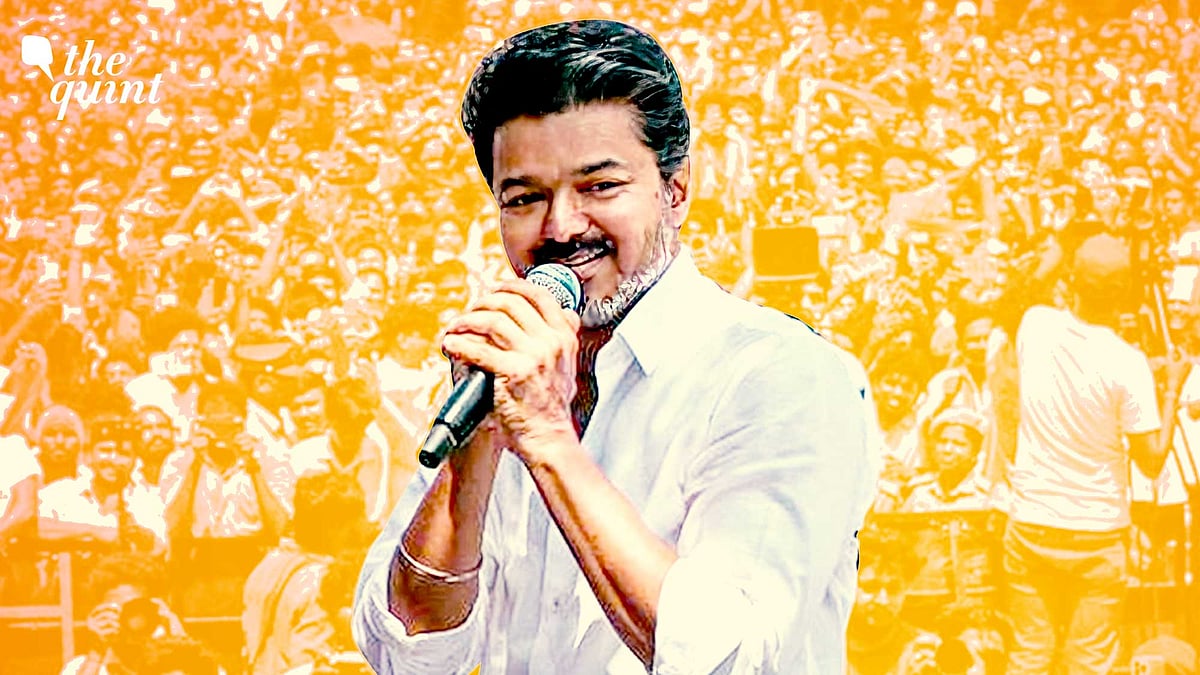
It rarely happens that a Rajinikanth dialogue fits someone else better than him but in the last 24 hours, this particular dialogue from the 2008 Rajini-starrer Sivaji has gone viral again across Tamil social media to describe actor-politician Vijay-led Tamilaga Vettri Kazhagam’s (TVK) unprecedented electoral debut.
No party had previously crossed the 8 percent vote share achieved by the Desiya Murpokku Dravida Kazhagam (DMDK) in the 2006 polls. A debut anywhere between 15 percent and 25 percent would have been historic and worthy of praise. TVK’s 34.92 percent vote share with a tally of 108 seats goes far beyond that.
What makes the achievement even bigger is that this new entrant did it without any political allies as against the DMK, which had 23 allies, in a state where cash flows heavily during elections. It did so while dealing with pressure from proxies of the Union government to ally with the National Democratic Alliance (NDA), and while simultaneously facing a hostile DMK-led state machinery in Tamil Nadu.
What must not be forgotten amid the TVK’s stunning debut performance is that most of our election pundits, self-proclaimed political commentators, and analysts not only got their assessment of the party’s fortunes wrong but were also off the mark in calibrating what the true parameter to assess the TVK’s success as a debutant should have been before the election.
TVK's 'Freak' Success Shows Delhi Doesn't Get it Yet
In a first-past-the-post system, for any party trying to break into a space dominated by two seasoned and deeply entrenched players like the DMK and the AIADMK, the first challenge is not necessarily to win an impressive tally of seats or get a majority in its very first poll outing. It is to build a durable voter base. Polling anything in the range of 10 percent to 25 percent vote share is the first step toward doing that.
It is also a sobering reflection on the credentials and qualifications of the hundreds of political commentators and analysts who dominate India’s airwaves and print space during election season that they missed this very elementary point while trying to set the parameters for assessing the TVK’s success even before the votes were polled.
So, why did the Tamil Nadu media or national media fail to see this Vijay wave coming? There are two different reasons.
The Tamil Nadu media, much like large sections of the national media, has become overwhelmingly partisan toward the ruling dispensation. In Tamil Nadu, this has meant a worrying tilt toward the DMK. This problem only peaked during the poll season, rendering much of the Tamil Nadu media incapable of even attempting to assess the TVK in a fair and objective manner.
The national media’s undoing was its Delhisplaining, or Northsplaining: the terrible tendency to interpret Tamil Nadu politics through a distant, reductive and often poorly informed national lens. It takes decades for academics or analysts with formal training, credible expertise, and sustained experience to understand the intricacies and nuances of a particular region and even then often struggle to fully master it after decades of work.
But the idea that a few parachute journalism-style election trips in the weeks leading up to the polls, wearing a mundu, mouthing a few Tamil film dialogues with a terrible diction, or munching on South Indian delicacies like idli or pongal is enough to understand the local context and then speak about it with absolute authority, tells us everything that is wrong with our punditry.
Why the ‘Vijay Wave’ Was Misread From the Start
Another case in point of this Delhisplaining or Northsplaining of the Tamil Nadu election results is the parallel being drawn with the Aam Aadmi Party’s (AAP) success in the 2013 Delhi elections.
Even the obsession with drawing parallels between TVK’s performance and MGR’s victory in the 1977 polls or NTR’s victory in the 1983 polls is off the mark. MGR had cut his political teeth in the DMK for decades before splitting away and forming the AIADMK. He also had allies with him and was engaged in a four-cornered contest, which made it easier for him to win more seats with a lower vote share in 1977 than the TVK in the 2026 elections.
In NTR’s case, there was no other major regional political entity in Andhra Pradesh at the time and decades of Congress dominance meant that it was relatively easier to capitalise on the anti-Congress sentiment that had been sweeping the state in the years leading up to the 1982 elections. Unlike MGR or NTR, Vijay’s path was unique and arguably the toughest of all. Up against the duopoly of the two Dravidian majors, the 2024 established TVK is a political infant. These differences are precisely what make TVK’s achievement even bigger.
This Was No Overnight Phenomenon
It is lazy analysis to reduce TVK’s victories to another instance of the South’s obsession with matinee idols and voting for a cine star from tinsel town.
Many of TVK’s candidates and cadres received their earliest organisational training through the Vijay Makkal Iyakkam. The VMI had also backed the ADMK in the 2011 polls, albeit comparatively covertly on the ground. In 2021, the VMI contested local body polls and achieved remarkable success.
Vijay, as an actor, has consistently taken a stance on several issues, ranging from GST, demonetization, the NEET exam, the rights of Sri Lankan Tamils, CAA, Jalikattu, and the Sterlite protests, both through his movies and in his off-screen comments. To do so risking a lucrative film career in a state where politicians and political parties have always wielded influence over the fortunes of cinema stars makes it clear that, while superstar Vijay was winning the Friday wars through his film releases, a politician named Vijay had also been in the making for decades.
The Tharukuri Tag
The election also witnessed Vijay’s younger supporters being called by the political slur Tharukuri, a Tamil word that loosely translates to an ignorant or illiterate person. This is deeply ironic because the only exit poll that got both the vote share and the seat share of the TVK right, the Axis My India poll, showed a positive correlation between higher levels of education and higher levels of support for the TVK. The more educated a voter was, the more likely they were to vote for the TVK, with support for the party being highest among postgraduates.
This silent voter backlash thesis finds support in academic research on elections and has been proven right in several other elections, such as Donald Trump’s victory in the 2016 US elections, where there was a silent counter-consolidation of voters behind a party or leader in response to being name-called or looked down upon by other parties and voters during the election.
This also highlights a worrying trend, not just for India but for democracies across the world, where voters and politicians across party lines are so consumed by partisan animosity that they are unwilling to see voters on the other end of the spectrum as fellow human beings. Instead, they dehumanise them and become desensitised to them.
Not Anti-Dravidian, But Anti-Duopoly
One interpretation of TVK’s meteoric rise in these elections is that this was a vote against Dravidian politics. This is far from accurate. TVK is not opposed to the core ideas of the Dravidian movement and hence cannot be described as an anti-Dravidian party. TVK was opposed to the Dravidian parties, not to Dravidian politics.
Vijay in his earliest speeches spelt out his commitment to secularism, social justice, equality, state autonomy, and anti-caste politics. The presence of the word Kazhagam in the very name of TVK makes this even clearer, as it signals an ideological affinity with the Dravidar Kazhagam, the original party of the Dravidian movement. TVK, Vijay, and its top leadership have also constantly cited both Periyar and Ambedkar as among their ideological leaders. So, reading these results as a vote against Dravidian politics, or criticising Vijay and TVK for lacking an ideology is completely unmerited.
However, what this verdict does mean is that Vijay and TVK have reshaped Tamil Nadu’s political landscape in three major ways.
A monopoly or a duopoly is bad for the markets. But it is worse for democracies. By completely dismantling the duopoly of the DMK and the AIADMK, the TVK has ensured that complacency is no choice for the major parties. The voters have more choice, no party is the default option to be voted in, if the incumbent falters and the message is clear to parties: perform or perish.
Secondly, Vijay’s appeal transcends caste divisions. Vijay is among the very few politicians in the state, and indeed the country, whose appeal goes beyond caste. The success that TVK has achieved would not have been possible if a large section of the electorate had not voted against their traditional caste loyalties. It is ironic that a state with such a rich history of anti-caste movements also has a large number of small caste-based political outfits. The rise of Vijay and TVK as a post-caste party is therefore a welcome development.
Tamil Nadu is among those states where parties splurge heavily and cash flows freely during elections. Seen in this context, TVK’s success in these elections, especially when considered alongside Vijay’s frequent appeals to voters not to sell their votes for a few thousand rupees, must be seen as one of the few developments that offers some hope for the health of our democracy in otherwise dark times.
However, it goes without saying that Vijay and TVK have their task cut out. The first challenge is, of course, delivering on the promises and expectations of this mandate. Will Vijay and TVK deliver a blockbuster second half after the interval? To paraphrase Vijay’s own popular “I am waiting” dialogue, “Tamil Nadu is waiting”.
(The author holds a Research Master's degree in Politics at Sciences Po, Paris. Currently, he is pursuing his PhD in Political Science at Temple University, where he researches on puzzles linked with electoral politics and voting behaviour in India. This is an opinion piece and the views expressed above are the author’s own. The Quint neither endorses nor is responsible for the same.)
- Access to all paywalled content on site
- Ad-free experience across The Quint
- Early previews of our Special Projects
Published: undefined