
Announced, Not Explained: India-US Trade Deal Leaves Much to the Imagination
By signing the EU pact, India strengthened its negotiating hand with the US, writes Manoj Joshi.
advertisement
There was a time when Free Trade Agreements (FTAs) and the like were seen as serious issues of policy and revealed only through official channels. But in the Trumpian world, the announcement of the breakthrough India-US trade deal—that de-escalated their year-long stand off—came through tweets.
Unfortunately, as of now, the deal remains mostly just that—announcements on social media and comments of ministers and officials to the media. We still do not have an authoritative statement or document detailing it.
A Trade Deal Announced on Social Media
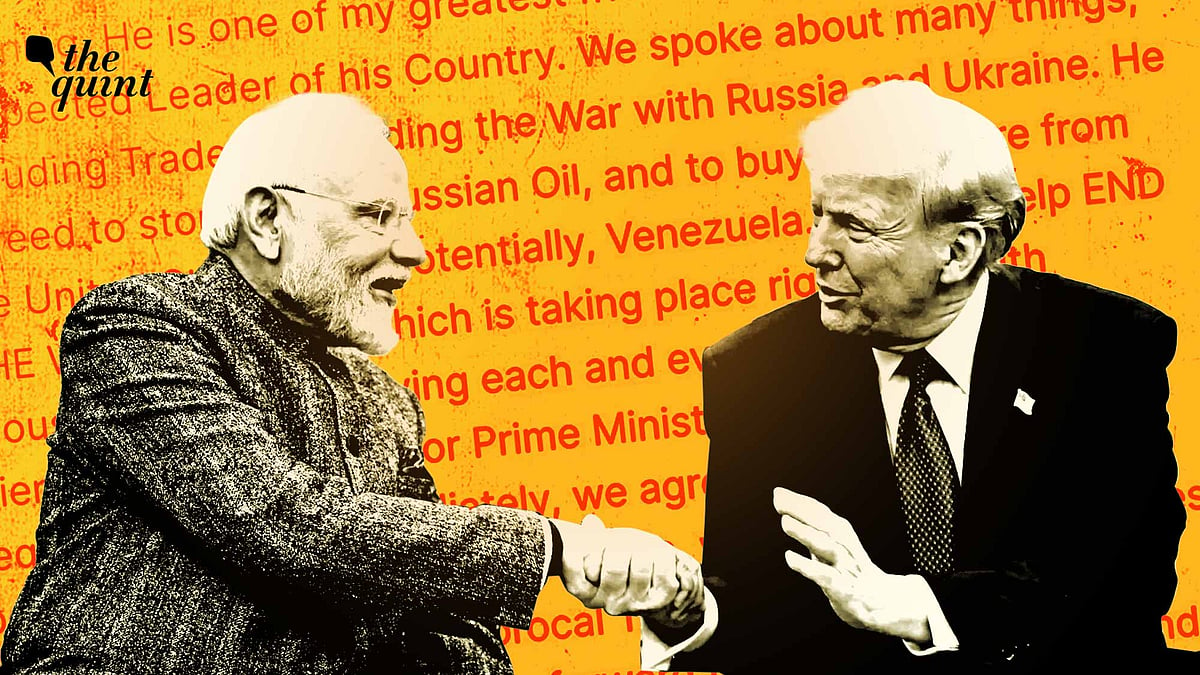
On Monday evening, US President Donald Trump announced in a Truth Social post that he had spoken to one of his “greatest friends”, Prime Minister Narendra Modi, about a host of issues relating to trade and war with Russia, and that “he (Modi) agreed to stop buying Russian oil, and to buy much more from the United States and, potentially, Venezuela.”
Modi’s response on X was far less specific. After speaking to his “dear friend” President Trump, he said, he was “delighted that 'Made in India' products will now have a reduced tariff of 18 percent”. He did not provide any other specifics except to say that this would “take our partnership to unprecedented heights.”
The US has reduced effective tariffs to 18 percent from the peak of some 50 percent earlier, since this also includes the removal of 25 percent punitive tariffs imposed on India on account of India’s purchase of Russian oil.
It is worth noting Trump’s characteristic framing—that everything had been done at Modi’s instance—from the announcement relating to the Russian oil as well to the US decision to lower its tariffs. Note, too, that the deal came less than a week after the announcement that India and the EU had reached a major free trade agreement.
Russian Oil, Venezuela, and Strategic Costs
A major concession, at least if we go by Trump’s tweet, is that India has agreed to stop buying Russian oil and pivot to the Americas and buy US and Venezuelan oil. As of now, there is no confirmation from New Delhi or Moscow as to whether this is indeed a fact. Buying Venezuelan oil will also require modification of Indian refineries to handle its heavy crude.
Trump has also spoken of US market access to India by a zero-tariff regime and also purchase over $500 billion worth of US energy, technology and even agricultural products.
Speaking in Washington on Tuesday, the US Trade Representative Jamieson Greer said that India had agreed to zero tariffs on “virtually all” industrial goods as well as agri food items like tree nuts, wines, spirits, fruits and vegetables, though India would maintain protection on some agricultural products. In New Delhi, Commerce Minister Piyush Goel, who did not offer any details of the deal, said that it “would protect our sensitive sectors of agriculture and dairy.”
Economic Upside and China+1 Advantage
Whatever information is available so far suggests that it could provide economic opportunity to India. At 18 percent, India's tariff rate is now lower than many regional competitors like Vietnam (20 percent), Bangladesh (20 percent), and Pakistan (19 percent), positioning India as a primary China +1 manufacturing alternative.
But note that some of these countries have more productive manufacturing sectors and can easily make up that difference. Secondly, while India would open up its market at zero tariffs for US manufactures, the US would charge 18 per cent on Indian exports.
This also poses strategic and sovereignty concerns. At the instance of the US, India has halted imports of Iranian oil since 2019, and now it is stopping the Russian imports—both of which were available at a discount and were geographically proximate. There is no clarity either on just what the zero-tariff access to India’s agricultural sector implies.
The announcement had little to say about the issue of the services sector and the H-1B visa issues which are vital for India’s IT industry. India’s services exports to the US are $41.6 billion and imports $41.8 billion.
Russia, Quad, and the Trump Factor
The deal, as announced, has important geopolitical consequences.
The first will be the potential rift with Russia, which says it has not yet received any official confirmation of New Delhi’s decision to halt oil purchases. India was not much of an importer of Russian oil before 2021, but it has now become a major buyer and to halt now at the instance of the Americans cannot but rile the Russians.
This would also affect India since in 2025, Russia was the largest exporter of oil to India, accounting to 35 percent of India’s imports. These peaked at 2 million barrels per day (bpd) in mid-2025, but went down to 1.38 million bpd, the lowest in two years on account of US and EU sanctions.
Confirmation of this, however, will only come after the Quad summit that India was hoping to host last year, but may now do it in 2026. A successful deal could also well lead to India joining the Trump Board of Peace and help in the Gaza reconstruction and deepening its Gulf initiatives with the UAE and Saudi Arabia.
Diplomacy, EU Pressure, and the Missing Fine Print
A major role in the acceleration of the India-US interaction seems to be the result of Sergio Gor arriving in New Delhi as the US ambassador. He was a White House aide and has direct access to Trump. His arrival was accompanied by high-level engagements and also saw the inclusion of India in the Pax Silica rare earths grouping and now the trade deal.
But there can be little doubt that the India-EU trade deal also pushed the Americans to focus. The deal sent a geopolitical signal that India was willing to move beyond a defensive trade policy. The Trump Administration officials perhaps realised that they may now become disadvantaged at the Indian market.
The past year, in which we have been waiting for the deal, has been a very long and consequential one. The issue played itself out in excruciating detail through a short war between India and Pakistan, the war in Ukraine, and the issue of India’s dealings with Iran. Trump’s cabinet members Howard Lutnick and Scott Bessent played the role of attack dogs. India was at the receiving end since US President Donald Trump sees tariffs as an all-purpose medicine to be dispensed against friend and foe.
Trade deals are trade deals and everyone knows that, in the world of commerce, it is important to read the fine print. So the big question is: When will the governments share the text of their agreement with us?
(The writer is a Distinguished Fellow, Observer Research Foundation, New Delhi. This is an opinion piece and all views expressed are the author's own. The Quint does not endorse or is responsible for it in any way.)
- Access to all paywalled content on site
- Ad-free experience across The Quint
- Early previews of our Special Projects
Published: undefined