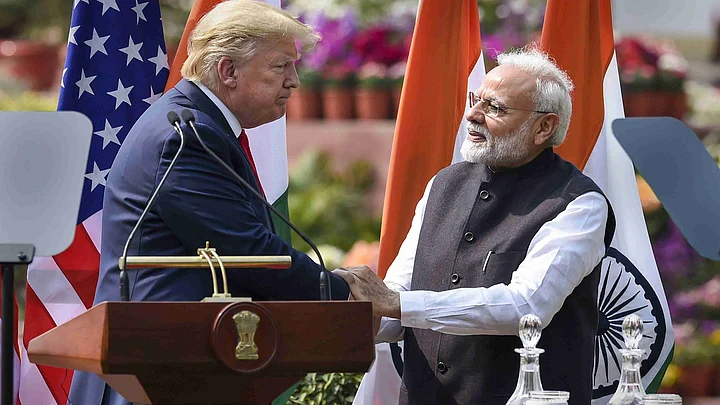
The United States and India have reached an agreement to reduce reciprocal tariffs, with the US lowering its tariff on Indian goods from 25% to 18%. The announcement followed a direct conversation between US President Donald Trump and Prime Minister Narendra Modi. Both leaders confirmed their commitment to strengthening bilateral trade relations and agreed to further reduce trade barriers. India is expected to reciprocate by reducing its tariffs and non-tariff barriers on US goods to zero.
According to The Indian Express, President Donald Trump stated that the tariff reduction was made out of “friendship and respect” for Prime Minister Narendra Modi. Trump also indicated that India had agreed to increase its purchases of American goods, including energy, technology, and agricultural products, as part of the broader trade deal. The US President described the agreement as a step towards ending the ongoing war in Ukraine, referencing India’s commitment to reduce Russian oil imports and increase purchases from the US and Venezuela.
As reported by Deccan Herald, the announcement came after a phone call between the two leaders, which was aimed at addressing recent tensions in bilateral relations. The US decision to lower tariffs was matched by India’s pledge to eliminate its own tariffs and non-tariff barriers on American imports. The move is expected to facilitate greater market access for both countries and marks a significant development in their economic partnership.
As noted in an article by Financial Express, the trade negotiations were confirmed by US Ambassador to India Sergio Gor. The call between Trump and Modi was the first since the India–EU trade agreement and took place amid ongoing discussions about tariffs and energy imports. Commerce Minister Piyush Goyal has described the new trade pact as the “father of all deals,” highlighting its potential to expand market access and support India’s export ambitions.
“Out of friendship and respect for Prime Minister Modi and, as per his request, effective immediately, we agreed to a Trade Deal between the United States and India, whereby the United States will charge a reduced Reciprocal Tariff, lowering it from 25% to 18%,” President Trump stated.
Coverage revealed that the timing of the trade deal coincided with India’s recent budget, which did not include major customs reforms but reflected ongoing negotiations with key partners, including the US. The incremental approach to tariff rationalisation is consistent with India’s broader economic strategy, which aims to correct inverted duty structures and enhance participation in global value chains.
Ongoing reporting indicated that India’s trade policy is also influenced by US sanctions and tariff threats related to its dealings with Iran and Russia. The absence of new budget allocations for the Chabahar port project in Iran was interpreted by experts as a tactical move to balance US relations while maintaining strategic interests in the region. Half of the 50% tariffs previously imposed on India were linked to its oil trade with Russia, and the new agreement is expected to ease some of these pressures.
Recent analysis showed that India is also reviewing its investment regulations, particularly those affecting foreign direct investment from countries like China. The government is considering reforms to encourage greater foreign investment and facilitate easier repatriation of earnings, which aligns with the broader goal of improving the ease of doing business and attracting global capital.
India’s economic and strategic position in the region remains a subject of international assessment. Recent coverage revealed that the Economic Survey 2025-26 cited India’s negative “Power Gap” score, indicating that the country is operating below its full strategic potential despite its growing economic capabilities. The new trade deal with the US is seen as a step towards leveraging India’s resources for greater influence and market integration.
Commerce Minister Piyush Goyal described the agreement as “key to expanding market access, boosting exports, and supporting India’s goal of reaching USD 2 trillion in exports by 2032.”
Note: This article is produced using AI-assisted tools and is based on publicly available information. It has been reviewed by The Quint's editorial team before publishing.