
Dear Cockroach Janta Party, Umar Khalid Is Exactly an Education Issue
The CJP's call for educational reform is incomplete without addressing academic freedom in universities, and Umar.
advertisement
I want to understand the argument being made and I want to take it seriously, because the people making it are not wrong about education and are not wrong that the movement needs to hold together, and yet something is missing when a protest against the destruction of universities will not say the name of a scholar who has been in prison for almost six years without trial.
Recently, Saurav Das, spokesperson of the Cockroach Janta Party, was asked about Umar Khalid at the protest site. He said they didn't have water and food and asked the media to focus on the actual issues. Then, a day later, he was asked more directly: why should Umar Khalid not be mentioned at a CJP protest? This time he explained that the movement is built around one issue, education, and bringing in other questions risks fracturing the unity because some people who disagree on those questions (likely people who support Umar’s incarceration) are currently united around this one. He did not name Umar. He then spoke, in the same breath, about how the Constitution guarantees the right to life and liberty.
With this logic, Umar is a distraction and a movement against the corporatisation and degradation of higher education must not mention a political prisoner who emerged from a university campus and student movements, and whose speeches, writings and organising were inseparable from the intellectual life of the university. His imprisonment is one of the clearest warnings issued to an entire generation of students.
The Crackdown on Universities
Universities are inhabited by students, teachers, researchers and people who engage with power. Universities are made by students who ask difficult questions and political cultures that allow disagreement. The destruction of universities begins when critical forms of thinking become punishable and not just when private companies enter campuses.
The state has always known this very well. Teachers have been surveilled, student leaders have been arrested, academics have lost their jobs, writers have faced criminal cases or, worse, got killed. Universities have been treated as political problems by the state because they produce people capable of criticising power. This is not a side effect of authoritarianism; this is how authoritarianism works. The prison and the university have always been connected.
The University Grants Commission, in 2023, dissolved PhD scholarships for students researching topics classified as "politically sensitive," including Kashmir, caste and Hindutva. A college principal in Indore faced criminal charges in 2022 because he had a book in his library titled Collective Violence and the Criminal Justice System, a book! Kashmiri scholar Aala Fazili was arrested in 2022 for an article on Kashmir she wrote in 2011. This is not even the tip of an iceberg.
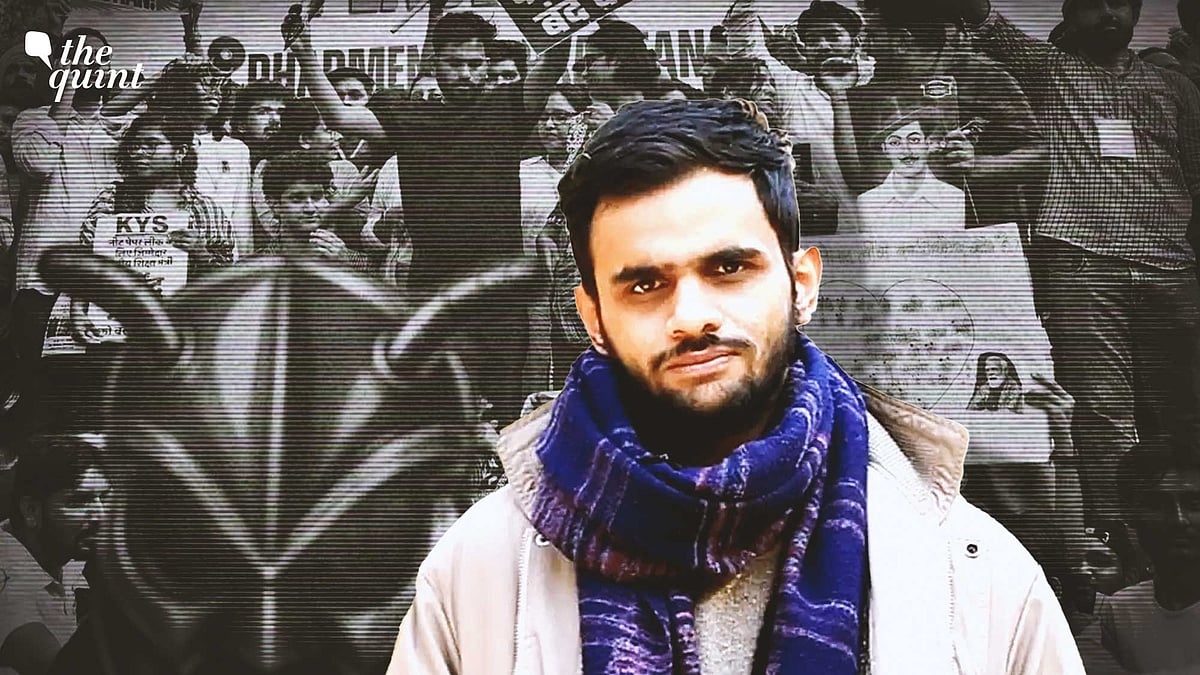
This is the environment in which anyone demanding education reform is operating. And in this environment, Umar is not a separate subject. He was a JNU researcher. His doctoral dissertation on Adivasi society in Singhbhum under British rule was described by historian Ramachandra Guha as one of the most accomplished doctoral dissertations by an Indian he had read, which is now being published as a book. He spent years organising on campus on questions of caste, gender and communal violence. He was first arrested in 2016 for participating in a university event and denied the right to submit his own PhD thesis by his own university.
Umar Khalid Would Have Been at Jantar Mantar
If he were free, he would be at Jantar Mantar. There is no version of this person who would have stayed home during a protest against the destruction of education. His public life from 2016 onward was an engagement with the questions of the state and education, where education was not only a theory but a praxis materialised both inside the campus and on the streets. Questions like what should an education entail in the precarious times that we have found ourselves in, especially after 2014, about what happens to students who speak, what happens to campuses when the state decides certain questions are not allowed, and how marginalisation is created by the state by appropriating the very system of education.
The CJP is protesting the NEET-UGC paper leak scandal and demanding the resignation of Education Minister Dharmendra Pradhan. However, one cannot separate the paper leak from the environment that produced it, and that environment has been built, in part, by putting people like Umar in Tihar and leaving them there.
One does not have to agree with every speech, organization or ideological position of every student leader to understand this. In fact, the state does not care whether it imprisons a perfect dissenter. The point is exemplary punishment and to make entire generations conscious of the costs of political thinking. You arrest a student leader, a professor, or a researcher and hundreds of students and researchers become cautious. You turn political prisoners into untouchable subjects with the aim that everyone else begins censoring themselves. This is why the imprisonment of Umar is also a question of politics in education.
It is true, of course, that Umar is in prison because he is a Muslim and because Muslim political dissent has become one of the principal objects of state repression. But he represents a generation of educated Muslim youth who entered universities, pursued research and participated in politics. The same applies, for that matter, to Sharjeel Imam, another scholar whose imprisonment has become inseparable from contemporary questions of the university, dissent and Muslim political life.
The state has spent years defining what counts as acceptable politics and what counts as a distraction. It does not do this through force alone, but also by making certain names costly and certain arguments illegal. When a movement decides that a Muslim political prisoner is too divisive to mention, I do not think that decision comes from nowhere. The state has already done the work of placing him outside the boundaries of respectable concern, and the movement is operating inside those boundaries without noticing that the boundaries were drawn by the same power it is protesting against.
The Privilege of Identity
There is also the question of privilege here, which comes with an identity. Vijeta Dahiya can continue as one of the main spokespersons of the CJP despite holding extremely transphobic views, but Umar cannot even be mentioned. If that is not privilege, what is? AAP's strategic silence during the anti-CAA movement and the violence in Northeast Delhi emerged from the same political instinct and insincerity.
Democracy, constitutionalism and education remain perfectly respectable words to utter for the state and then the same respectability politics is produced within savarna liberalism. The belief that political legitimacy comes from appearing reasonable to power rather than confronting it, and the belief that one can defend universities while avoiding those who have been punished for participating in and creating university politics, is something the state has inculcated in the general upper-caste public consciousness.
The state takes someone, removes them from political life by putting them in prison, and then uses their presence in prison as a reason to exclude them from political conversation. If a movement's definition of education can accommodate privatisation, corruption, appointments, budgets and governance but cannot accommodate the person whom the state unjustly incarcerated for being a free thinker, for being a scholar, for being a student activist and for doing university politics, then the state has already decided the shape of the movement for us.
People who talk about the future of education while treating jailed scholars, student leaders and political prisoners as distractions are not protecting the movement. They are defending the boundaries the state built for them. They are defending universities emptied of courage.
(Nabiya Khan is a researcher and PhD student at Rice University. Her focus is on the infrastructure of oppression. This is an opinion piece and the views expressed above are the authors' own. The Quint neither endorses nor is responsible for them.)
- Access to all paywalled content on site
- Ad-free experience across The Quint
- Early previews of our Special Projects
Published: undefined