
Being CJP in BJP's Hindu Joint Family: 4 Ways Modi Govt Manages Youth Dissent
Modi govt takes youth protests very seriously. It has adopted a four-pronged approach to tackle them.
advertisement
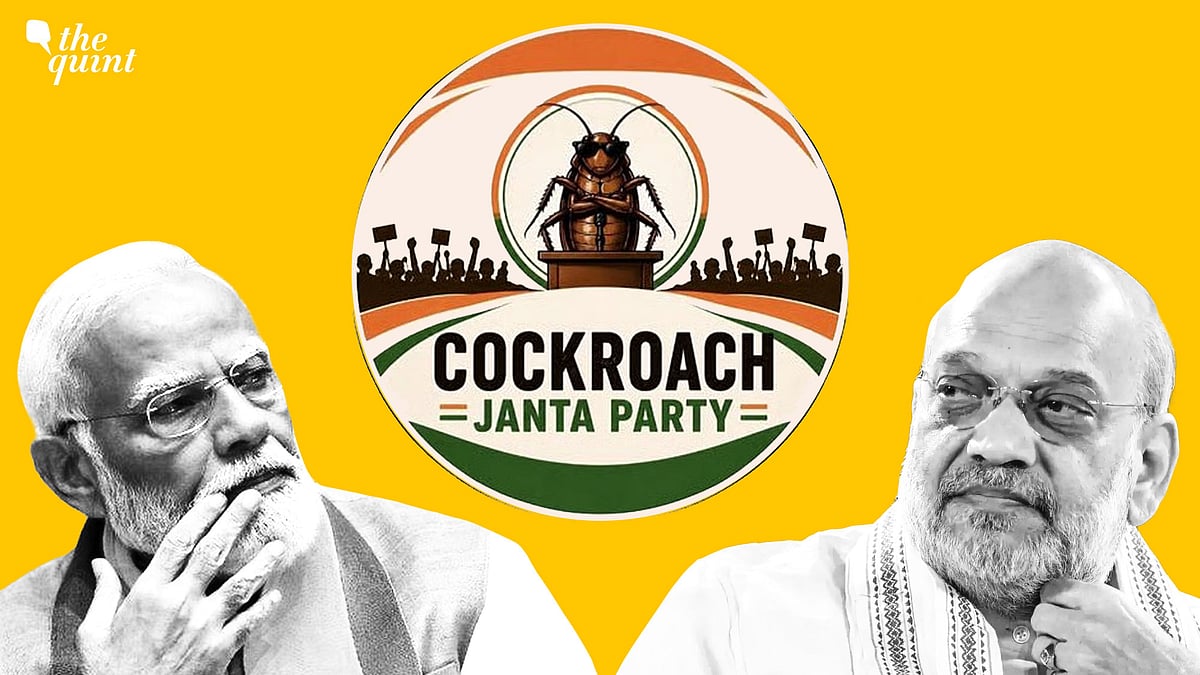
One aspect that stood out during the Cockroach Janta Party (CJP) protest at Jantar Mantar on 6 June, Saturday, was the approach of the Union government, under which the Delhi Police falls. By all accounts, the police were cooperative, all the permissions were duly granted, and there were no major complaints of the police intimidating protesters or preventing people from reaching the protest site.
Does this support the conspiracy theories that the Narendra Modi government is tacitly backing the protests? Not necessarily.
What it shows is that, for now, the Modi government has allowed the protest to happen. This could be for one or more of these three reasons:
To provide a safety valve against public anger on paper leaks.
To send the message that setup in India is democratic and that the government "allows" protests if they abide by certain rules.
To ascertain the strength of the CJP beyond social media.
Their past track record indicates that PM Narendra Modi and Amit Shah take youth-led protests very seriously. One of their biggest concerns has been the prospect of youth-led protests turning into political opposition with electoral consequences. To prevent that from happening, they have followed a diversity of strategies: from brutal crackdowns on one hand to forgiving the worst insults from anyone who later shows the willingness to be co-opted by them.
This has happened to several individuals and parties who, at different points in time, had the potential to get youth support.
Rahul Gandhi and his Youth Brigade
Flashback to the 2011 Anna Hazare/India Against Corruption agitation and the build-up to the 2014 Lok Sabha elections. The pro-BJP ecosystem launched a massive online campaign against Rahul Gandhi, presenting him as "entitled","Pappu" and representative of all that is wrong with the system.
A Congress general secretary and later vice-president in those years, Gandhi was not part of the government. The BJP and RSS wanted to ensure that the clamour for 'change' represented by the IAC movement shouldn't get contained with an internal generational change within the Congress. Hence, the campaign to delelgitimise Rahul Gandhi beyond repair.
More recently, a young politician to have been subjected to a similar targeted campaign was Aaditya Thackeray—from the memes ridiculing him to absurd claims linking him to the suicide of Disha Salian.
The idea was to delegitimise him even before he could emerge as a youth leader.
Hardik Patel and Alpesh Thakor
In 2017, the BJP came close to losing Gujarat due to a youth upsurge led by three young leaders—Hardik Patel, Alpesh Thakor, and Jignesh Mevani, representing the Patidar, OBC, and Dalit communities respectively. The biggest threat for the BJP was Hardik as he threatened to disrupt one of BJP's most loyal votebanks in the state: the Patidar community. Patel succeeded in routing the BJP in rural Saurashtra but couldn't replicate it in Gujarat's urban centres like Surat.
Even his fiery speeches and allegations like "Amit Shah may try to get me killed" were forgotten. Alpesh Thakor was co-opted into the BJP even earlier as he joined the party in 2019.
Jignesh Mevani, on the other hand, continues to face cases as a Congress MLA.
Anti-CAA Protesters in Assam
The BJP has used the two Cs and two Ds against the youth leaders of the anti-CAA protest in Assam. Remember, in Assam, the anti-CAA stir was led by ethnic Assamese youth. It wasn't a Muslim-led protest like in the rest of India. Therefore, it posed a threat to the BJP's base in the state.
On one hand, the BJP co-opted All Moran Students' Union leader Arunjyoti Moran and Assam Chah Mazdoor Sangha leader Rupesh Gowala into the BJP. Both had been part of the anti-CAA movement. Gowala had also been leading the protests demanding better wages and working conditions for tea garden workers. He was given a ticket from Doom Dooma in Tinsukia district and was even made minister from 2024 to 2026.
On the other hand, it slapped UAPA against Akhil Gogoi and he was placed under detention for 567 days.
Since Gogoi's release and the growth of his party Raijor Dal, Assam chief minister Himanta Biswa Sarma has been making statements saying that the party can be an option for "Miya Muslims". This is a clear attempt to delegitimise Gogoi among Assamese Hindu voters.
Raghav Chadha and Sandeep Pathak
Another entity that has been subjected to all the above steps is the Aam Aadmi Party (AAP). The BJP leadership recognised the threat AAP posed, being a neophyte party with a relatively clean slate. Few parties have faced as many top-level arrests and defections as AAP: Arvind Kejriwal, Manish Sisodia, Satyendar Jain and Amanatullah Khan were arrested and put in jail. On the other hand, general secretaries Raghav Chadha and Sandeep Pathak and senior leaders like Kapil Mishra and Kailash Gahlot switched to the BJP in a dramatic manner, just to name a few.
Chadha's case is particularly important. At least on social media, Chadha had a sizable following of his own among the youth. There's a particular message the BJP is trying to send by making someone like him defect. More on that in the next section.
The Hindu Undivided Family
The youth in India are hurting. The employment situation has worsened (According to the State of Working India report by Azim Premji University, 40 percent of young graduates in India are unemployed). Campus placements have been suffering. For even those who get jobs, starting salaries have been stagnant for some years now. Policies like Agniveer have also affected a section of the rural youth in states with a tradition of being in the armed forces. In such a scenario, paper leaks add insult to injury. It's like kicking down a ladder when someone is about to reach the top.
However, instead of addressing these issues from a policy point of view, the government seems more concerned about containing the political cost of youth resentment.
The same is the message to online Gen-Zs when Chadha shifted to the BJP. In some ways, it is like a large Hindu Undivided Family where the government is the patriarch which is being induldgent with naughty teenagers.
BJP's larger aim is to make the youth accept the political status quo, irrespective of their grievances. So long as their protest is on a particular issue or even a particular minister, they will be tolerated. As soon as they start demanding political change, the rules of the game will change.
Of course, co-option is an option for those are part of this Hindu Undivided Family in the first place, that is those from the same demographic profile as the BJP's base. If they belong to oppressed or minority communities such as Amritpal Singh, Sharjeel Imam, Umar Khalid or Surendra Gadling, prolonged arrest seems to be the only policy. There is no co-option, only crackdown.
Even the status quo we spoke of above may mean different things for both sections.
Abhijeet Dipke of the CJP is also a Dalit, but he's not an Ambedkarite, at least based on his public positions. The cause he has taken up doesn't change the status quo of caste and communal hierarchies in the country. This would give him immunity from the kind of blanket crackdown that the Bhima Koregaon leaders, Muslim anti-CAA protesters and Waris Punjab De members had to face.
What Does This Mean for CJP?
So far, the BJP doesn't seem to have adopted an openly hostile approach towards the CJP. Even RSS spokesperson Sunil Ambedkar said that "there should be space for different opinions" and expressed confidence that the youth are "patriotic". The approach of the government and police to the Jantar Mantar protest seems to be on the same lines.
In contrast, the Congress protest against paper leaks and malfunctioning of the CBSE in Kurukshetra, had to face water cannons. The BJP is fine so long as a protest doesn't challenge the political or social status quo.
Very soon, the CJP will be faced with a dilemma. If they are to get the BJP government to meet their demands or take them seriously, they will have to up the ante somehow.
Once they reach that stage, they will have to be prepared to be subjected to the two Cs and two Ds we discussed above.
- Access to all paywalled content on site
- Ad-free experience across The Quint
- Early previews of our Special Projects
Published: undefined