
AIADMK is at War With Itself, the Tamil Nadu Floor Test Proves it
Floor tests are meant to measure governments. This one measured an opposition party.
advertisement
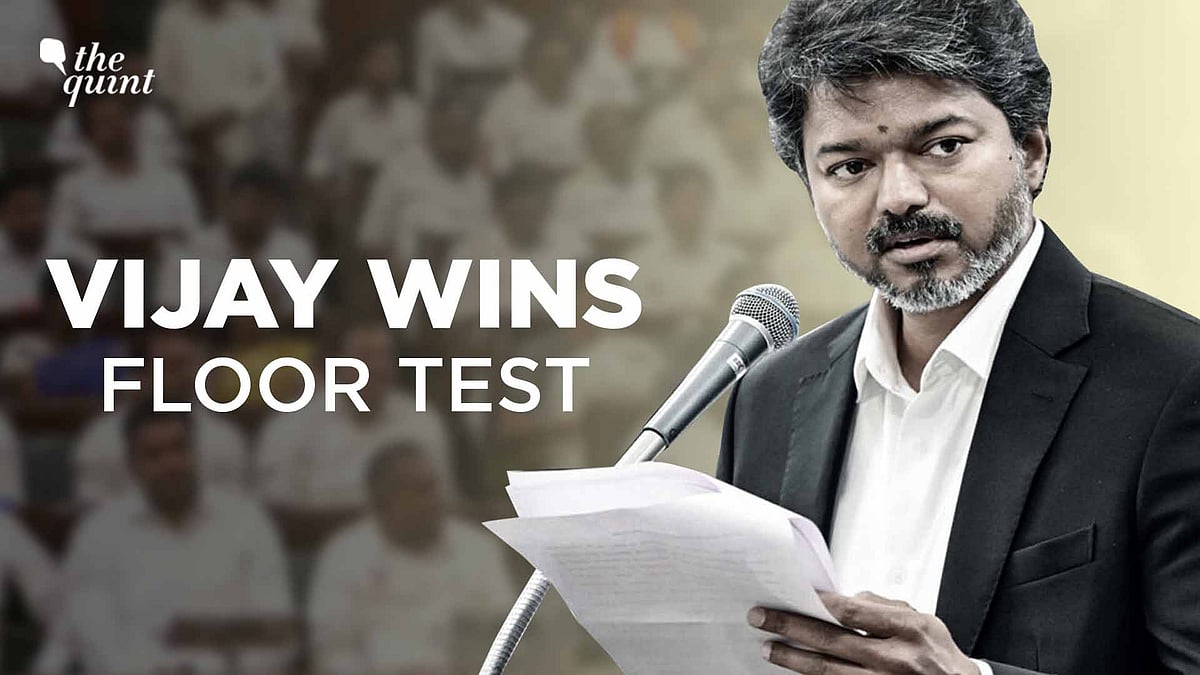
The floor test in Tamil Nadu that handed Chief Minister C Joseph Vijay and his Tamilaga Vettri Kazhagam (TVK)-led government a comfortable majority may be remembered not merely for stabilising a new regime, but for laying bare the crisis within the All India Anna Dravida Munnetra Kazhagam (AIADMK).
In a 234-member House, where the majority mark stood at 118, the government secured 144 votes. Crucially, that margin was made possible by 25 AIADMK legislators who cross-voted in favour of the trust motion, turning a confidence vote into a public display of rebellion inside the opposition party.
For the AIADMK, this was not merely an embarrassing legislative moment, but a public demonstration that the party, once among India’s most disciplined regional machines, is struggling to maintain coherence after the election. The trust vote converted internal whispers into visible arithmetic. Numbers inside the Assembly often tell a larger story outside it, and these numbers suggest that AIADMK’s organisational authority has drastically weakened at the very moment when it must recover.
That contrast matters a lot.
Beyond Electoral Losses
Before the 2026 Assembly election, many believed AIADMK was positioned for a revival. After the Dravida Munnetra Kazhagam (DMK)’s incumbency, anti-incumbency sentiment, alliance recalibrations, and the expectation of a bipolar contest appeared to give AIADMK a route back to power. Instead, Tamil Nadu produced a far more disruptive verdict. TVK emerged as the single largest force with 108 seats, while AIADMK was reduced to 47. DMK secured 59, retaining enough relevance to become the formal Opposition.
The rebellion reportedly involved senior leaders, including C V Shanmugam and SP Velumani, who were linked to the faction that backed the government. Their support was significant not only because of numbers, but because it signalled that dissent was not confined to first-time legislators or politically insecure backbenchers. It appeared to involve figures with networks, influence, and organisational memory.
For party chief Edappadi K Palaniswami, the cross-voting is a direct challenge. Since the death of “Amma” J Jayalalithaa, AIADMK has struggled to recreate a command structure that combines charisma, fear, patronage and unquestioned legitimacy. Palaniswami did stabilise the party after years of factional turmoil and positioned himself as its principal face. But stabilisation is not the same as consolidation. The trust vote suggests that while he controls the formal organisation, he does not command unanimous obedience within the legislative wing.
That distinction is vital in Tamil Nadu politics. Regional parties in the state historically depend on centralised leadership and strong symbolic authority. Cadres and legislators often tolerate ideological flexibility if leadership appears electorally viable. But when victory seems distant and authority uncertain, transactional politics returns quickly. MLAs begin to hedge, factions seek leverage, and local satraps test the limits of discipline.
The 25-member rebellion can be read precisely through that lens. Some may have preferred a constructive line toward the new government, while many others appear to see TVK as the rising pole in Tamil Nadu politics and wish to remain relevant in a changing landscape. Others may simply be signalling dissatisfaction with internal decision-making, ticket distribution, alliance strategy, or the concentration of power in a narrow circle; whatever the motive, the collective act suggests many within AIADMK no longer believe silence is the best strategy.
Damaging Perceptions
The optics are particularly damaging because AIADMK, politically backed by the Bharatiya Janata Party (BJP), had hoped to emerge from the election as a dominant anti-TVK force. Instead, DMK occupies the Opposition benches while AIADMK appears internally divided. In parliamentary democracies, the Opposition space matters almost as much as government space. It determines media attention, agenda-setting and the ability to convert government mistakes into political gains. AIADMK now risks losing that space to both DMK and a rapidly institutionalising TVK.
In fact, AIADMK’s instability did not begin on the Assembly floor. It was visible when former Chief Minister O Panneerselvam crossed over to DMK, taking with him symbolic capital that once anchored the party’s post-Jayalalithaa transition.
There is also a deeper ideological question. AIADMK historically balanced welfare populism, Dravidian identity politics, anti-DMK sentiment and pragmatic alliances. But what does the party represent today beyond legacy and anti-incumbent positioning? When a party lacks a clear contemporary message or a prime leadership figure, disputes intensify because power becomes the only organising principle. The floor test underlines that the AIADMK has not yet answered the post-Jayalalithaa question of purpose.
For cadres, morale may become the next battlefield. AIADMK still retains a substantial vote base, a recognisable symbol, district-level structures and emotional capital built over decades. But cadres need evidence that the leadership can fight, unite and win. Repeated public dissidence sends the opposite signal. Local workers become hesitant, funders become cautious, and second-rung leaders begin exploring alternatives. Political decline often begins not with voter abandonment, but with worker demobilisation.
TVK, meanwhile, has every incentive to deepen these contradictions. A new ruling party does not merely govern; it expands.
If Vijay can project administrative seriousness while attracting disgruntled AIADMK legislators and functionaries, he could permanently replace AIADMK as the principal non-DMK pole much faster than expected. That would be the most consequential long-term outcome of the floor test.
Yet, it would be premature to write AIADMK off. Tamil Nadu politics has repeatedly shown that parties with durable social coalitions can recover from sharp setbacks. AIADMK’s rural pockets, caste-community networks, welfare memory and anti-DMK vote reservoir remain real assets. Many voters may also hesitate before fully transferring loyalty to a still-young TVK experiment. If the government stumbles, space could reopen quickly.
Road to Recovery Fraught
The AIADMK leaders argue that the current turbulence is temporary rather than terminal. Speaking to The Quint, KC Palanisamy said that AIADMK remains a deeply rooted party among voters and cadres.
But recovery requires choices.
First, AIADMK needs clarity on leadership and vision rather than endless ambiguity. Second, it needs an ideological refresh that speaks to younger voters on jobs, governance and federal rights instead of relying solely on nostalgia.
Third, it needs internal mechanisms to manage ‘misunderstandings’ or factional ambition before it spills into public spectacle. Fourth, it must decide whether it wants to be a waiting-room party hoping for government failure, or an assertive opposition building an alternative for the people.
The immediate question is whether the rebellion becomes a one-day rupture or a durable bloc. If disciplinary action triggers more exits, the floor test may be remembered as the formal beginning of a major split. If, however, the leadership negotiates a truce and recentres the party, it may become a painful but corrective warning. Threats of action against rebel leaders suggest the first response has been punitive rather than conciliatory. Whether that restores discipline or deepens resentment remains to be seen.
For Tamil Nadu’s broader opposition politics, the implications are equally serious. A fragmented AIADMK helps both TVK and DMK. It helps TVK by enabling expansion into AIADMK’s voter base. It helps DMK by weakening a historic rival and preserving bipolar memories in pockets where anti-incumbent votes would otherwise consolidate. The only actor it does not help is AIADMK itself.
If Palaniswami’s promise of a “responsible Opposition” was meant to reassure cadres, the floor test instead amplified Shanmugam’s sharper verdict: “EPS has no such idea.” Between those two statements lies the present crisis of AIADMK. The numbers 144 and 25 may fade from headlines soon. But for AIADMK, the deeper arithmetic has only begun.
(Amal Chandra is an Indian author, political analyst and columnist. His debut book, The Essential (2023), was launched by Dr Shashi Tharoor and features a foreword by former External Affairs Minister of India, Advocate Salman Khurshid. This is an opinion piece and the views expressed are the author's own. The Quint does not endorse or is responsible for the same.)
- Access to all paywalled content on site
- Ad-free experience across The Quint
- Early previews of our Special Projects
Published: undefined