
ADVERTISEMENTREMOVE AD

Why Congress Stayed With DMK Despite Vijay's TVK Temptation

A breakdown between the DMK and Congress could have split minority and anti-BJP votes, benefiting the NDA.

Published
story-hero-img
i
Aa
Aa
Small
Aa
Medium
Aa
Large

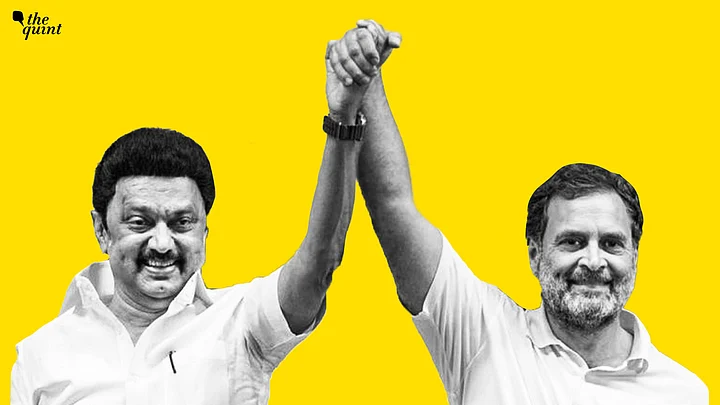
For the past few months, the relationship between the Dravida Munnetra Kazhagam (DMK) and the Congress in Tamil Nadu looked genuinely strained. Leaders from both parties traded barbs, whispers of discontent filled political circles, and speculation about an impending breakup ran wild across the media.

The question many observers were asking was simple: would the alliance that delivered a sweeping Assembly victory and two successful Parliamentary elections actually fall apart over seat-sharing disputes?

Now that wiser counsel has prevailed, and the agreement has finally been sealed, one thing is clear: the continuation of Congress in the DMK-led alliance is not merely politically convenient; it is strategically essential for both parties. As the dust settles, attention naturally shifts to the next big test: the 2026 Tamil Nadu Assembly election. And the signs increasingly point to a formidable advantage for the DMK-led alliance.

ADVERTISEMENTREMOVE AD

A Partnership Built on Electoral Success

To begin with, this partnership has a proven track record. In politics, nothing speaks louder than victory. When the DMK and Congress contest together in Tamil Nadu, they win together. That success is not simply emotional loyalty but a combination of electoral arithmetic and political chemistry.

Breaking such a relationship risks more than losing an election. In fact, it risks losing years of political capital painstakingly built over multiple electoral cycles.

Still, the tensions of the past few months were real. Some Congress leaders openly criticised the DMK government. Speculation grew that sections within the Congress were exploring the possibility of aligning with actor Vijay’s Tamilaga Vettri Kazhagam (TVK), a new political entrant buoyed by enormous fan enthusiasm and the promise of greater bargaining power.

The temptation was understandable. A new party led by a hugely popular film star could appear to offer a shortcut to greater influence. But politics is not cinema. Fan clubs do not automatically translate into votes. Within the Congress, seasoned leaders reportedly cautioned against such a gamble.

Aligning with an untested political formation simply because it promises a coalition government would have been risky. In the end, the party appears to have recognised that the DMK alliance rests on something deeper than seat arithmetic.

Ideology Over Celebrity Politics

It is well known that both DMK and Congress share longstanding commitments to social justice, secularism, and constitutional values.

These are not merely rhetorical positions but ideological foundations that have shaped their identities for decades. Choosing TVK would have meant abandoning this ideological clarity in favour of celebrity appeal. By staying with the DMK, the Congress chose political continuity over uncertainty.

It is also important to note that, despite Vijay’s announcement that he is open to coalition governments, no major political party has yet joined hands with TVK. That silence is revealing. Political parties are rarely sentimental; they are pragmatic. Many appear unconvinced about the new party’s electoral viability.

The DMK, by contrast, brings something TVK cannot yet claim: administrative experience and institutional depth. Tamil Nadu’s development trajectory depends on sustained investment in education, social welfare, industrial growth, and the protection of state autonomy within the Indian federal framework.

The DMK government has demonstrated its ability to manage these priorities. TVK, on the other hand, remains largely an organisation built around fan enthusiasm rather than a fully developed political structure. It lacks deep cadre networks, policy articulation, and tested governance experience.

A State Alliance With National Implications

There is no denying that the alliance also carries significance beyond Tamil Nadu. Chief Minister MK Stalin has repeatedly framed the upcoming 2026 election as something larger than a routine contest between the DMK and the AIADMK.

In his narrative, it is a battle between the DMK-led alliance and what he describes as “anti-secular forces” attempting to reshape India’s political and social fabric.

Such rhetoric may sound dramatic, but it resonates with sections of the electorate who are concerned about centralisation of power and the erosion of federal autonomy. In that context, the DMK-Congress partnership becomes more than a state-level arrangement. It symbolises a broader political resistance. Additionally, the DMK has consistently positioned itself as a defender of federalism, linguistic identity, and social justice.

In Parliament, its MPs provide an important support base for the Congress, especially when legislative numbers matter. Stalin was also among the earliest regional leaders to endorse Rahul Gandhi as a possible prime ministerial candidate, signalling the DMK’s view that the Congress remains a necessary national anchor in opposition politics.

Consolidating the Anti-BJP Political Space

From the Congress perspective, Tamil Nadu remains one of the few states where it continues to retain a respectable electoral presence, largely because of its alliance with the DMK.

Breaking away in search of short-term advantage could have weakened that position. Among minorities and secular-minded voters, the DMK-Congress alliance is widely perceived as a primary bulwark against majoritarian politics. Maintaining that perception has direct electoral consequences.

If anyone emerges as a loser from the renewed alliance, it may be the National Democratic Alliance (NDA) led by Edappadi K Palaniswami. A breakdown between the DMK and Congress could have split minority and anti-BJP votes, indirectly benefiting the NDA. That possibility now appears largely closed. TVK may also feel the impact.

A partnership with the Congress could have given the fledgling party instant political legitimacy. However, contesting independently might ultimately benefit Vijay, allowing his party to test its real electoral strength without relying on established allies. Fan enthusiasm is one thing; translating it into booth-level mobilisation and votes is quite another. A solo contest will reveal whether TVK represents a genuine political force or merely a temporary wave of celebrity excitement.

ADVERTISEMENTREMOVE AD

The Rainbow Alliance and the 2026 Test

Looking ahead to the 2026 Assembly election, the most significant effect of the renewed alliance may be the consolidation of the anti-BJP and anti-AIADMK political space.

The DMK-led coalition now includes more than 20 parties, ranging from Left groups to regional, caste-based, and minority formations. This “rainbow alliance” aggregates multiple social constituencies such as Dalits, minorities, backward classes, and sections of the urban middle class, making it difficult for opponents to penetrate its voter base.

Tamil Nadu elections often hinge less on dramatic swings than on vote consolidation. Even a two or three percent shift in vote share can determine outcomes in many constituencies. A large alliance minimises vote splits among ideologically similar parties while expanding geographic reach through multiple party networks.

The psychological impact is equally important. A coalition of over 20 parties projects momentum and political inevitability, influencing undecided voters and smaller regional outfits seeking relevance.

Obviously, this places considerable pressure on the opposition, particularly the AIADMK and the BJP. Since the passing of J Jayalalithaa, the AIADMK has struggled to regain its earlier dominance. Under the leadership of Edappadi K. Palaniswami, the party continues rebuilding its organisation while managing internal factional tensions.

Facing a large and cohesive alliance makes consolidating anti-incumbency sentiment considerably harder. For the Bharatiya Janata Party, Tamil Nadu has always been a challenging terrain due to the entrenched influence of Dravidian political ideology. A broad anti-BJP coalition may further consolidate resistance to Hindutva politics in the state, delaying its dream of making significant inroads into Tamil Nadu politics. 

Besides, the DMK’s rainbow alliance complicates the prospects of new entrants like TVK. When a broad coalition already represents multiple social groups, new parties struggle to carve out a distinct political space. Unless they mobilise strong issue-based or youth-driven campaigns, they risk being squeezed between two larger blocs. Charismatic figures such as Vijay may influence urban and first-time voters, but translating that appeal into seats, especially in a four-cornered contest, will require organisational strength.

In many ways, the DMK-Congress alliance resembles an old bridge; sometimes creaky, occasionally in need of repair, yet still connecting two vital political landmasses. Abandoning it for a shiny but untested alternative would have been risky.

For the future of both parties, for Tamil Nadu’s political stability, and for the broader national opposition space, this bridge continues to matter. Of course, the partnership may not be perfect, but it has shown resilience. And in politics, resilience often makes the difference between fleeting excitement and enduring power.

(P John J Kennedy, educator and political analyst based in Bengaluru. This is an opinion article and the views expressed above are the author’s own. The Quint neither endorses nor is responsible for them.)

Speaking truth to power requires allies like you.
Become a Member
Monthly
6-Monthly
Annual
Check Member Benefits
×
×