
SC Verdict vs Dalit Christian Lives: Stigmatised by Caste, Antagonised by Faith
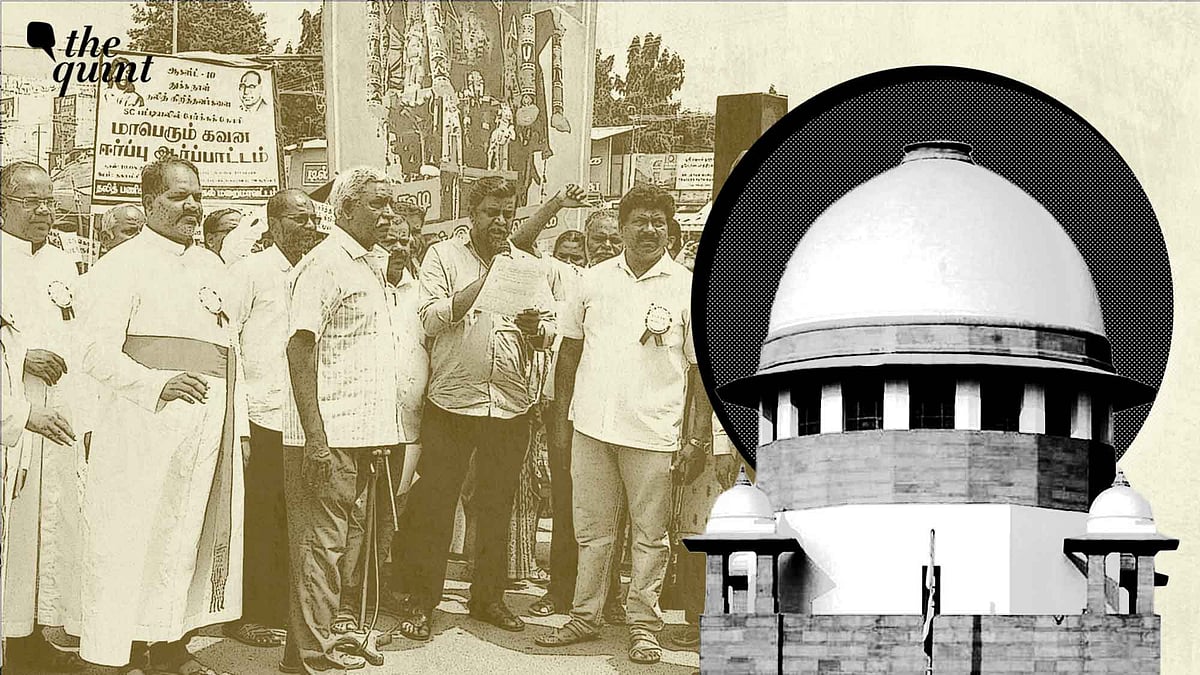
The Supreme Court has ruled that only Dalit Hindus, Sikhs, & Buddhists are eligible for protections accorded to SCs.
advertisement
The year was 2009, and I was in high school. Odisha was caught up in the web of inter-religious tensions, and stories of killings and exodus of hundreds of Christians from nearby Kandhamal district were shared around almost every tea stall, shop, and family meetings for months in my district. Men guarded our Christian locality almost every night to prevent any possible attacks by other communities and right-wing groups.
As young boys and girls, we were told not to move around too much away from our locality—and always be alert. It almost seemed like the society outside could turn against you at any point, and there might not be much support from the police. Fortunately, those weeks passed by, and we were told that the right-wing associations that were plotting to attack our locality had to withdraw because of the fear of the backlash.
Why am I narrating this event, and why does it matter in the context of larger debates around Christians in India?
This is not the Christian story where one’s mind immediately goes to beautiful white churches or AR Rahman's Hosanna song.
The ‘Undesirable’ Christian Story India Ignores
At times, caste is invoked to target and discriminate against Dalit Christians. On other occasions, faith is invoked. It is not easy to separate these two kinds of demarcations because most Dalit Christians live alongside their larger Dalit communities. Most scholars on Dalit Christians have argued that it is the caste identity—and the concomitant subjectivities, conditions, and aspirations emerging out of it—that make them uniquely demarcated in the society both within and outside the church.
To address these disadvantages and demarcations, Christians from the untouchable caste backgrounds have sought many redressal mechanisms since the second half of the nineteenth century through petitions to the government and approaching the missionaries.
Scholars Sanal Mohan and Rupa Vishwanath have written extensively on these questions in Kerala and Tamil Nadu, respectively, while Joel Lee and Otto Waack have briefly alluded to them in the context of North India and Odisha.
In the meantime, untouchable caste communities across different parts of India sought different pathways to seek new identities, such as Ad Dharmi, Adi Hindu, Adi Dravida, Buddhist, Muslim, and Sikh. They also simultaneously demanded that the colonial British government provide opportunities in education, employment, and political representation.
However, in the first few decades of the twentieth century, certain political events and discourses particularly worked against the Christians from the untouchable castes.
Mou Banerjee and Pralay Kanungo argue that some of these suspicious and hostile attitudes towards Christianity among Indian elites also had their antecedent in the polemics of missionaries directed towards the Hindu religion in places like Calcutta and Puri in the nineteenth century. Here, upper-caste Hindu elites active in the public sphere saw it as an encroachment and wanted to protect their spiritual domain and caste.
Mou Banerjee, in her book The Disinherited, shows that there was a series of court cases in Calcutta to disinherit those upper-caste men who had converted to Christianity. The cumulative affects and discourses resulting from these events are felt by the Dalit Christians even today.
Why Dalit Christians Missed Early Political Consolidation
While they were depressed classes, Christian associations in the Madras Presidency and mobilisations by Pulaya Christians in Kerala moved towards addressing their demands within larger political formations such as the Dravidian movement and the Communist parties in the regions.
The emergence of a national-level demand and collective identity claim-making happened much later in the 1980s, in the aftermath of the Dalit Panthers in Maharashtra and Jesuit activism in South India, that Dalit Christian political demands came to gain visibility.
Dalit Christians, despite being the majority of Christians, were not able politically mobilise for a long time because of a lack of support from church bodies led by caste Christians and a particular theological orientation that sought to circumscribe them within a spiritual realm.
Debunking the Arguments Against SC Status
In the immediate decades of independent India, the association with Christianity made Dalits and tribals particularly vulnerable to suspicious foreign associations and links in Central India and in the Northeast.
For example, the demand for Jharkhand as a separate state and the nationalist and separate state movements in the Northeast were all linked to missionary influence. Savarkar, in one of his articles in 1956, alludes to the influence of the missionaries among tribals in Central India.
This atmosphere led to the Niyogi Committee Report on Christian Missionary Activities and anti-conversion laws in Odisha and Madhya Pradesh in the 1970s, and a gradual grassroots institutional penetration by the Rashtriya Swayamsevak Sangh (RSS) in Central India. These challenges in Central and East India—combined with no large-scale networking among Dalit Christians from different regions—made it difficult to come up with collective political actions.
In the late 1990s, conversion among Dalit and Adivasi Christians became a national debate in the aftermath of the killing of the Australian missionary Graham Staines and his two children by Hindutva groups in Odisha and violence against tribal Christians in Gujarat's Dang.
However, amid this hostile public sphere, in recent decades, due to judicial activism and support from political parties, particularly in South India, state governments in Andhra Pradesh, Tamil Nadu, and Telangana have advocated for their inclusion in the SC category. Maybe this is due to their numerical strength.
Scholars and activists like Shireen Azam, Khalid Anis Ansari, and Ali Anwar have been trying to make it a compelling political question in the public sphere. The denial of SC status to Dalit Christians and Dalit Muslims, then, is a denial of equal citizenship due to a lack of collective political bargaining power.
The many other arguments to dismiss them are either prejudiced or sociologically unfounded.
In the following section, I aim to disentangle some of them—and move beyond the popular South India-centric understanding of Dalit Christians, which many in the public sphere, including in the Dalit-Bahujan movement in North and West India, use.
Caste Does Not Disappear With Conversion
I will begin with the weakest of all arguments.
It is that the basis for the SC list was already decided in the presidential order of 1950, and the Constituent Assembly, and it cannot be changed. Not only were the Constituent Assembly debates contested to include Sikhs from untouchable castes years after in 1956, but the SC list of 1936 was also changed.
In the central OBC lists for different states, Dalit Christians are listed as SCs converting to Christianity. On paper, they are already demarcated by their caste status, and everyone knows the connotation that the word SC carries.
It is basically the same caste in two different administrative categories. For example, the Lal Begis in Uttar Pradesh, who are Muslims, are in the OBC list, and those who are termed as Hindus are in the SC list. The caste background of the Dalit Muslims and Dalit Christians is then officially out in the open, and they know it when they have to navigate local bureaucracy, education, and employment opportunities.
Sikhs and Buddhists also claim normative equality, and even a section of Hindu caste elites claim that Varna was based on Guna (quality), and not birth, and hence, initially, everyone was equal. Claims to normative equality are usually a means to justify the uniqueness of one’s own faith and religious system to draw others. They are most of the time not living social practices.
This is not to equate the degree of differentiation of Dalits among different religious communities, which, undisputedly, is the worst among Hindus, and, in fact, they have textual sources to legitimise it.
SC status, at least on paper, seeks to address not only this demarcated subject but also the lack of access to education, jobs, and the need for protection emerging out of this demarcated condition. Sociologically, Dalit Christians and Dalit Muslims fit this criterion. One should just take a look at the slums in North Chennai or Lucknow for a preliminary study to verify this.
The other statement that I have come across over the years is that many Dalit Christians and Dalit Muslims do not acknowledge their subordinate caste status, and hence, they cannot claim SC status. This is largely a floating opinion—and not evidence from any large studies—because the majority of them know their castes. It is in their documents and part of their family stories.
For some, caste identity conversation remains suppressed, but it comes out during marriage discussions, community gatherings, and in dealing with local bureaucracy and employment. But even then, those who have studied Indian history and are aware of contemporary caste society, it is not difficult to find Dalits either not referring to their caste in different settings or claiming a non-caste identity to claim dignity. It is not unique to Dalit Christians and Dalit Muslims.
Caste Persists Beyond Conversion
Next is the claim that Dalit Christians lose their caste culture once they convert, and hence they can’t claim SC status. Such assumptions almost make it seem like caste culture is a pure domain somewhere protected without any changes in it. People migrate, they engage in popular culture, they draw on multiple repertoires of symbols, ideas, icons, and keep innovating their cultural practices, and it is never static.
In fact, a Dalit Christian in the North Chennai slum shares more in common with a fellow Dalit in that slum than a Dalit from Punjab or Maharashtra. Scholars such as Nathaniel Roberts, Rebecca Samuel Shah, and Ashok Mocherla, who have worked on Dalit Christians in different parts of South India, show that the caste socialisation of Dalits shapes their religious activities.
But none of this scrutiny should matter because SC status is not predicated on caste cultural protection, and no Dalit caste has held on to any religious tradition or cultural practices from time immemorial. There are always invented traditions that have emerged at particular historical junctures and got identified with particular castes.
Many sanitation labour castes, a hundred years ago, were Lal Begis and had nothing to do with the figure of Valmiki, but today that history is overwritten with a new community name. One caste is not equal to one religion among Dalits, because there has been no sense of a long historical unified religion, textual source or priesthood within a particular caste. There have been local village deities, saint poets, Jatras, and community icons, making it a melange.
There are then those who say that the Dalit Christians take benefits from the Christian institutions, and hence, should not be allowed to be included in the SC category. In fact, most of the Christian institutions, educational as well as hospitals, it is the caste Hindu middle class that benefits the most. So many non-Christian Dalits also attend these institutions, but it is largely Dalit Christians who are asked to be enclosed within these limited opportunities that cater to a very small section of the Dalit Christians and only in some places.
On many occasions, the support gained by Dalit Christians from these limited number of institutions is blown out of proportion to almost make it seem like an alternative governance system. That is far from true.
Additionally, the church is not the authority to give electoral representation to Dalit Christians at different levels to negotiate power for the community and direct resources, nor is it the court or police to protect Dalit Christians from caste violence through the Scheduled Caste and Scheduled Tribe (Prevention of Atrocities) Act, 1989. It is the responsibility of the state, and only an SC status can allow this possibility.
A Case for Religion-Neutral Reservations
Here, it is also necessary to point out the generic argument that assumes that across India, the problem of Dalit Christians is about caste discrimination inside their churches, and that if they are facing casteism inside the churches, why are they not leaving their faith?
This argument is misplaced and does not understand that in many parts of North, Central, and East India, the converts are largely from a few Dalit and Adivasi communities, unlike parts of South India, where the presence of converts from middle and upper castes gives rise to caste discrimination. And Dalit Christians have engaged in activism within South Indian churches, particularly in Tamil Nadu, since the 1980s. There are multiple theological, psychological, and community reasons why they don’t leave their faith, which is their own journeys to navigate.
But in places like Odisha, Madhya Pradesh, Gujarat, and Chhattisgarh, the caste demarcation of Dalit Christians happens by the caste Hindus and right-wing-leaning associations of certain Adivasi communities. Dalit Christians are linked to foreigners, treated with suspicion, denied localness, and perceived as traitors to the local cultures.
These assumptions are widely shared. It also becomes part of the local bureaucracy that scrutinises them regularly. They are denied job opportunities and land, and are targeted with anti-conversion laws that prevent them from meeting openly in their villages.
The Christian story I shared in the begininng is about these Christians, the thousands of Panos and Doms, who cannot be asked to go and deal with the caste discrimination problem in the church that does not exist in their contexts.
They require the SC category, and in fact, Pinky Hota, who has extensively studied Odisha, argues that land ownership should be an important component of the SC category, and Dalit Christians should be allowed equal protection under the Scheduled Area provisions as those communities listed in the ST category. This, she hopes, would prevent Dalit Christians in particular from being treated as outsiders due to their faith.
But given the situation in the neighbouring Chhattisgarh where Adivasi Christians, despite the ST status, are increasingly being targeted as having lost their adivasiness by their own community members, the difficulties of Dalit and Adivasi Christians need to be thought-through and articulated in new ways by becoming more place and context-sensitive.
As I have argued, many of these decisions are dependent on political calculations and attending to different constituencies. Many sections of the Dalit and Adivasi communities also feel that, within limited opportunities in SC and ST categories, others should not take them away.
This is a genuine fear, given the way the SC/ST reservation is implemented, and government jobs have been drastically cut down, and hence the need to expand the reservation quota for SCs and STs according to population and inclusion of Dalit Christians and Dalit Muslims should happen simultaneously.
In fact, the caste elites among Christians and Muslims are disinterested in the demands of these groups.
On the other hand, making the SC category religion-neutral would weaken the hold of religious elites across and provide avenues for community actions and specific demands outside of their institutional leaderships. The enclosure of the SC category as a largely Hindu category has enabled upper caste Hindus to do politics on imaginary community lines, thereby stifling the emergence of an assertive, autonomous Dalit politics geared towards material needs.
Mobilisation around any one single religion is bound to hit roadblocks because Dalits are quite diverse, and they have historically sought a range of faiths according to their contexts. The hope of an unsabotaged caste census and making the SC category religion-neutral can be a pathway towards a radical Dalit politics.
We need to look back to the great sensitivity of Babasaheb Ambedkar on the Dalit Christian problems, and the stances of prominent leaders such as Kanshiram and Mayawati to include Dalit Christians in the SC list. Additionally, incorporating Dalit Muslims, because that is what expanding the Dalit-Bahujan politics among the last and vulnerable would look like.
(Sumit Samos is a researcher and anti-caste activist and his research interests are Dalit Christians, cosmopolitan elites, student politics, and society and culture in Odisha. This is an opinion piece, and the views expressed above are the author’s own. The Quint neither endorses nor is responsible for the same.)
- Access to all paywalled content on site
- Ad-free experience across The Quint
- Early previews of our Special Projects
Published: undefined