
Modi Govt's 'Demographic Change' Committee and Its Hindutva Vision for India
The committee faces scrutiny over its lack of demographic experts and focus on alleged demographic imbalances.
advertisement
Five months after its official formation by the Narendra Modi government, the 'High-Level Committee on Demographic Changes' (HLCDC) has now opened a public portal to get 'inputs' on what its parent ministry—the Ministry of Home Affairs (MHA)—calls "unnatural demographic changes, its causes and underlying factors behind these changes, abnormal settlement patterns, etc."
Individual citizens and organisations, including international organisations, can submit their inputs in various formats, including PowerPoint presentations, and even attach audiovisual or infographic evidence. The committee says that it prefers inputs only from 2011 onwards.
The HLCDC is headed by Justice Prakash Prabhakar Naolekar, a retired Supreme Court judge, and is composed of five other members: the current Registrar General and Census Commissioner of India; a recently retired chief secretary of the Uttar Pradesh government; a former IPS officer who served with the Research and Analysis Wing (R&AW); a current economic advisor to the PM; and a serving senior bureaucrat at the MHA.
The Premise and Context
It is not uncommon for governments around the world to set up expert committees and seek public input on demography, immigration, refugee settlement, and other related matters.
Countries like Canada, the UK, and South Africa have done it in the past. However, the ideological premise and policy intent of such exercises matter—whether they are aimed at greater inclusion or exclusion can make all the difference.
This becomes doubly important if such initiatives are undertaken by governments known to propound sectarian ideas of nationhood.
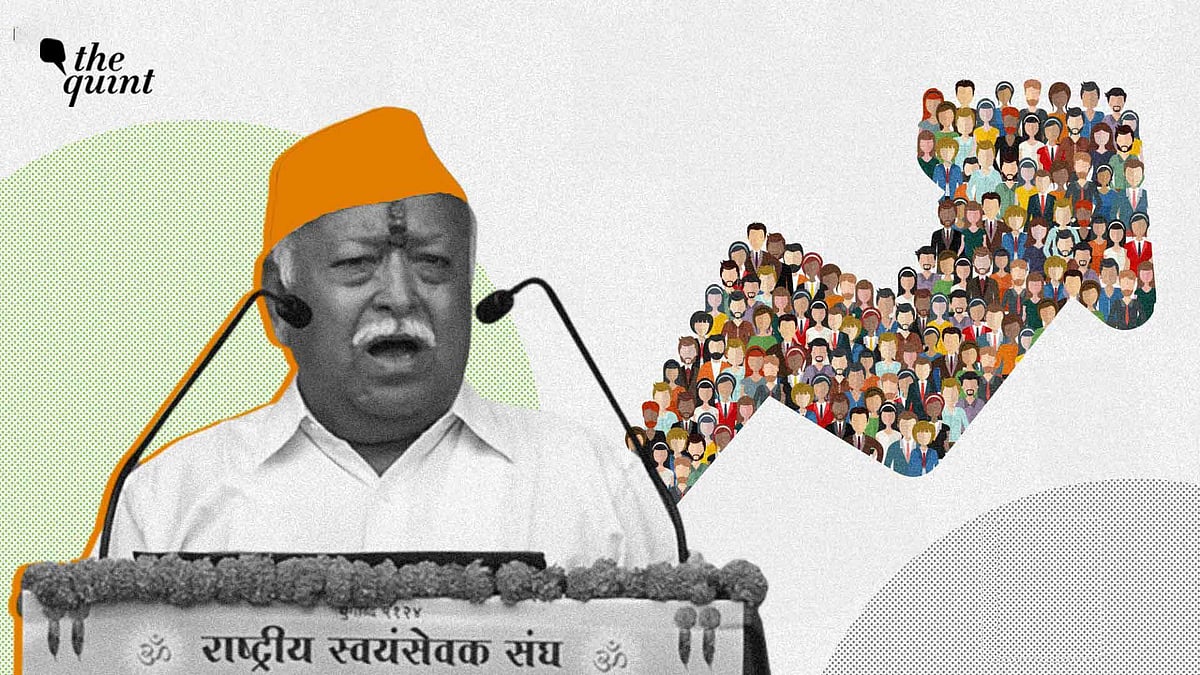
It is based on the shibboleth of "demographic imbalance", the widely held belief among Sangh networks that minority communities, most prominently Muslims, are steadily outnumbering the majority community through differential population growth and religious conversions.
The fix, then, is to bolster the majority’s numbers under the guise of a neutral population control policy.
Such a sectarian vision of India’s demography has long been a key ideological pivot for the RSS-BJP combine. In 2015, just a year after the Modi government came to power, the RSS passed a resolution in Ranchi, expressing "deep concern over all the severe demographic imbalances", especially in the eastern states of Assam, West Bengal, and Bihar.
At the organisation’s foundation day in 2022, its chief, Mohan Bhagwat, linked "religion-based population imbalance" to factors such as "conversions by force, lure or greed and infiltration".
Two years earlier, senior Bharatiya Janata Party (BJP) leader Giriraj Singh, lamenting the "dwindling population of Sanatanis in Northeast India", called for the introduction of a new population control law.
In fact, the HLCDC’s formation tracks a resurgence of the Sangh’s demographic fearmongering. In August, the RSS held a three-day, all-India, demography-focused coordination meeting in Visakhapatnam in which one of its senior leaders, CR Mukunda, claimed that "certain classes or certain communities are seeing a massive increase in their population while other communities and classes are seeing a decrease."
Then, on 28 September, the RSS' national publicity in-charge, Sunil Ambekar, argued that legal restrictions on Hindu marriages created demographic imbalances between different religious communities.
In that sense, the committee is carefully designed to give a sophisticated policy cover to the Sangh’s deeply sectarian vision of majoritarian nationhood and institutionalise it in new ways.
A Fait Accompli?
In fact, the committee’s notified premise preemptively outlines the central themes of its final report, scheduled for release in May 2027. Without any evidence, it claims that "extensive challenges have arisen from demographic changes, including due to illegal immigration" and that abnormal "fertility or mortality trends" have emerged due to "external abnormal factors such as illegal immigration, irregular population mobility, and administrative laxity".
It then goes on to assert that "these changes are most visibly concentrated in the border districts".
The precise subtext of such propagations is the assumption that "infiltration" from Muslim-majority neighbours, most prominently Bangladesh, has steadily bolstered the Muslim population in these areas and, in turn, eroded the Hindu demographic base.
Such claims, however, are rooted in sectarian paranoia rather than hard data. There is not enough quantitative evidence to show that the Muslim population has spiked dramatically along India’s eastern frontiers, least of all because of "illegal immigration" from Bangladesh.
In fact, in the case of Assam, border districts showed lower exclusions than the hinterland districts in the 2019 National Register of Citizens (NRC), busting the long-held myth that areas bordering Bangladesh were dominated by illegals.
The Modi government should have ideally waited for the HLCDC to do its job of parsing through the evidence and considering public inputs before making loaded observations on demographic changes. Instead, it appears to have foisted its prejudiced opinion on the HLCDC as a fait accompli.
It is as if the committee were constituted to simply put an official imprimatur on what the Hindutva regime already propagates: that at any cost, Hindus must be protected from becoming minorities in their own homeland.
In policy terms, this means identifying and disenfranchising Muslims to protect Bharat’s sacred geography from a "demographic invasion", or, as the Supreme Court once called it, an "external aggression" from across the border.
From the policy of arbitrary detentions and forced cross-border 'pushbacks' in Assam and West Bengal to the countrywide Special Intensive Revision (SIR), the emergent regime of mass disenfranchisement and displacement is calibrated to exclude and expel the Bengali Muslim and, in turn, fortify India’s eastern frontiers from an imagined Muslim invasion.
Mechanics of Exclusion
The HLCDC must be placed within this wider context of systematic exclusions.
By crowdsourcing inputs, the HLCDC makes a strategic move to incorporate the BJP-RSS’ majoritarian political base into its knowledge-production fold under the guise of a public consultation.
It seeks to render every citizen into an agent of the sectarian state who can surveil, scrutinise, and report minority populations on its behalf. In that sense, it is akin to the Immigration and Customs Enforcement (ICE) tip line in the US, which, under President Donald Trump, has encouraged xenophobic mass surveillance of non-white population groups across large parts of the country.
The next point seeks "an appropriate institutional mechanism to strengthen border management, population stabilisation, and identification systems for sustained monitoring of such trends."
These suggest that the HLCDC is geared to justify the institutionalisation of a multi-tier system of minority disenfranchisement and displacement that integrates the existing and disparate governments of demographic headcount (like the NRC and Census), electoral roll revisions (like the SIR), confinement (like arbitrary detentions), and forced expulsions (like ‘pushbacks’) into a single policy framework.
The RSS-BJP likely believes that such a mechanism could slowly ‘correct’ the adverse imbalance of population to ultimately consolidate the majority demographic base.
The truth remains that the HLCDC’s presupposed and rather prejudiced mandate, along with its narrow and politically lopsided membership lacking independent experts, makes it thoroughly unsuitable for any objective assessment of India’s demographic landscape.
What could have been a golden opportunity to create an inclusive, sustainable and forward-looking population policy—and likely even a national policy on irregular migration—has been contorted into an insidious and anti-pluralist project to exclude large groups of people from the Indian national community.
(The author is a PhD candidate, National University of Singapore and King’s College London. This is an opinion piece and the views expressed are the author’s own. The Quint neither endorses nor is responsible for them.)
- Access to all paywalled content on site
- Ad-free experience across The Quint
- Early previews of our Special Projects
Published: undefined